The recent attack in Pahalgam is being dubbed India’s next Pulwama moment by Indian defence analysts and a habitually jingoistic media. Rumbles of war drums and calls for a ‘strong response’ against Pakistan are being raised, albeit the fact that the attack was carried out in an occupied territory with heavy presence of Indian Armed Forces. Instead of asking the right questions, particularly about the security lapse and failing to respond to the attack, India has once again resorted to diversionary tactics like suspension of the Indus Waters Treaty (IWT), ceasing diplomatic and political channels, and overt military posturing, all of which heighten the risk of miscalculation and undermine regional strategic stability.
This deduction is informed by the precedent set during the Pulwama episode, where India’s response demonstrated a marked willingness to climb the escalation ladder. The crisis saw amplified rhetoric, a downgrading of diplomatic ties, and the withdrawal of Pakistan’s Most-Favoured Nation (MFN) status. The dominant narrative of revenge, reinforced by Prime Minister Narendra Modi’s public calls for punitive action against alleged terrorist sanctuaries, culminated in the aerial strikes on Balakot—marking a significant shift in India’s crisis response posture
However, the attempt to conduct airstrikes at a sub-conventional level failed to materialise due to operational inefficiency and poor planning by the Indian Air Force (IAF). Satellite imagery analysis by the Atlantic Council, Reuters, and Australian Strategic Policy Institute confirmed that Indian strikes failed to hit any significant targets. As a result, no tangible gains were made, yet the Indian government claimed killing 300 so-claimed ‘terrorists’ and cashed it for electoral purposes and political capital, resulting in an overwhelming victory of the BJP in subsequent elections.
The very next day, India’s aggression was responded to in broad daylight under ‘Operation Swift Retort’ that saw two Indian aircraft shot down and one pilot captured, who was later released as a goodwill gesture by the Pakistan Air Force (PAF). During the episode, an Indian surface-to-air missile (SAM) unit also downed its own Mi-17 helicopter in a friendly fire incident, killing six airmen onboard. In all these instances, Pakistan’s prudence and strategic restraint resulted in avoiding unwanted escalation.
Once again, signals emerging from the Indian strategic community suggest the possibility of another miscalculated move. The persistence of retaliatory narratives in the post–Operation Swift Retort environment indicates that India has yet to internalise the limitations and risks exposed during previous confrontations. In the aftermath of the setbacks experienced in 2019, India expedited the acquisition of Rafale fighter jets equipped with AESA radar and a suite of high-precision weaponry, including SCALP cruise missiles and Meteor air-to-air missiles. The induction of these advanced platforms appears to have reinforced a sense of military confidence, potentially encouraging India to consider actions similar in nature to the Balakot strikes despite the inherent risks of escalation and strategic miscalculation
Given the presence of a trigger-happy neighbour like India, Pakistan has long recognised the critical importance of maintaining strategic readiness through continuous technological advancement and operational self-reliance. Capitalising on the lessons of past crises, Pakistan has a forward-looking defence strategy that integrates advanced procurement with an accelerated push for indigenisation. Notably, the Pakistan Air Force (PAF) has platforms such as the JF-17 Thunder Block III and the J-10C Vigorous Dragon aimed at enhancing situational awareness and operational responsiveness. Furthermore, plans to induct fifth-generation stealth aircraft, particularly the J-31, underscore Pakistan’s intent to secure a technological edge and ensure credible deterrence against evolving Indian capabilities. In hindsight, Pakistan has also remained acutely aware of the rising strategic value of unmanned aerial vehicles (UAVs). To this end, it has developed and acquired a robust fleet, including Bayraktar Akinci, TB-2, CH-4, and indigenous Shahpar drones, providing it with a qualitative edge in precision targeting of high-value assets while minimising operational risks and personnel losses.
In contrast, India continues to grapple with an ageing fleet, currently operating only 31 active squadrons against a sanctioned strength of 42. To address this numerical shortfall, India has announced plans to induct approximately 500 fighter aircraft, primarily through domestic development. Key among these are the Advanced Medium Combat Aircraft (AMCA) and the Light Combat Aircraft (LCA) projects. However, both programmes face major hurdles stemming from the absence of a mature indigenous aerospace industrial base and persistent gaps in design and manufacturing capabilities, which cast doubts on the feasibility of timely and large-scale implementation. These structural tailbacks not only hinder India’s ambitious aerospace endeavours but also risk delaying production, putting it at a qualitative disadvantage vis-à-vis Pakistan.
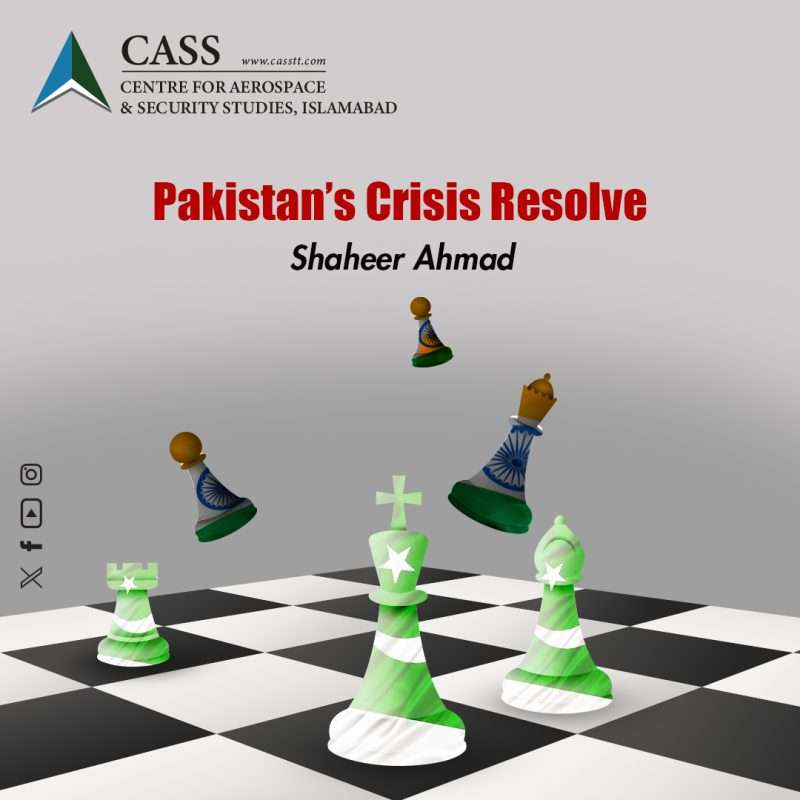
In light of these factors, an aerial misadventure from the Indian side would see a response larger in magnitude than swift retort. Mindful of technological advancements and precarious regional environment, Pakistan has remained ahead of the curve when it comes to maintaining operational readiness and reinforcing deterrence. In a tense geopolitical environment, Pakistan is exercising restraint with strategic patience. However, its resolve remains intact if the deterrence threshold is breached.
Shaheer Ahmad is a Research Assistant at the Centre for Aerospace & Security Studies, Islamabad. He can be reached at [email protected]