In 2025, according to governmental data, around 32,000 highly-skilled and highly-qualified Pakistanis registered for employment abroad, equivalent to roughly six per cent of the country’s half a million annual graduates. This number, too, represents only a part of the exodus of Pakistan’s advanced human capital nurtured in the country and now being absorbed into foreign economies. It excludes thousands of other highly qualified and skilled emigrants who attain a job abroad after completing higher studies there, secure employment through private channels, or start businesses overseas.
Advanced human capital outflows from Pakistan have risen sharply in recent years, driven by an increasing convergence between domestic push factors and the rising global demand for talent. Between 2021 and 2025, the number of emigrants in the ‘highly-qualified’ and ‘highly-skilled’ categories registering for employment abroad was about a hundred per cent higher than during 2011 to 2015. By contrast, the combined total of highly-skilled and highly-qualified emigrants in the 2011-15 period was lower than in the corresponding period a decade earlier, reflecting a visible shift in trend over time.
Pakistan has long pursued labour migration as a state-supported policy, with its antecedents dating back to the 1970s, when the Middle Eastern oil boom prompted the government to establish policies and structures to streamline and incentivise migration. Within a decade, the number of annual emigrants increased more than thirtyfold, including predominantly the mid-skilled and unskilled segments of the labour force. While the choice to migrate, driven by economic necessities, may have come with difficult trade-offs for many migrants, for the government, the immediate outcome was a win-win, easing labour market pressures while generating a stream of foreign exchange inflows. From USD 0.14 billion in FY 1972-73, worker remittances rose to USD 1.4 billion by FY 1978-79.
With these attractive dividends, the policies in favour of streamlining migration adopted a self-sustaining character, continuing to improve in successive decades under different regimes. These policies went beyond just facilitating the migrants to also supporting their families back in their home countries, reflecting the extent of the government’s commitment to labour export. For instance, families of individuals who had emigrated on valid and protected work visas after 23 March 1979 through the governmental migration authorities or those voluntarily registered with the Overseas Pakistanis Foundation (OPF) are eligible for a wide range of benefits, from access to dedicated housing schemes to education scholarships for children.
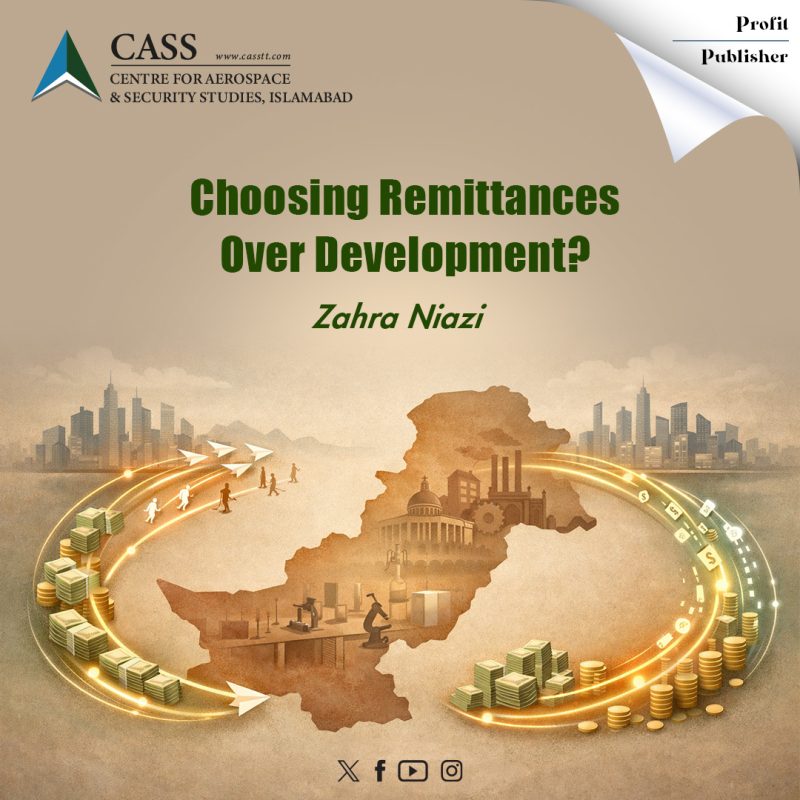
For decades, this policy approach was presented as intended to facilitate the migration of lower-skilled workers as part of the state’s social contract with its citizens. Yet, even as the outflow of advanced human capital has increased, the state’s muted response to it indicates that dependency on remittances has taken precedence over concerns about brain drain. In other words, it reflects an economy increasingly choosing short-term capital relief over long-term growth.
If empirical findings are any guide, remittances and other contributions by highly skilled and qualified migrants, such as knowledge transfers or policy advising, cannot compensate for the losses resulting from their migration abroad. With brain drain, the economy loses not just the tax-funded investment spent on developing this human capital but also a future taxable base, a significant proportion of its innovation and entrepreneurial potential, and its long-term growth capacity. What’s more, remittances may also decline with an increase in migrants’ level of education, as a large proportion of such individuals tend to come from relatively wealthier households or are more likely to take their families along and settle abroad permanently.
However, even if one were to assume that these inflows are still large enough, remittances ought to be celebrated only insofar as they act as complements to development rather than as substitutes for economic reforms. In recent years, an increase in the number of Pakistani emigrants abroad, diversification of destination countries, government initiatives to reduce the transaction costs of transferring money, and an increasingly transnational character of migrants have tilted the debate on remittances’ sustainability in favour of the optimists. In practice, too, these years have shown that remittances have become an increasingly dependable source of foreign exchange inflows for Pakistan. In FY 2025-26, these are expected to surpass the USD 40 billion mark, higher than even the country’s projected export value for the next fiscal year.
Yet, this dependability has also reinforced reliance on these inflows, placing the policy urgency for reforms to expand exports and investment on a back burner. The result is an economy that remains markedly below its potential, lacking resilience to shocks. Closely connected, most remittances in Pakistan are consumed instead of being invested, promoting consumption-led growth, which is exposed to any external shock that exerts a downward pressure on the purchasing power of households.
An overhaul of the current economic model – transitioning from a stability-oriented to a growth-and-stability-oriented approach – is no longer a matter of choice but rather a matter of urgency. The longer it is relied upon, the more entrenched it risks becoming. In today’s globalised world, migratory outflows will continue, taking their natural course, and remittances will flow in, but the challenge emerges the moment remittances begin being treated as the economy’s lifeline and human capital as a commodity. Only when the economy is broken free from this model can the state pursue structural reforms in earnest and create incentives to retain its young and productive human potential, boosting growth, enhancing resilience, and expanding the economy’s capacity to absorb the labour force at home. Attracting and retaining the young potential requires not just ad hoc measures but a coherent national strategy that advances fairness and transparency in the labour market, funds innovation, and rewards return migration.
The writer is a Research Associate at the Centre for Aerospace & Security Studies (CASS), Islamabad. The article was first published in Profit. She can be reached at: [email protected].