
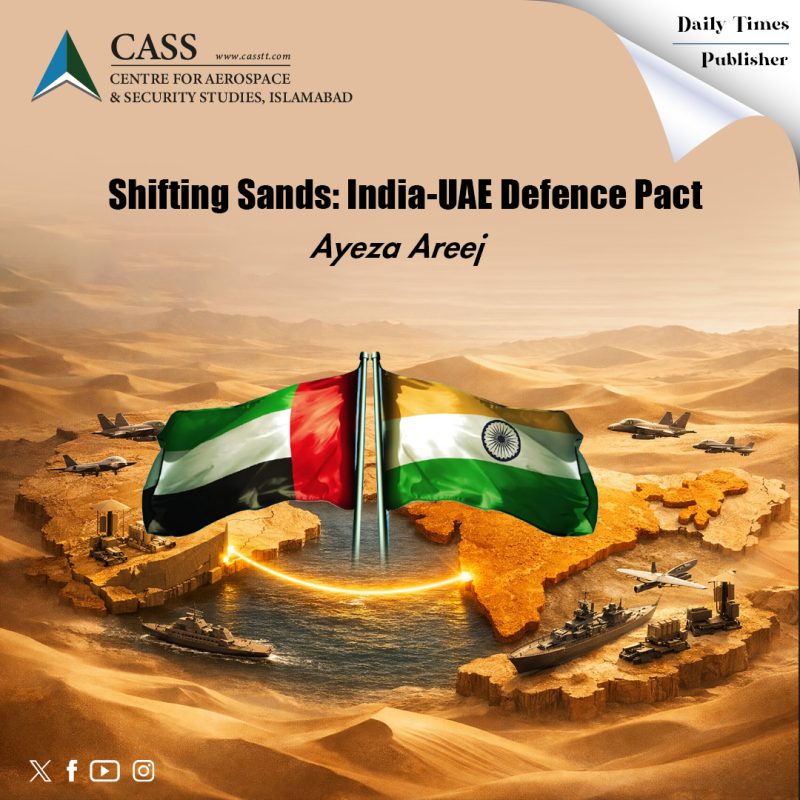
On 19 January 2026, the three-hour visit of the United Arab Emirates’s (UAE) president, Sheikh Mohamed bin Zayed Al Nahyan, to India attracted significant attention due to the potential outcomes it intended to materialise. The visit prospects a deep strategic engagement between the two states across several domains, including defence innovation, industrial development, advanced technology, training, education and counter terrorism. Yet, it also raises serious questions regarding New Delhi’s regional alignment and its long-term strategic interests in West Asia.
India wants to enhance its strategic presence in the West Asian region, which is vital for its energy supplies, diaspora and economic security. Both parties, under the agreement, decided to double the bilateral trade to about USD 200 billion in the coming six years and signed a USD 3 billion Liquefied Natural Gas (LNG) agreement (making the UAE the second largest LNG supplier to India). According to the agreement, Abu Dhabi National Oil Company (ADNOC) will provide 0.5 million metric tons of oil or LNG to Hindustan Petroleum for over a decade.
A ‘letter of intent for a bilateral Strategic Defence Partnership’ was signed between the two governments covering joint defence manufacturing, advanced military technologies, enhanced training, special forces cooperation, strengthened cybersecurity and counter-terrorism coordination, with defence dialogue elevated institutionally. According to this understanding, IN-SPACe and the UAE space agency will collaborate for the enhancement and modernisation of space infrastructure like space academies, spaceports and satellite fabrication units. A special investment region is also expected to be developed in Dholera, where a pilot training school, airport and Maintenance, Repair and Overhaul (MRO) will be established through UAE participation.
The visit also highlighted the intent to further increase tech-cooperation between the two states through joint ventures, civil-nuclear cooperation, and Artificial Intelligence. In addition to defence and technology, a Virtual Trade Corridor is also envisioned to serve as a ‘software building block’ under the existing India-Middle East-Europe Economic Corridor (IMEC).
Given the growing convergence of India and the UAE in the domains of defence and advanced technologies, the possibility of an India-Israel-UAE nexus cannot be overlooked and must be taken seriously. Their close coordination can effectively reinforce the I2U2 framework with the support of the United States, without officially forming a security alliance. This recent defence pact will allow Israel to overcome isolation and minimise external pressure. Moreover, it will not only enable New Delhi to utilise Tel Aviv’s defence technology to secure its interests in the Gulf, but will also allow the UAE to strengthen its security partnerships.
In the broader strategic context, the sense of urgency in this hasty deal indicates that there is more to it than the substance of the commitment. The ongoing rift between former allies Kingdom of Saudi Arabia (KSA) and the UAE highlight a clear fragmentation in Gulf politics. Both countries support opposing factions in Yemen (UAE backs Southern separatists and KSA supports the Yemeni Government), and are facing tensions over oil production. The shifting calculus of alliances in the Middle East and South Asia appears to be one major reason, where the deal might be an intended counter-measure to the recent Strategic Mutual Defence Agreement between Pakistan and Saudi Arabia, with Turkey anticipated to become part of this coalition.
The long-standing relationship between India and Saudi Arabia indicates that the UAE cannot expect Indian strategic support against their regional rivals. The Indian Foreign Secretary Vikrim Misri declared, ’Our involvement on the defence and security front with a country from the region does not necessarily lead to the conclusion that we will get involved in particular ways in the conflicts of the region.’ Yet Indian media is portraying the defence agreement as a counterweight to ‘Islamic NATO,’ which involves KSA, Turkey and Pakistan. Network18, for instance, characterised the defence pact as ‘India’s counter through strategic depth to Pakistan’s expanding defence outreach.’ Despite the media’s sensationalism, New Delhi is unlikely to engage in actions that could undermine its relations with friendly Arab states.
In parallel, Pakistan continues to maintain friendly relations with all Gulf countries. Pakistan’s contributions and status is well recognised in the region. Accordingly, Pakistan will continue to maintain its mediator role and act as a facilitator to counter regional challenges in the Gulf.
Ayeza Areej is a Research Assistant at the Centre for Aerospace & Security Studies (CASS), Islamabad, Pakistan. The article was first published in Daily Times. She can be reached at [email protected]



