Fifth August 2024 marks half a decade since India annexed the Indian Illegally Occupied Jammu and Kashmir (IIOJK) and denied the disputed territory’s right to statehood through a rushed presidential decree. Months after winning the second term in the Lok Sabha polls 2019, the Bharatiya Janata Party (BJP) government revoked Article 370 of the Indian constitution on 5th August, which granted IIOJK special status. They divided it into two unions, Jammu and Kashmir, to have its separate assembly; and Ladakh, to be governed directly by New Delhi.
With revocation of Article 370, its provision of Article 35A (added to Article 370 in 1954) was also automatically scrapped. These articles extended considerable autonomy to the region to make laws except those related to defence, foreign policy, and finance. Moreover, Article 35A forbade outsiders from buying land, holding local government jobs, and seeking permanent residence. However, over the years, these constitutional provisions were diluted so much that the move to scrape them five years ago only lifted the pretence of autonomy and formalised India’s colonisation of IIOJK.
For over seven decades, the people of IIOJK have been subjected to India’s brutality in almost every aspect of their lives. However, post-2019 saw a renewed phase of suppression. There has been an amplification of the military siege along with continuation of brazen human rights violations by the Indian Army. Since abrogation of Article 370, the Indian security forces have killed 887 Kashmiris, tortured 2,430 people, made 24,688 arrests, and sexually assaulted 133 women.
Besides the use of security forces to dehumanise Kashmiris, BJP has also taken various demographic, administrative, and electoral measures to further disenfranchise the Muslim identity of occupied Kashmir. Taking inspiration from the Israeli model of illegal settlements in Palestine, the BJP has been working on altering the demography of the region by planning to turn the Muslim majority into a minority. Under the new domicile law (2020), the government issued more than 3.5 million domiciles to outsiders, establishing illegal non-Kashmiri colonies. These non-residents were also granted voting rights.
In 2022, the Indian government seized properties of the J&K Waqf Board (the administrative body responsible for managing the functioning of Muslim institutions/places of worship). In its bid to erase the religious identity of Muslims in the occupied territory, they took control of significant religious shrines, arrested prominent Islamic scholars, and barred prayers in various mosques.
Additionally, in May 2022, the Indian Delimitation Commission gave a delimitation plan for new electoral constituencies in IIOJK. In this plan, Jammu was given six more seats in the J&K assembly, while Kashmir was given one more seat, even though (as per the 2011 census) Jammu had a population of 5.3 million compared to 7 million in Kashmir. The deliberate disregard of Muslim majority areas to impact the electoral landscape indicates BJP’s aim of disempowering Muslims.
Furthermore, as per the Indian Supreme Court, the Election Commission is supposed to hold Legislative Assembly Elections in the region by 30 September 2024. However, given the result of the recent Lok Sabha elections (first since abrogation of Article 370), it is yet to be seen if BJP will hold these elections. The party faced resentment from the people of IIOJK, as evidenced by an overwhelming voter turnout. For many years, most residents of Indian-occupied Jammu & Kashmir had boycotted elections, viewing them as attempts by New Delhi to legitimise its control over a region. However, this trend shifted as India conducted its national elections. Voters and local politicians assert that this was not an endorsement of India or its policies. Rather, they argue it reflected a significantly altered political landscape in the region, leaving them with no other option to express their dissent against New Delhi. Wary of the rejection from the public, the BJPdid not field candidates in Kashmir, and even its proxies were firmly rejected by the voters.
BJP and Narendra Modi have been trying to mask their intensified atrocities through a forced narrative of normalcy and development in one of the world’s most militarised regions by propagating that after removing the so-claimed ‘barrier of Article 370’, political and economic progress has returned to the occupied territory. Indian mainstream media continue to play a pivotal role in furthering the government’s disingenuous version of the situation. Likewise, the flow of information from the ground has been suppressed through draconian measures. Local Kashmiri journalists face intimidation, surveillance, and arrests by the security forces, along with the use of fear-inducing legislation, e.g., the Unlawful Activities (Prevention) Act (UAPA), to stifle any voices of dissent in IIOJK.
Over the past five years, the Indian government has intensified its oppressive actions in IIOJK. Despite this, the people of the occupied territory, continuing a legacy of over seven decades, have remained steadfast in their struggle for freedom. On this 5th August, Pakistanis stand resolutely with their Kashmiri brethren, exposing Indian atrocities and reaffirming unwavering support for their right to self-determination, as enshrined in United Nations Security Council (UNSC) resolutions. However, the United Nations and the international community need to stop turning a blind eye to the continued Indian human rights violations in occupied Jammu & Kashmir. They must stand unequivocally with the Kashmiri people in their struggle for self-determination, as mandated by UNSC resolutions, and hold India accountable for its systematic efforts to erase Muslim identity from the religious, demographic, cultural, and political spheres of IIOJK.
Ajwa Hijazi is a Research Assistant at the Centre for Aerospace & Security Studies (CASS), Islamabad, Pakistan. She can be reached at [email protected].
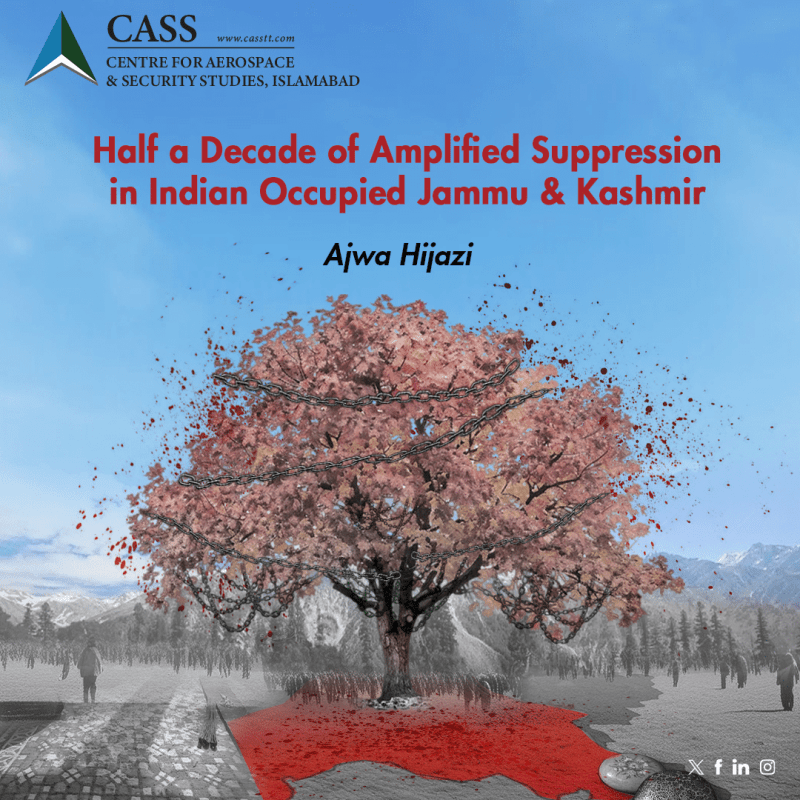
Image Inspiration: Altaf Hussain Wani