
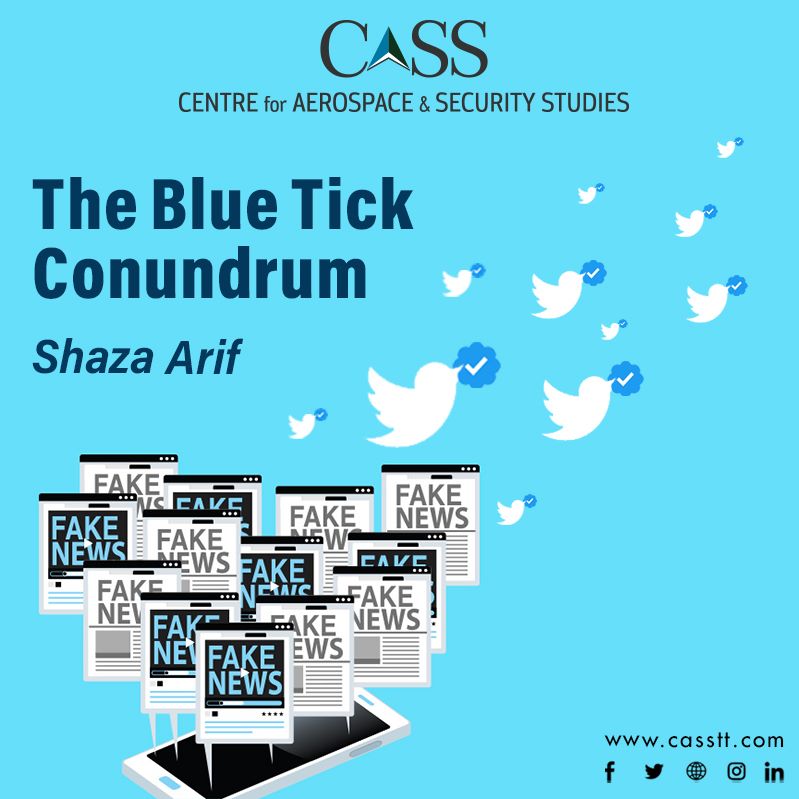
Trust but verify is a common adage often used to highlight the importance of confirming the information provided before it is assumed true. While the digital landscape is being increasingly contested, it is becoming equally difficult to determine the authenticity of the information which is available on digital platforms, particularly social media platforms.
Over the years, Twitter has emerged as one of the most trustworthy social media platforms due to the verified accounts of notable celebrities, politicians, governmental departments and multilateral organisations. Twitter’s ‘Blue Tick’ verification system allowed users to authenticate that the account actually belonged to the person/organisation claiming it. As a result, many governmental organisations safely used the platform to make important announcements for faster outreach to citizens. However, as per its new policy, Twitter has conditioned the blue verification mark to a USD 8 subscription.
In the last week, Twitter started removing the verification marks of its legacy verified accounts (those who acquired blue ticks before Elon Musk purchased the platform last year). Resultantly, even popular accounts such as Bill Gates, Pope Francis, and Cristiano Ronaldo were not spared and lost the authentication marks that distinguished them from their parody accounts. Strangely though, many ‘blue tickers’ still somehow have the mark even without subscribing to it.
The removal of Twitter’s verification mark creates fresh obstacles for the platform as it was a symbol of authenticity that distinguished genuine accounts from fraudulent ones. However, removing the verification mark from thousands of accounts while offering primary subscription services introduces several complications for the platform, particularly in combatting misinformation. The recent fake news coming from Sudan is a testament to this. A fake but verified twitter account of the ‘Rapid Support Forces’ – a paramilitary force fighting in Sudan – tweeted about the death of its leader, Mohamed Hamdan Dagalo, otherwise known as ‘Hemedti’ during the combat. As per Twitter’s own statistics, the tweet was seen by one million users. Surprisingly, the account claiming the death had a blue tick, whereas the actual account of the ‘Rapid Support Force’ was no longer verified.
Similar events were witnessed in November 2022 when Elon Musk announced that anyone could get a blue verification mark via subscription. Scores of parody accounts popped up after individuals purchased the Twitter subscription and started propagating fake news, such as insulin being free from a verified account of Eli Lilly and Company (a pharmaceutical company). With just a nine-word tweet saying, ‘We are excited to announce that Insulin is now free’, Eli Lilly’s share price sank 4 per cent the next day after the fake tweet. Likewise, erroneous news of a coup d’état in Brazil was spread or a Tesla crashing into the World Trade Center by a parody verified account of Tesla itself. These incidents highlight the harm caused by the misuse of the verification mark.
While the blue tick has been reinstated for the legacy accounts with over one million followers, and government handles have been given a special verified feature, the problem remains on the table – thousands of organisations, including news organisations around the world, use Twitter to disseminate important information. Several of these accounts are considerably important even if they do not cross the one million target in terms of followers. While they may eventually opt for the blue badges/ticks, the issue of parody accounts remains a challenge. These accounts can easily purchase the subscription and use the verification badges to legitimise false information.
The removal of the verification mark, coupled with the subscription offer, can also erode users’ trust in the authenticity of the accounts they follow. Moreover, making verification a feature that anyone could avail by simply paying a fee also undermines the process itself. Hence, users may be less confident regarding the information available on the platform – something that may adversely impact user engagement. Conversely, while Twitter is often considered a rather elitist platform, only those who can afford to pay will be verified. This could create a two-tier system where some users are perceived to be more legitimate or trustworthy than others simply because they have a verification mark. Paid verification would also make it easier for scammers to deceive users by making fake accounts look more legitimate. This could lead to an increase in scams and other fraudulent activities on the platform.
Although Twitter’s recent policy change may seem minor, it holds significant importance and is likely to have further implications in the future. This change should serve as a reminder to internet users to exercise critical thinking when encountering questionable content on any digital platform. It is crucial to verify the source and accuracy of digital content before accepting it as true, as the reliability of information is becoming increasingly ambiguous over time, whether or not a traditional blue verification badge is present.
Shaza Arif is a Research Assistant at the Centre for Aerospace & Security Studies (CASS), Islamabad, Pakistan. The article was first published in Modern Diplomacy.She can be reached at: [email protected]



