The High Cost of Low-Cost Warfare

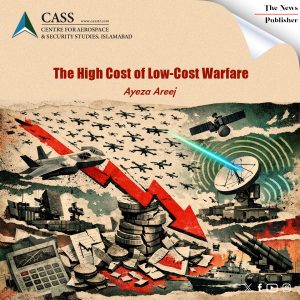
‘If we don’t figure out a way to fight far more cheaply, we won’t be able to afford to win a single battle.’ This warning from Peter W. Singer, an American strategist, reflects a reality that the arithmetic of warfare has inverted. The economic equation of conflict has changed so rapidly that a USD 500 drone can now target billion-dollar assets of state-of-the-art militaries. Meanwhile, the cost of counter-drone technology has risen to an absurd level. This cost curve has become a greatest vulnerability and a critical weakness for major powers. Consequently, states are indulging in a race not just to build cheaper and expendable drones but also affordable
Continue ReadingThe High Cost of Low-Cost Warfare

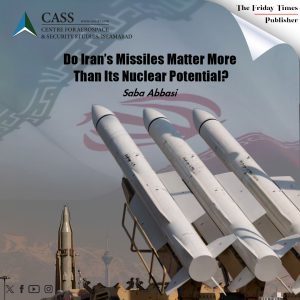
Do Iran’s Missiles Matter More Than Its Nuclear Potential?

Iran’s missile arsenal is the newly identified threat to Israel and US forces in the region. In the days leading up to 29 December’s meeting between Netanyahu and President Trump, there was considerable speculation that Iran would be the primary item on the meeting’s agenda, and this ultimately proved to be the case. According to the reports, Prime Minister Netanyahu briefed President Trump about the necessity and urgency of attacking Iran again. However, this time the primary threat is not its nuclear programme, but rather Iran’s growing ballistic missile stockpiles.

Continue ReadingDo Iran’s Missiles Matter More Than Its Nuclear Potential?

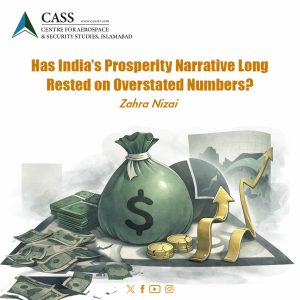
Has India’s Prosperity Narrative Long Rested on Overstated Numbers?

From the congested slums of Mumbai to the neglected neighbourhoods of Delhi, where the poor struggle to survive each day, the widely-documented ground realities in India have long reflected the country’s weak social and human development conditions. Its ranking of 130ᵗʰ on the Human Development Index (HDI) further speaks of these realities. Against this backdrop, the government has relied heavily on headline GDP figures to project a narrative of prosperity, but growing evidence suggests that this part of the narrative, too, may have been based on overstated numbers

Continue ReadingHas India’s Prosperity Narrative Long Rested on Overstated Numbers?

THE FUTURE OF INDIA-PAKISTAN RELATIONS IN 2026

  • Post author:

The May 2025 crisis between India and Pakistan marks an important chapter in the South Asian context, reinforcing the enduring volatility of one of the world’s most militarised rivalries. The conflict has redefined the regional dynamics and the bilateral relationship between the two states. Although the confrontation was brief, its intensity and strategic signalling underscored the persistent risk of escalation between two nuclear-armed neighbours. The events of May 2025 have contributed

Continue ReadingTHE FUTURE OF INDIA-PAKISTAN RELATIONS IN 2026

Internal Contradictions in U.S. National Security Strategy 2025

National Security Strategy (NSS) of United States, released by President Trump, intends to reform the miscalculations of past leaders and improve decades of Washington’s reach. Trump administration, as per the document, promises respect for sovereignty, restraint and renunciation of protracted global involvement. However, upon closer examination, the 33-pager document is full of internal inconsistencies. In contradiction to NSS, which vows to pull back from taking global responsibilities and adopts the policy of non-intervention, the U.S. pressurises other states through economic, military and political coercion.

Continue ReadingInternal Contradictions in U.S. National Security Strategy 2025

Why Afghan Trade Can’t Bypass Pakistan

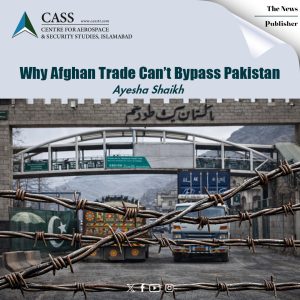
A year ago, the Sarhad Chamber of Commerce Industry (SCCI) and Pakistan-Afghanistan Joint Chamber of Commerce Industry (PAJCCI) reached a Memorandum of Understanding to boost trade between Pakistan and Afghanistan, only to end in doldrums in 2025. Due to the recent geopolitical tensions between the two states, the Taliban’s minister of commerce declared a trade boycott against Pakistan. While the move is compelled by the geopolitical rift, it is a miscalculated decision given the region's geographical reality

Continue ReadingWhy Afghan Trade Can’t Bypass Pakistan

Merger of European Space Industry: Lessons for Emerging Space Nations

The announcement on 23 October that Airbus, Thales and Leonardo will merge their satellite operations was a historic development for the European space industry. The plan aims to establish a new combined entity by 2027. Historically, the European space industry has been a competent but fragmented market in the form of national champions and competing initiatives. However,

Continue ReadingMerger of European Space Industry: Lessons for Emerging Space Nations

SPACE AND PAKISTAN’S FUTURE: MOBILISING YOUTH AND FOSTERING INNOVATION

  • Post author:

In recent years, outer space has emerged as a critical domain shaping national power, economic competitiveness, and technological sovereignty. Advances in satellite technology, space-based services, and space exploration missions are no longer confined to a handful of major powers

Continue ReadingSPACE AND PAKISTAN’S FUTURE: MOBILISING YOUTH AND FOSTERING INNOVATION