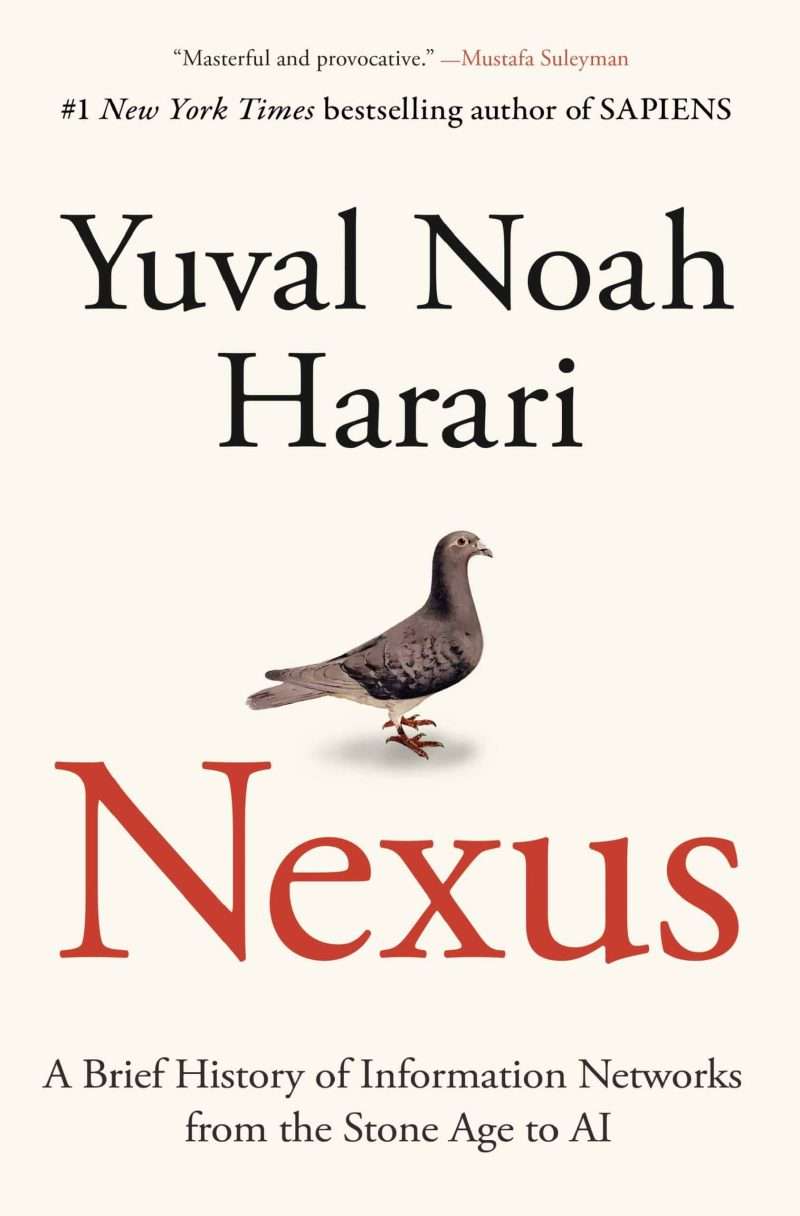
Yuval Noah Harari, Nexus: A Brief History of Information Networks from the Stone Age to AI (New York: Random House, 2024).
Reviewed by Shah Muhammad
Technological advancement has been one of the driving forces behind societal evolution. Nexus by Yuval Noah Harari blends technology, politics and history to build on this idea, offering a timely and compelling account of human society in the digital era. Having built his stature as a globally renowned historian through his previous works Sapiens and Homo Deus, Harari argues that our ability to handle information networks has been a key determinant of social interactions, power structures and evolution as a whole.
The book comprises three parts, spanning over a total of eleven chapters. The first part delves into the epochs of history, elucidating how the ancient information networks such as oral traditions and the invention of writing shaped social interaction and political power. The author argues that the written documents were instrumental in creating a social reality, thereby facilitating formation of institutions that wielded power (p. 43). Additionally, the printing press was a relatively advanced information technology that acted as a double-edged sword. Although it facilitated the free exchange of ideas pivotal for the scientific revolution, it also served as a medium for the spread of parochial notions that opened the doors to witch-hunting and chaos (pp. 83-84). The second part of the book evaluates dawn of the information age wherein modern technologies are being instrumentalised for repression and violence. Harari mentions the algorithmic newsfeed of Facebook as a case study which incited anti-Rohingya persecution in Myanmar in 2016-17 (p. 179). He points out that computer-to-human chains in contemporary information networks are radically different from the ancient human-to-document chains, culminating in the emergence of computer-to-computer chains that are vesting more power in machines and removing humans from the decision-making loop (p. 197). The last section exercises strategic foresight vis-à-vis the political implications of AI-driven information networks. He foresees a gloomy future for democracy in light of algorithmic manipulation of elections, data-grab for data colonialism and totalitarian tendencies of surveillance regimes. The imperialistic designs of Big Tech companies have already compelled governments in countries like China, Russia and India to limit these giants’ foothold in local digital markets (p. 341). In the same section, the author offers remedial measures to offset the adverse implications of AI-driven information networks. He calls for decentralisation of data and the operationalisation of self-correcting mechanisms in information networks to protect the democratic way of life. He places substantial emphasis on self-correcting mechanisms as a means to empower truth over falsehood.
The strength of the book lies in its analytical and interdisciplinary depth. Harari taps into novel analytical frameworks to convey his essential arguments. For instance, he introduces the framework of ‘Alien Intelligence’ to challenge the traditional understanding of AI by defining it as a technology which ‘becomes less artificial and more alien’ (p. 200). Comparing AI to human-level intelligence might be a flawed approach as it could rather morph into something non-human/alien with unimaginable capabilities. Similarly, drawing on Churchill’s slogan of ‘Iron Curtain,’ he turns to another analytical framework of ‘Silicon Curtain.’ It reflects the geopolitical balkanisation of great powers into distinct blocs, characterised by contentious and incompatible approaches towards handling information networks. He warns that this polarisation would undermine the goal of AI regulation and thereby amplify its adverse outcomes across the world (p. 335). The book is a well-rounded effort to present interdisciplinary arguments clearly and thoughtfully. Harari connects his historical knowledge with the technical aspects of various technologies, while staying attentive to the political changes shaping our times.
Despite its contributions, ‘Nexus’ reels from glaring limitations that merit attention. Harari is unduly tilted towards the downsides of technology, with his interdisciplinary approach failing to grasp the upsides in that regard. Therefore, the book fails to be a balanced, holistic take on technological and social evolution. In particular, the chapters on AI overlook its various benefits, effectively adding to the AI phobia that currently prevails around the world. The narrative leans so heavily towards dystopian AI that it might foment alarmist attitudes in scholarly and policy circles. Furthermore, the framework of alien intelligence is admittedly novel but Harari does not offer sufficient empirical cases of AI models and their operational dynamics to substantiate his warnings to that effect. Lastly, the book leans towards validating West-centric perspectives, as it offers limited theoretical and empirical engagement with non-Western technological, political, and historical viewpoints.
‘Nexus’ evokes themes that have been explored in similar works before such as ‘The Age of Surveillance Capitalism’ by Shoshana Zuboff and ‘Inhuman Power’ by Atle M. Kjøsen. Unlike the other two, Harari does not leverage the Marxist framework to criticise and warn about the perils of AI. He clings to liberal-capitalist ideals while calling for regulatory and ethical oversight to minimise the risks associated with AI.
In sum, the book stands out as an intellectually engaging contribution to the interdisciplinary study of technology. It is particularly valuable for students and scholars interested in unpacking the complex interplay between technological change and societal transformation. Indeed, one should always be driven by the pursuit of a question that Harari has also raised, ‘Why are we so good at accumulating more information and power, but far less successful at acquiring wisdom?’
Shah Muhammad is a Research Assistant at the Centre for Aerospace & Security Studies (CASS), Islamabad, Pakistan. He can be reached at [email protected].