
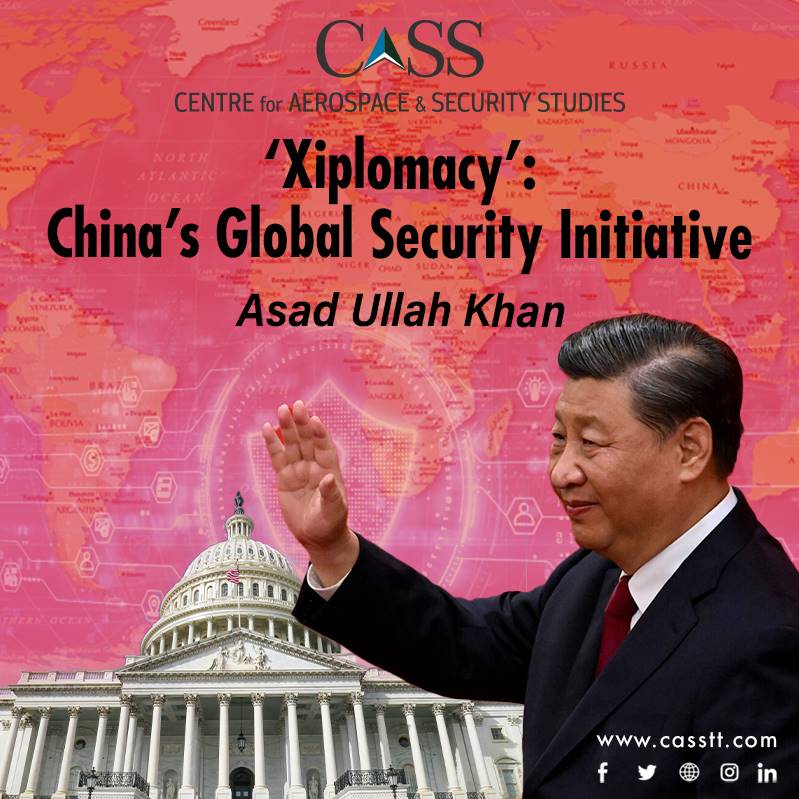
At the opening ceremony of Boao Forum’s Annual Conference 2022, Chinese President Xi Jinping laid down a new security framework to address traditional and non-traditional security issues at the global level. Termed the ‘Global Security Initiative’ (GSI), the flagship proposal laid down principles for global peace and common security. Regarded by Chinese policymakers as another public good offered by Beijing, the initiative has now been transformed into a concept paper. With the goal to enhance cooperation and coexistence in a peaceful international environment, the new framework for international security is seen to have significant impacts on the international order, marked by an already increasing strategic rivalry between the United States and China.
The Global Security Initiative comes with six fundamental principles advocated to eliminate the root causes of international conflicts through improved security governance and joint international efforts.
First, the initiative talks about the need for common, comprehensive and sustainable security. The vision aims to broaden the security agenda by incorporating traditional and non-traditional security sectors, bringing security actors to communicate their concerns on inclusive platforms and eradicating the fundamental causes and instability and volatility on the international stage. In this regard, China’s recent peace mediation in the Middle East, prioritising economic security to eliminate fundamental causes of conflict, and emphasis on comprehensively addressing environmental security issues are highlighted by Chinese diplomats as indicators of Beijing’s commitment to the new security framework.
Second, the concept paper of the new framework enlists the needed commitment to respecting the sovereignty and territorial integrity of all countries. In the post-World War II security architecture – which Beijing regards as one made without its consent – territorial integrity of smaller states has frequently been breached on the pretext of ideological experiments, missionary liberal-democratic expansion, and proxy warfare. China proudly proclaims that it has never violated the territory or airspace of any sovereign country nor does it intend to do so. In its growing competition with Washington as well, Beijing has consistently rebuked the US of meddling in its internal affairs while using human rights and economic concerns as possible excuses.
Third, the new vision considers the UN Charter as an abiding set of principles for security interaction on the global stage. Beijing calls for implementing the UN Charter to orchestrate a functioning system of collective security for peace and stability in the international system. Xi Jinping’s vision for new security governance is based on the working of international law against competing tendencies for unilateralism, the bloc mentality of the Cold War, and grouping against any particular country. Therefore, GSI considers the UN Charter as the cornerstone of envisioned multilateralism needed to address security concerns on the international stage.
The fourth component of the new security vision is to genuinely respond and address legitimate security concerns of all countries. For China, this means that powerful states should not ignore, let alone challenge, the core security interests of other states. Instead, these concerns should be addressed on multilateral platforms while simultaneously upholding individual and common security, traditional and non-traditional security, and security and development. Beijing, through its persistent diplomatic posture to solve conflicts through dialogue, inclusion and mutual respect, calls for a balanced security architecture.
This is followed by Xi Jinping’s past emphasis as well on the fifth point of the new framework: the solution of disputes through peaceful means of dialogue and consultation. China calls on the international community to bring conflicting parties together, provide platforms for discussion, and diffuse tensions by fulfilling the responsibility of ensuring peace through dialogue and consultation. Against unilateral and use of force to impose unsustainable solutions on unequal footing, Xi’s new vision is backed by China’s new role of peace between Saudi Arabia and Iran, diplomatic posture towards the Indian Occupied Jammu & Kashmir Conflict, and persistent effort to defuse tensions with Washington through peaceful means.
Lastly, GSI calls for an equal amount of significance to be given to traditional and non-traditional security challenges with a marked emphasis on environmental sustainability. Against the sole focus on conventional measures of power, Beijing advocates the inclusive and broadened conception of security aimed at addressing climate change, economic uncertainties, food insecurity and turmoil in energy markets. From reducing its carbon footprint to enhancing economic connectivity through the Belt and Road Initiative, China has incorporated these principles into its policy framework for the 21st Century.
The principles of the new security vision are not mutually exclusive; instead, they reinforce and complement each other. If transformed from a conceptual framework into a policy benchmark, the Global Security Initiative could provide a sustainable avenue for eradicating conflict, maintaining international peace and reimagining global security order in a more inclusive, multilateral and sustainable manner. This concept shows the Chinese vision of enhancing its global footprint via ‘Xiplomacy’ – how President Xi Jinping wants to engage with the rest of the world. The vision does have the potential to initiate and gain fruition for a dialogue to diffuse tensions and manage competition between the US and China. For the two superpowers, broadening the security agenda, introducing consultative platforms and incorporating the principles of the UN Charter could be the starting point for lasting peace.
Asad Ullah Khan is a Senior Research Associate at the Centre for Aerospace & Security Studies (CASS), Islamabad, Pakistan. He can be reached at [email protected]



