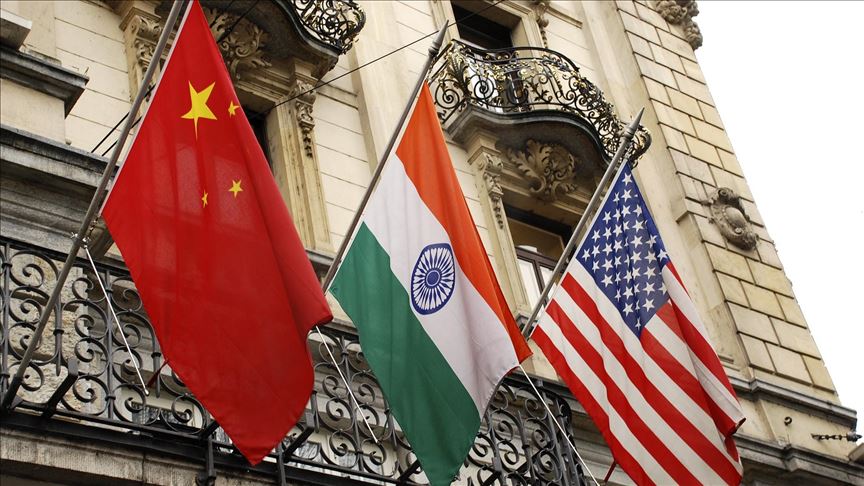
The strategic partnership between India and the United States has deepened over the years and both are now major defence partners. India is also part of the Quad along with the US, Australia and Japan which is ostensibly posed to counter a rising China. New Delhi is also engaged in direct defence trade with Washington to enhance its military capabilities against Beijing. The US Secretary of Defence Mark Esper has gone so far as to declare that the US stands shoulder-to-shoulder with India to face China’s ‘aggression and destabilizing activities’ in the region. However, a number of recent developments have called into question India’s role in this partnership to contain Beijing’s rise.
First, India’s recent deployment of the Ballistic Missile Defence (BMD) system S-400 purchased from Russia has touched a nerve in the White House. The transfer of the S-400 came on the heels of the visit of Russian President Vladimir Putin to India in late 2021. The subsequent deployment of the system received huge traction due to the US reaction. Earlier, Washington had sanctioned its NATO ally Turkey for purchasing the same system from Russia under its ‘Countering American Adversaries through Sanctions Act’ (CAATSA). Reportedly, the US also cautioned India against going ahead with finalizing the deal, warning that a second CAATSA waiver was unlikely. But, by introducing the Circumspectly Reducing Unintended Consequences Impairing Alliances and Leadership (CRUCIAL) Act, 2021, US representatives tried to salvage India from impending sanctions. The Act seeks to exempt Quad members from sanctions under CAATSA. Notably, many in India also hoped that the US would let the issue slide, claiming that the said system would ultimately be deployed to fortify New Delhi’s defence against China. However, this claim was debunked with reports that India deployed the S-400’s first battery in the Punjab along its border with Pakistan. This leaves India’s aerial defence against China unchanged.
The deployment of the S-400 is also irksome for the US because, although the Indian military arsenal is growing, this increase is primarily coming from countries other than the United States. As the S-400 originates from Russia, it helps the country project its defence prowess which is definitely not something Americans would applaud. The system can also lead to interoperability issues with the US platforms in India’s inventory. Additionally, deployment of such systems can also cause security issues between American and Indian forces.
Similarly, questions are being raised about India’s intentions to pursue US interests in case the Sino-US trade war heats up again. In such a scenario, the US will naturally expect India to side with it, owing to their major defence agreements. The irony is that despite these military agreements worth billions of dollars, Indian military capabilities and economy lag behind China. And while India continues to beat the drums of a ‘two-front’ war scenario with Pakistan and China, this rhetoric is also believed to be a trope aimed at receiving compensation from the US as going to war against China is suicidal for New Delhi. The Indian government seems aware of this situation as it has chosen to stay quiet in the face of recent Chinese advancements in disputed territories. In fact, even the opposition leaders have claimed that the BJP Government has chosen to remain silent in response to Beijing’s increasing consolidation of its claims. This docile attitude was also visible from the overtures made by the Indian side to calm down the situation on the border, despite Chinese moves. Reportedly, India made several proposals to China to enter into talks to disengage from all ‘friction points’ at the Line of Actual Control (LAC).
India’s capacity and capability to face China militarily came into question in June 2020 when over 20 Indian soldiers were killed in a scuffle with Chinese soldiers. Experts believe that within just one year of that clash at Galwan Valley, New Delhi threw in the towel on at least three occasions. Indian military preparedness remains primarily focused on Pakistan, as is also asserted by its military leadership.
Moreover, although New Delhi has sought to modernise its military, experts believe the country is investing in outdated war domains while China is investing in cutting edge war technologies of the future. China has a sophisticated military arsenal consisting of cyber, Artificial Intelligence, electronic and electromagnetic capabilities while India plans to resort to old, traditional ways of war fighting which will put it at odds with the People’s Liberation Army.
Given the above scenario, the situation is clear – India will always further its own interests even at the cost of US interests. It will not pick a fight with Beijing just to appease the White House as no nation would willingly go into an all-out war against a military and economic giant like China. Besides, despite importing sophisticated military technologies, India’s military is not capable of taking China head on. The US should face the reality that seeking to contain China’s influence by relying on India, a country which has neither the intent nor is equipped to perform this task, will definitely not yield desired results. While India continues to garner military dividends, stirring up a two-front war narrative to skim material gains from the US and evade its sanctions, China’s rise continues unabated, and the US policy to rely on India is clearly flawed.
Khansa Qureshi is a researcher at Centre for Aerospace & Security Studies (CASS), Islamabad, Pakistan. The article was first published in Strafasia. She can be reached at [email protected]
Image Source: Korkmaz, Huseyin. 2020, “China-India border clashes and US strategy in Indo-Pacific,” Anadolu Agency, June 26, https://www.aa.com.tr/en/analysis/analysis-china-india-border-clashes-and-us-strategy-in-indo-pacific/1891028