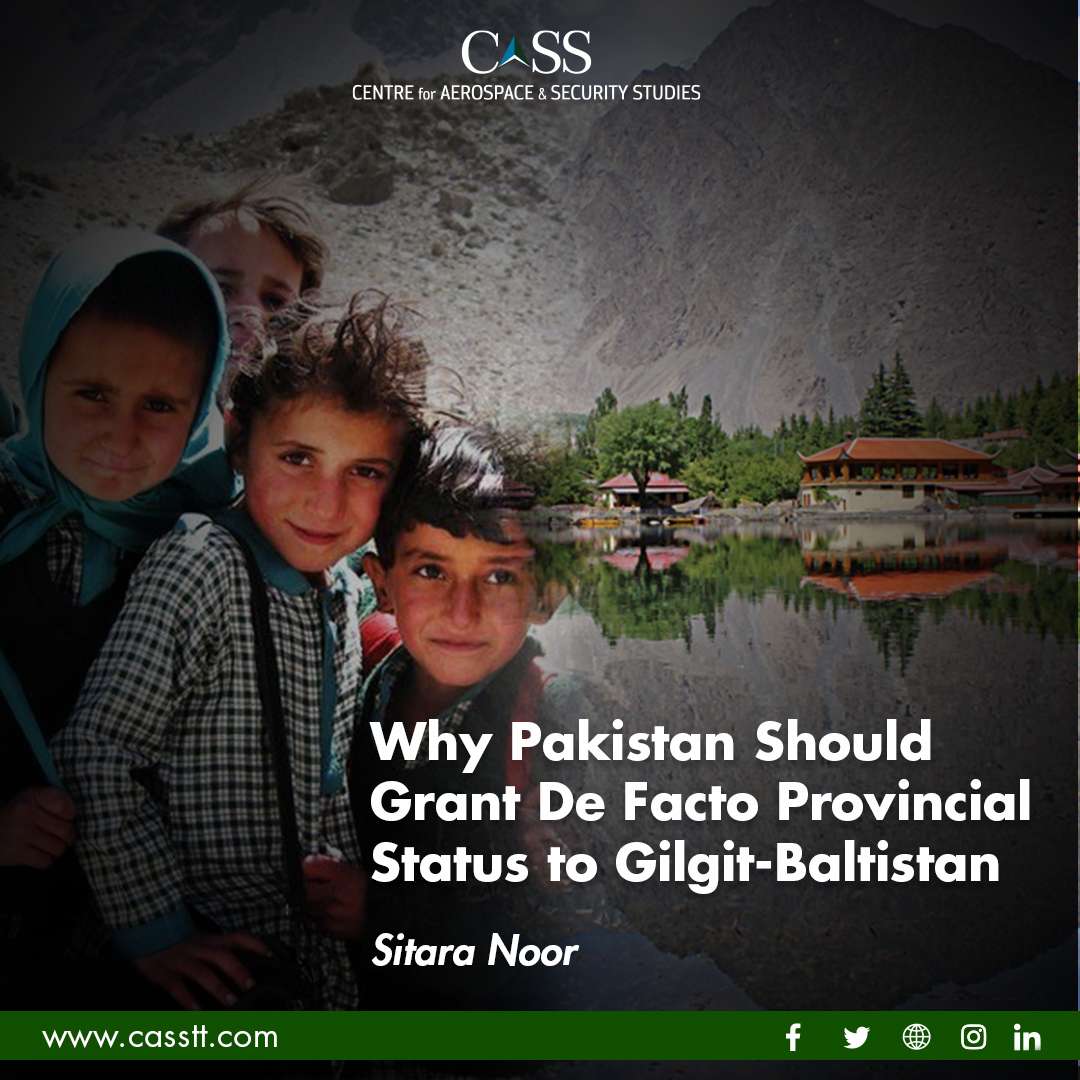
Gilgit-Baltistan (GB), Pakistan’s northern region, connects Pakistan with China and is the starting point of the much-celebrated China-Pakistan Economic Corridor (CPEC) on the Pakistani side. Although the region has been under Pakistan’s administrative control for all practical purposes since 1947, its constitutional status is in limbo due to its legal linkage with the long-standing Jammu and Kashmir dispute between India and Pakistan.
Pakistan’s international position as of August 14, 1947, is that GB is part of Kashmir, even though the people of the region considered themselves distinct from Kashmiris at the time of Partition. In 1947, the people of today’s GB rebelled against Dogra rule, driven by both anti-India and anti-Kashmir sentiments. The region formally joined Pakistan in 1948.
Pakistan’s decision to merge GB with Kashmir was based on the presumption that it would help the country gain more votes in a potential United Nations plebiscite on Kashmir. However, despite linking GB with the Kashmir dispute, its administrative arrangements are different from those of Azad Jammu & Kashmir (AJK) which has its own constitution, whereas GB is administered by the center in Islamabad.
GB’s people are unanimous in their demand for constitutional rights, as demonstrated by the joint resolution passed by its Legislative Assembly demanding an interim provincial status. All major political parties in Pakistan have upheld the shared common objective of giving constitutional rights to the people of GB. Former Prime Minister Zulfikar Ali Bhutto is credited with having abolished the draconian Frontier Crimes Regulations (FCR), thereby ending local raja rule and forced labor in the erstwhile Northern Areas. Later, the Pakistan People’s Party government under then-Prime Minister Benazir Bhutto introduced the first party-based elections in 1994 and in 2009, under Yousaf Raza Gillani, promulgated the GB Empowerment and Self-Governance Order and also gave the current name to the region.
In 2015, the then-ruling Pakistan Muslim League-Nawaz’s Committee on Constitutional and Administrative Reforms, headed by Sartaj Aziz, recommended giving the area “provisional provincial” status until the final settlement of the Kashmir dispute. This was followed by a landmark judgment by the Supreme Court of Pakistan, in January 2019 that ordered conferral of the legal status and constitutional rights to the people.
On November 1, 2020, then-Prime Minister Imran Khan announced his government’s intention to grant this provisional provincial status, making the region a de facto fifth province of Pakistan. The announcement came after a high-profile meeting attended by both government and opposition parties on the status of GB, which led to the draft 26th amendment to the constitution. If passed by a two-thirds majority in Parliament, the amendment would have awarded GB a provisional provincial status without affecting Pakistan’s position on the issue of Jammu and Kashmir, as per U.N. resolutions.
Now, with a new government at the center, there is a risk that the push for GB’s status may lose steam, with the leadership likely to prioritize other urgent issues, such as the economy and energy crisis, during their one-year term in office. However, since the issue of granting provisional provincial status has received bipartisan support in the past, the government may continue to push it forward with incremental steps to sustain the momentum.
If the proposed constitutional amendment bill is passed by Parliament, it will address some of the constitutional demands of the people of GB and lead to three major changes. First, it will allow representation of people from GB in Parliament. Second, the jurisdiction of the Supreme Court of Pakistan may be extended to GB after the abolition of its Supreme Appellate Court. Third, GB’s Election Commission will be merged with the Election Commission of Pakistan. Provisional provincial status may not address all concerns of the people, who are demanding rights similar to other provinces such as transfer of administrative, financial, and legislative powers as per the 18th amendment. Nevertheless, it will be a concrete first step that will address the issue of constitutional ambiguity in this region.
Any such move, however, is not without its challenges. On the administrative front, while a lot of work has already been done, the current Parliament does not have the two-thirds majority required to pass the proposed 26th constitutional amendment. Additionally, given the economic crisis, a holistic financial implication plan will have to be made to assess the fiscal repercussions of this move. GB will have to undertake their part of the bargain as well. In order to come under the National Finance Commission (NFC) framework for resource mobilization, GB will have to expand its own resource potential and will have to come under the direct tax net.
There are some political challenges as well. Historically, any move in the direction of granting GB provisional provincial status has always received backlash from the Azad Jammu and Kashmir (AJK) government, which maintains that the former is part and parcel of Kashmir and any change in its status will affect Pakistan’s case in the United Nations. Therefore, it is important to take the entire Kashmiri leadership on both sides of the Line of Control (LoC) into confidence. Lastly, granting de facto provincial status is likely to receive a massive backlash from India, which has repeatedly staked its claim over this territory and has threatened to take it by force in the recent past.
The rightful demand of the people of Gilgit-Baltistan for constitutional rights received great attention after India’s action on August 5, 2019, when New Delhi revoked Article 370 of the Indian Constitution and stripped Indian-occupied Kashmir of its special status. The need for constitutional amendments was also felt to protect the legal position of the China-Pakistan Economic Corridor (CPEC), which passes through the GB region. But, most importantly, provisional provincial status is needed for the people of this region, who deserve and are demanding attention and preservation of their fundamental rights.