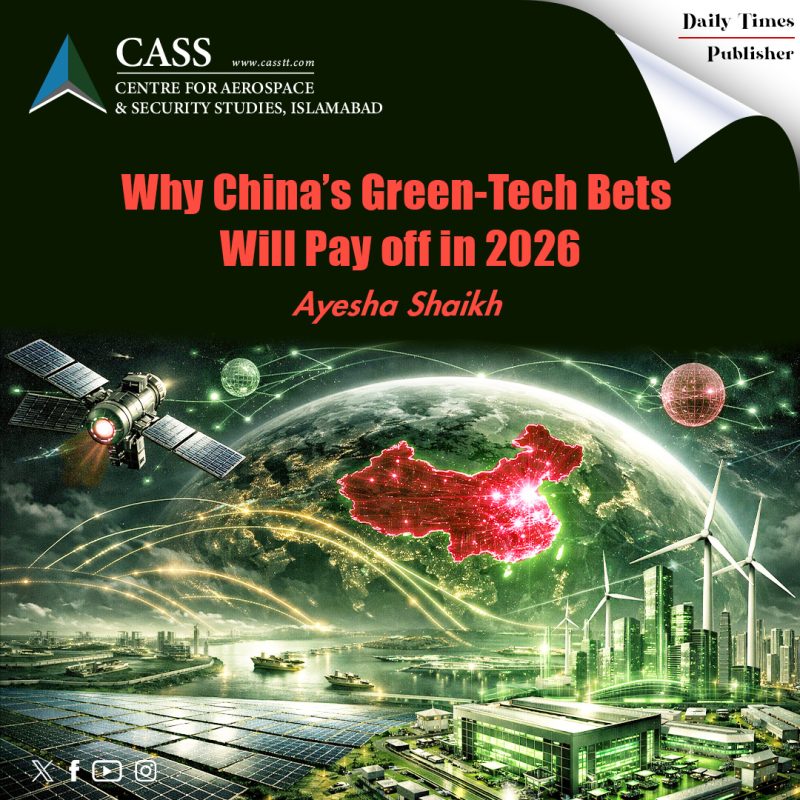
‘When it comes to clean energy, there is only one player, U.S. is not even in the room,’ stated the representative of China’s climate hub. The withdrawal of the U.S. from the climate front has provided room for China to translate its uncontested investment in green-tech into a strategic advantage. China’s green-tech dominance in 2025 indicates that apart from the normative label of ‘save the planet,’ China’s investment in the green-technology has economic and political incentives.
In 2023, China made a prudent investment of 180 billion USD in the Post-Carbon global order, as a matter of economic and strategic leverage. The move was driven by the belief that whoever claims the green infrastructure will enjoy the strategic advantage in the Post-Carbon global order, as the oil producers did in the previous century. The investment has translated into a strategic advantage for China in 2025. China has dominated the production and supply chains of green tech and climate. As a result, it has gained the leverage to translate this dominance into implicit influence on terms and conditions. Furthermore, the retreat of U.S. leadership from the climate front has created a global governance vacuum. As a result, the global order regarding climate and green tech is being nurtured under Chinese active influence. From multilateral forums to bilateral dealings, China has attained geopolitical edge through prioritisation of green technology.
Economically, China has dominated the global markets of green tech, including PV modules, Electric Vehicles (EV) batteries, and turbines. China holds 41 per cent of the global renewable equipment exports. For instance, it has 69 per cent of shares in the global electric-vehicle battery market. Furthermore, China has increased its investment in green tech by 80 per cent in 2025, through bilateral agreements with states across Asia, Africa, Latin America, and the Middle East. However, the investment is not limited to the Global South, as the energy needs of Europe are also being targeted. CATL, Stellantis, and AESC are the major Chinese green-tech firms operating across European countries, including Hungary, Spain, France, and even Portugal and Slovakia. Overall, China’s ascendency in global green tech and the growing global dependence on Chinese procurement seems uncontentious.
This dominance translates into a two-fold economic advantage for China. Firstly, the green supply chains are immune to the tools of economic coercion like sanctions and host-state intervention. In the past few years, China has been subject to Western criticism for dumping its goods in foreign markets and intellectual property theft. Nevertheless, due to the normative value of climate preservation and sustainable development attached to the green technology, it can escape the burden of sanctions. Similarly, the asymmetric advantage that China has maintained through big shares in production and exports, the green-tech sector is relatively immune to geopolitics compared to the semiconductor industry. For instance, in the recent episode of host-state intervention against the operation of semiconductor firms like Nvidia and Nexperia, green-tech firms are immune to such disruptions. Thus, the investment in green-tech has translated into considerable economic advantage for China.
On the political front, China has translated its green-tech supremacy into a precedent for global norms regarding green-tech governance. In the face of retreat from the U.S., China has maintained an active presence on global climate governance platforms like COP30 and UN Climate dialogue. Furthermore, through initiatives like a 113 billion USD investment in Hainan Island as well as green infrastructure projects in the Belt and Road Initiative (BRI), China is creating future markets for green technology. Consequently, it is likely to further influence the governance of future markets based on its preferential terms.
Similarly, monopoly over the development of AI-integrated energy optimisation, climate monitoring, and predictive infrastructure provides an additional edge to China. For instance, China has launched a global AI-driven early warning system called Mazu. If alternatives are not available, excessive dependence on such tools can translate into an asymmetric strategic advantage for China. It can control the regulatory side of global climate and tech governance in future by maintaining this dominance.
The trajectory of China’s progress in the green-tech industry over the year indicates that China has escaped the myth of overcapacity. Substantial investment in the green-tech sector is actively translating into active dominance over global supply chains of green-tech. Furthermore, this dominance has allowed China to not only create and invest in future markets of green-technology but also develop the overall blue-prints of the governing mechanism for climate and green-tech.
Thus, Chinese dominance in the green-tech has an economic and political advantage, in addition to its normative value. Its devoted investments in the green-technology over the past few years, have translated into a strategic advantage. It is likely to provide leverage for the state to influence the terms and conditions for governance of green-tech markets as well as global climate governance. However, China’s leap in the global governance regarding the domain of climate can be attributed as much to the lack of competition as to the dedicated green investments made by China for the post-carbon future.
Ayesha Shaikh is a Research Assistant at the Centre for Aerospace & Security
Studies (CASS), Islamabad, Pakistan. She can be reached at [email protected]