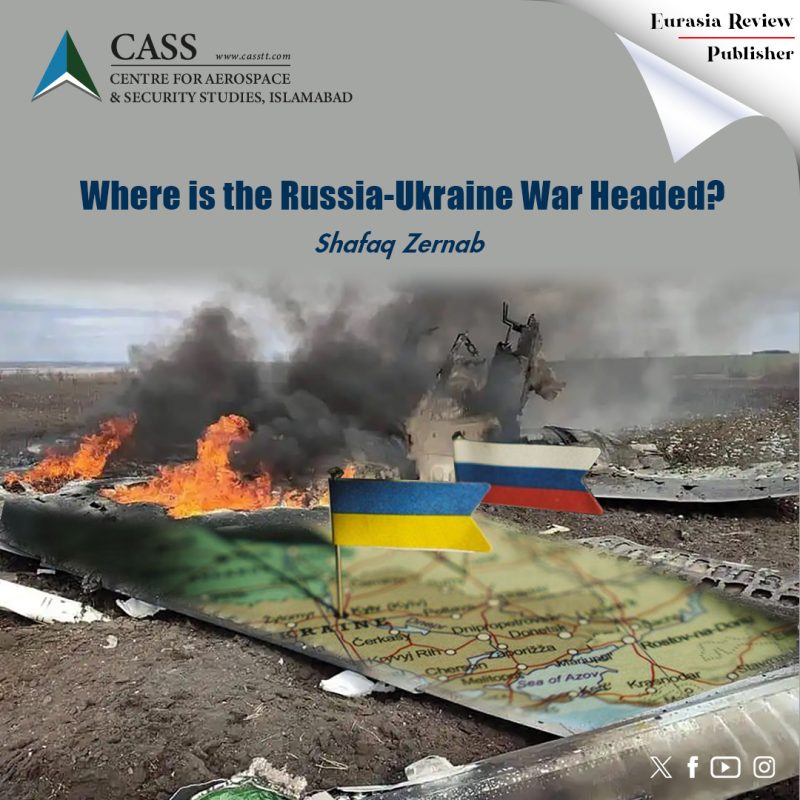
Since President Trump assumed office in his second term, a lot has been said about peaceful culmination of the Russia-Ukraine war. The President himself claimed that the end of the war is imminent. Though conditions for negotiated ceasefire gradually coalesce, the frontline remains entrenched in stalemate as Professor John Mearsheimer puts it ‘the conflict will be settled on the battlefield, period, end of the story.’
As of late 2025, the U.S. led high-level discussions to end Russia-Ukraine conflicts have intensified. Most notable are Alaska summit, talks in Berlin and recently Miami Peace Talks where officials have met to discuss the Ukraine Peace Plan, NATO-like security guarantees for Ukraine, territorial issues and economic reparations. These diplomatic overtures are mere theatrics, masking the harsh geopolitical and military realities that are driving Ukraine towards a strategic defeat.
President Putin outrightly rejected any compromise and reiterated Moscow’s commitment to the ‘liberation of its historical lands through military means’, in case Kyiv and its Western partners fail to adhere to substantive negotiations. Russia is still adhering to its maximalist ambitions. Although Europe has signalled a commitment to assist Ukraine, the decisive element that would sustain Ukraine’s strategic momentum, American support, is being systematically and intentionally retracted. Such a stern Russian position precludes the possibility of any substantive negotiations.
While Russian obstinacy is a significant factor, it is not the sole source of current impasse. The Ukrainian diplomatic stance has also remained unyielding. Although Ukrainian forces have withdrawn from Donetsk, Kyiv is unwilling to relinquish its territories, demanding restoration of its borders and categorically rejecting any arrangement that jeopardies its future security alignments towards the West. Furthermore, it also conditions any settlement with long-term NATO-like security guarantees and reparations for Russia, which Moscow deems unacceptable. Though politically understandable, these positions narrow down the space for any concrete compromise.
Hence, these irreconcilable objectives result in a continued stalemate. Russia aims for neutrality in Ukraine’s political orientation and secure its territorial gains. Conversely, Ukraine seeks sovereignty and security guarantees from the West, especially the U.S. and a complete restoration of its territories. Under these circumstances, any meaningful diplomatic negotiations seem unlikely, signaling a continuation of the war.
The American role and priorities have further shifted the strategic balance. The U.S. is now pursuing detachment from its role in Europe and is seeking to transfer greater responsibility for Ukraine to its European allies as depicted clearly in the U.S. national security strategy 2025. The shift came under renewed focus of Washington towards China and an attempt to recalibrate its relations with Russia. The perspective in the U.S. is that Europe is either unwilling or unable to carry its own share of the security burden; hence a reduced commitment to the European theatre is signalled by the U.S.
The consequences of such an American policy are detrimental for Ukraine as its war efforts rely heavily on western allies, especially the U.S. Given the lack of financial capacity, industrial depth, and political cohesion, European states, are struggling to mobilise resources and have started exploring controversial options such as using the frozen Russian assets to fund Ukraine, which carries grave political and legal risks. Without American support, Europe’s internal fragmentation has left Ukraine all exposed to Russian offense.
The battlefield statistics depict a balance in favour of Russia. Owing to heavy state investment in its defence sector and the support from partners, the financial capability of Moscow remains consistent and sustained even if the war continues for several years. The ground offensive shows a clear maintenance of manpower, air support, air-drop supplies, and drone warfare despite having incurred severe losses and damage. Russia’s scale of production and persisting production capabilities have provided it with a decisive advantage in low-cost tech such as first-person-view drones.
The ground realities depict how Russia has leveraged its strategic capabilities by utilising low-cost munitions to cripple Ukrainian energy infrastructure especially in Zaporizhzhia region. Due to severe damages inflicted on Ukraine’s energy grids, power outages are a regular occurrence across the country. In response to Russian strikes, Ukraine attacked a Russian naval vessel employing drones. The move was tactically impressive but holds little to no strategic leverage.
Kyiv’s gravest perils are acute manpower shortage and combat losses. These vulnerabilities incentivise Russia to sustain a low-intensity protracted conflict if a decisive diplomatic breakthrough seems elusive. In such a scenario, Ukraine’s ability to sustain war, is likely to falter under military exhaustion, economic strain and strategic overstretch. This would turn Kyiv into a liability, forfeiting its integration in any Western security or political framework.
The war has entered a protracted and grinding stage for Ukraine exacerbated by widening resource deficit and wavering security assurances from the West. Though diplomatic overtures persist, they only reflect the harsh realities of the conflict shaped by brute force rather than genuine negotiations. With Washington recalibrating its priorities, Europe incapacitated to compensate for this strategic shortfall, and both Kyiv and Moscow locked in debilitating stalemate, the trajectory of the conflict appears deterministic. It is less about negotiating a lasting peace and more about consolidation of results on the battlefield.
Shafaq Zernab is a Research Assistant at the Centre for Aerospace & Security Studies, Islamabad. The article was published in Eurasia Review. She can be reached at [email protected]