modern warfare


Share this article

Facebook
Twitter
LinkedIn

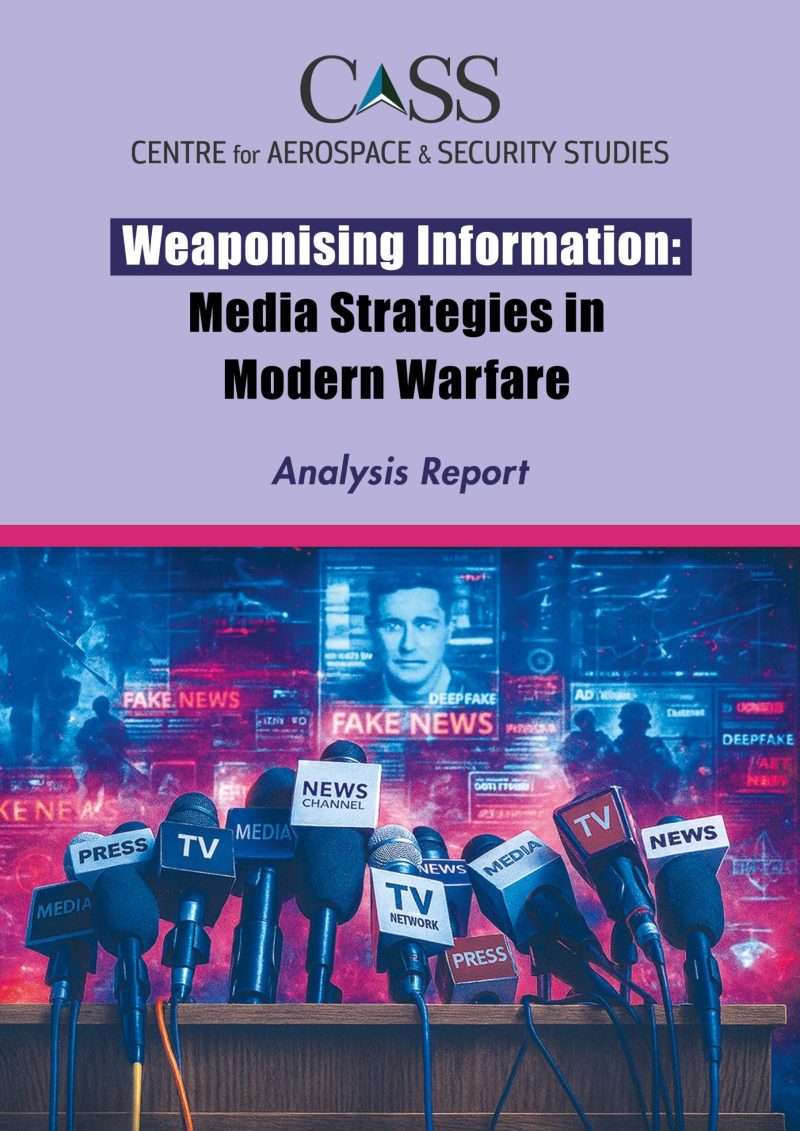
In contemporary warfare, the control of narratives and information has become as critical as the control of territory. The weaponisation of information through disinformation campaigns, deepfakes, and psychological manipulation has transformed the modern battlefield into one fought as much on screens as on the ground.

The recent 2025 India-Pakistan escalation highlighted the centrality of information operations. From premature victory claims to fabricated videos shaping international discourse, the conflict highlighted both the vulnerabilities of traditional media and the growing influence of artificial intelligence (AI) in amplifying hostile narratives. For Pakistan, this experience demonstrated the urgency of integrating a comprehensive and anticipatory media strategy into its national security framework.

To critically examine these developments, the Centre for Aerospace & Security Studies (CASS) Islamabad organised a Roundtable Conference on “Weaponising Information: Media Strategies in Modern Warfare” on 27th August 2025. The conference aimed to address:

  • The evolving role of media in shaping battlefield outcomes and public perception.
  • Lessons from the 2025 India-Pakistan escalation in terms of information operations.
  • Pakistan’s strengths and shortcomings in countering hostile media strategies.
  • Policy and institutional measures to develop an anticipatory information ecosystem.

The session featured two distinguished speakers: Mr. Amer Zafar Durrani, a seasoned development expert and the President of Reenergia, and Mr. Rehman Azhar, a distinguished broadcast journalist currently serving as the Executive Director for the Centre for Law and Security, Islamabad. The discussion was moderated by Air Marshal Zahid Mehmood (Retd), Senior Director CASS with Welcome and Concluding Remarks delivered by President CASS, Air Marshal Javaid Ahmed (Retd).

Recent Publications

Browse through the list of recent publications.

Golden Dome: Capabilities and Constraints

In an era of novel threats, a layered defensive shield is once again at the centre of US strategy. The announcement of the Golden Dome by President Trump shortly after assuming office has given rise to new expectations, questions, and concerns regarding the project.
The capability is envisioned as a comprehensive missile shield for the continental United States (CONUS) against ballistic missiles, hypersonic vehicles, cruise missiles, and UAVs. Conceived as a multi-tiered system, it aims to integrate existing missile defences with new space-based platforms. The layered system, combining land, sea and space-based sensors

Read More »

Trump’s Coercive Diplomacy: America’s Harder Turn

President Donald Trump renamed the Department of Defense (DOD) to the Department of War in September 2025. Then, just a month later, he threatened at least three countries with war. Trump’s economic war was waged on most states, in the form of tariffs, from the day he assumed office, but the threats and signalling toward an armed confrontation have been growing more frequent and explicit.

Read More »

Do India- Bangladesh Relations Signal a New Strategic Front?

Amidst transforming regional security dynamics, India reinforced its eastern flank by establishing three fully operational military stations at strategic points around the ‘Siliguri Corridor’ near the India-Bangladesh border. The new bases include the Lachit Borphukan Military Station near Dhubri in Assam along with two forward bases at Chopra in West Bengal and Kishanganj in Bihar. Indian Army also reviews a fourth station in Mizoram as part of extended defence arc around the Siliguri corridor. Amidst deteriorating ties with Bangladesh, India’s fortification of its eastern

Read More »