
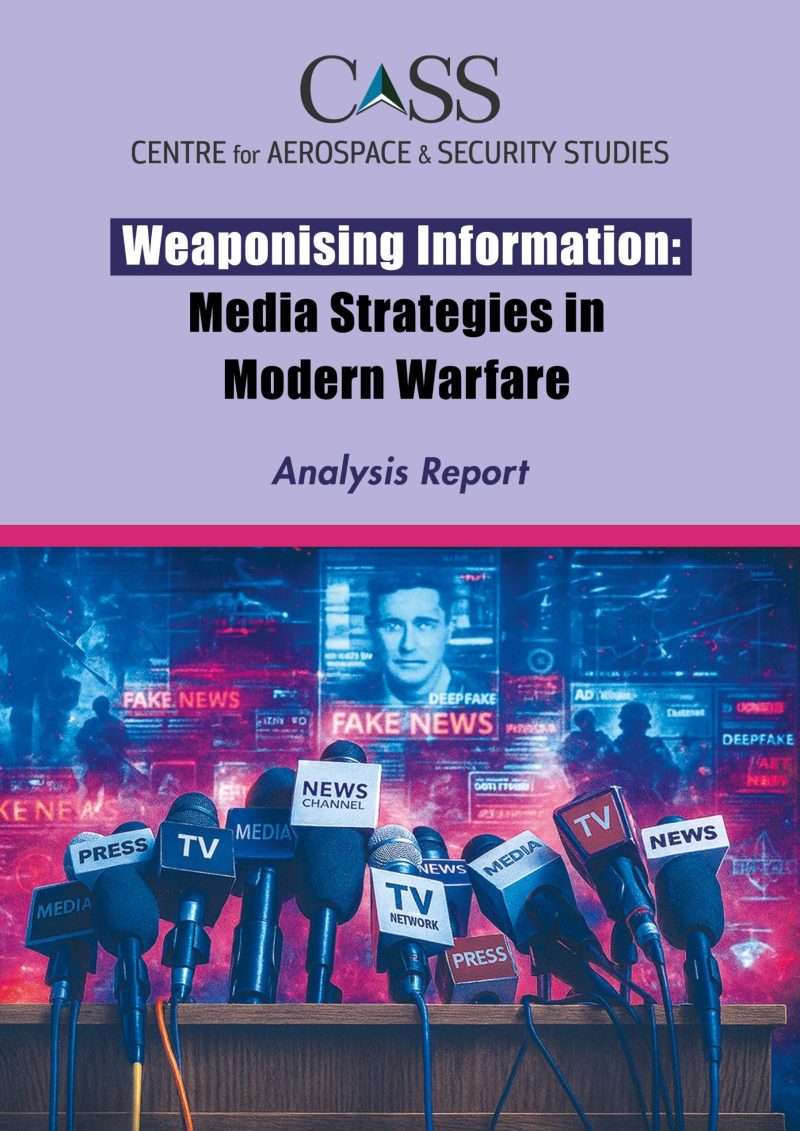
modern warfare

In contemporary warfare, the control of narratives and information has become as critical as the control of territory. The weaponisation of information through disinformation campaigns, deepfakes, and psychological manipulation has transformed the modern battlefield into one fought as much on screens as on the ground.

The recent 2025 India-Pakistan escalation highlighted the centrality of information operations. From premature victory claims to fabricated videos shaping international discourse, the conflict highlighted both the vulnerabilities of traditional media and the growing influence of artificial intelligence (AI) in amplifying hostile narratives. For Pakistan, this experience demonstrated the urgency of integrating a comprehensive and anticipatory media strategy into its national security framework.

To critically examine these developments, the Centre for Aerospace & Security Studies (CASS) Islamabad organised a Roundtable Conference on “Weaponising Information: Media Strategies in Modern Warfare” on 27th August 2025. The conference aimed to address:

  • The evolving role of media in shaping battlefield outcomes and public perception.
  • Lessons from the 2025 India-Pakistan escalation in terms of information operations.
  • Pakistan’s strengths and shortcomings in countering hostile media strategies.
  • Policy and institutional measures to develop an anticipatory information ecosystem.

The session featured two distinguished speakers: Mr. Amer Zafar Durrani, a seasoned development expert and the President of Reenergia, and Mr. Rehman Azhar, a distinguished broadcast journalist currently serving as the Executive Director for the Centre for Law and Security, Islamabad. The discussion was moderated by Air Marshal Zahid Mehmood (Retd), Senior Director CASS with Welcome and Concluding Remarks delivered by President CASS, Air Marshal Javaid Ahmed (Retd).


Share this article

Facebook
Twitter
LinkedIn

Recent Publications

Browse through the list of recent publications.

The Cover-up: IAF Narrative of the May 2025 Air Battle

Even after one year since the India-Pakistan May war of 2025, the Indian discourse regarding Operation Sindoor remains uncertain under its pretence of restraint. The Pahalgam attack on 22 April, which killed 26 people, triggered an escalatory spiral. New Delhi quickly accused Pakistan-linked elements, while Islamabad refuted the allegation and demanded an independent investigation. On 7 May, India launched attacks deep inside Pakistan under what it later termed as Operation Sindoor. The political motive was intended to turn the crisis into coercive signalling by shifting the blame onto the enemy and projecting a sense of military superiority.
This episode, however, began to fray immediately as war seldom follows the intended script. Within minutes PAF shot down 7 IAF aircraft including 4 Rafales. On 8 May, Reuters reported that at least two Indian aircraft were shot down by a Pakistani J-10C, while the local government sources reported other aircraft crashes in Indian-occupied Jammu and Kashmir

Read More »

Why the IAF’s Post-Sindoor Spending Surge is a Sign of Panic

After Operation Sindoor, India is spending billions of dollars on new weapons. This is being taken by many people as an indication of military prowess. It is not. This rush to procure weapons is in fact an acknowledgement that the Air Force in India had failed to do what it was meant to do. The costly jets and missiles that India had purchased over the years failed to yield the promised results.

Sindoor was soon followed by India in sealing the gaps which the operation had exposed. It was reported that Indian Air Force (IAF) is looking to speed up its purchases of more than 7 billion USD. This will involve other Rafale fighter jets with India already ordering 26 more Rafales to the Navy in 2024 at an estimated cost of about 3.9 billion USD. India is also seeking long-range standoff missiles, Israeli loitering munitions and increased drone capabilities. Special financial powers of the Indian military were activated to issue emergency procurement orders. The magnitude and rate of these purchases speak volumes.

Indian media and defence analysts have over the years considered the Rafale as a game changer. When India purchased 36 Rafales aircrafts at an approximate cost of 8.7 billion USD, analysts vowed that the aircraft would provide India with air superiority over Pakistan. Operation Sindoor disproved all those allegations. Indian aircraft did not even fly in Pakistani airspace when the fighting started. India solely depended on standoff weapons that were launched at a safe distance. The air defence system of Pakistan, comprising of the HQ-9 surface-to-air missile system and its own fighters, stood its ground.

Read More »

May 2025: Mosaic Warfare and the Myth of Centralised Air Power

Visualise a modern-day Air Force commander sitting in the operations room, miles away from the combat zone, overseeing every friendly and enemy aircraft and all assets involved in the campaign. In a split second, he can task a fighter, reposition a drone, and authorise a strike. In today’s promising technological era, he does not even need an operations room; a laptop on his desktop will suffice. The situation looks promising as it offers efficiency, precision, and control. The term used for such operational control is ‘centralisation’, which has been made possible with advanced networking, integrating space, cyber, surveillance, artificial intelligence, and seamless communication, enabling a single commander to manage an entire campaign from a single node. Centralised command and control, championed by the Western air forces and then adopted by many others, has thus been seen as a pinnacle of modern military power.
The concept of centralisation, enabled by state-of-the-art networking, may seem promising, but it is nothing more than a myth.

Read More »
