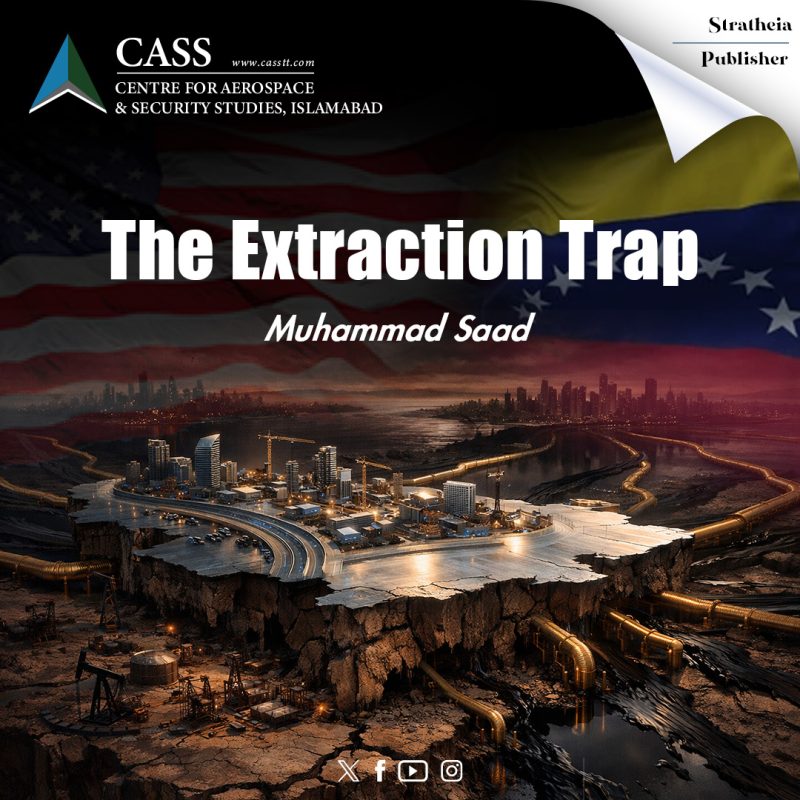
Trump’s declaration to “run Venezuela” after Maduro’s capture is a seeming promise of a sudden cure to Venezuela’s ills. However, it ignores the nation’s terminal diagnosis of a century of plunder. The rhetoric of imminent revival on the basis of the speedy return of international oil capital and the promise of 100 billion US dollars in reconstruction funds made the intervention seem like a unique opportunity. However, this line of argument wilfully ignores the deeper, ongoing pathology of the political economy of Venezuela. This pathology is not necessarily ideology-based but rather a historical chronology of resource extraction that has systematically exported national wealth.
The basics of this extraction are discussed very well in the work of economist Gabriel Zucman. Analysing the peak of the mid-century oil boom, Zucman calculates that in 1957, Venezuela’s entire net domestic product in profits was transferred directly to shareholders in the U.S., totalling around 12 per cent. This was not an isolated event but the peak of a constant outflow. Between 1920 and 1975, the total sum of the direct income transferred to the foreign owners was estimated at more than $100 billion. Ironically, this capital was seen nowhere in domestic investment pools.
This historical data serves to underline that the suffering of Venezuela is a good example of a profound Dutch disease. The vast hydrocarbon reserves in the country were exploited in the 1920s and 1950s, decades before strong democratic institutions, a professional civil service or any system of managing the sovereign wealth were built. The outcome was the untimely birth of a rentier state, where political authority was based on the ability to control oil rents and not on the ability to build a wide-based economic productivity, thereby placing the nation in a path-dependent institutional trap of economic frailty and foreign dependence.
The key to successful resource management lies not in what you have, but in when you find it. Norway discovered its major oil reserves in 1969, long after the consolidation of a high-trust democracy, a welfare state in every sense of the word, and a culture of fiscal transparency. This helped to immediately impose a 78 per cent marginal tax rate on petroleum profits and establish its Government Pension Fund Global, worth more than $1.4 trillion today, under tight parliamentary supervision. On the other hand, Venezuela’s early oil fortune solidified a petro-state mentality that actively cannibalised the other sectors of the economy. By 1970, oil accounted for more than 90 per cent of export revenues and about 70 per cent of government revenues.
The Chavez government of the 2000s temporarily obscured this fundamental flaw in a historic commodity super-cycle. Taking advantage of oil prices, which skyrocketed from under $20 to over $140 per barrel, poverty rates constricted sharply and access to education and healthcare widely expanded. However, these social gains were paid for entirely by volatile rents and not economic diversification. When prices collapsed after 2014, the fragility that lay beneath the surface was revealed. Ultimately, the Maduro regime experienced a virtual implosion. The IMF estimates cumulative GDP reduced by over 78 per cent within a decade, whereas oil production dropped to under 850,000 barrels per day in 2020 compared to almost 3.5 million barrels per day in 1997.
The interventionist approach by the Trump administration to recover these lost rents face a reality of physical and economic decay. The International Energy Agency (IEA) notes that the turnaround of Venezuela’s oil industry collapse will take colossal capital of about 80 to 100 billion dollars in ten years. It also requires years of technical labour, because the critical infrastructure is severely degraded. Furthermore, a revival of production threatens to flood a market where the IEA’s Sustainable Development Scenario projects global oil demand peaks before 2030. This could cause a market depression and reduce the fiscal benefits of the intervention itself.
A clinical analysis shows that neither nationalist populism nor foreign corporate control is a way out of this trap. The Chavez model used rents on social spending and patronage without fostering a resilient, diversified productive base, resulting in a hyper-exposed economy to price shocks. On the contrary, the historical record of foreign control, as measured by Zucman, shows profit repatriation to be the main priority, with reinvestment into local infrastructure and human capital being secondary at best. Both models view oil as a permanent endowment, a point of view that has been rendered dangerously anachronistic by the global energy transition.
In 2023, the Bank of England officially announced the end of its policy of prioritising fossil fuel company bonds for its corporate debt purchases, as a signal of growing divestment pressures. In this context, to treat the reserves of Venezuela as a perpetual revenue stream is to overlook systemic market and regulatory changes.
The sole demonstrably effective method involves a legal mandate directing all future resource revenue into a sovereign transition fund.. This calls for transparent, rules-based governance in which a set minimum percentage (empirical studies of successful funds, such as in Botswana, the Pula Fund, suggest 60-70 per cent at the very least) is automatically invested in non-oil sectors, renewable energy and education, with no political discretion for reallocation. Independent oversight, possibly by international organisations such as the UN Economic Commission for Latin America, would be non-negotiable.
For emerging resource economies like Guyana, the lesson is acute. Institutions need to be fortified before rents take over. Guyana’s score of 41/100 on the Corruption Perception Index in 2019 is a vivid representation of the absolute necessity in a brief political time horizon to come up with robust structures before the rentier consolidation process. The other option is to imitate the well-documented footsteps of Venezuela as it is.
The reserves of Venezuela theoretically have the power to fund an economic transition. But that requires a fundamental re-evaluation of oil not as the source of national identity and prosperity, but as a diminishing financial asset whose sole aim is to fund its own decline. It is up to any external neocolonial actor, including the United States, whether to contribute to the achievement of this disciplined exit or to persist in a pattern of extraction and collapse that has a 100-year-long history. Learning from Venezuela’s extractive past, the developing economies have two options. Either continue the cycles of extraction or build an unprecedented future by breaking the very pattern of resource exploitation.
Muhammad Saad is a Research Assistant at the Centre for Aerospace & Security Studies (CASS), Islamabad. The article was first published by Stratheia. He can be reached at [email protected]