Although the SDMA does not identify an adversary, effectively functioning as a deterrent, it cannot be viewed in isolation from the Israeli belligerence in the Middle East. Israel’s war against Hamas has expanded beyond the genocide of Gaza; it has bombed the West Bank, Lebanon, Syria, Yemen, Iran, and recently Qatar. Tel Aviv’s campaign under the banners of ‘anti-Semitism’ and ‘terrorism’ has engulfed the whole Middle East in a war-like situation, which has generated new enemies and has deepened the instability of the region. This has raised concerns among the Arab world, who fear that this conflict’s spill-over effects could trigger regional instability in their country and give rise to new insurgencies.
To mitigate this looming crisis, Arab leaders have tried to lobby for a two-state solution, but in the absence of any effective regulatory body, Israel has no incentive to negotiate. This sense of frustration in Arab diplomats can be reflected in the statement by Jordanian Foreign Minister Aman Safadi in September 2024. He stated that Israel rejects the two-state proposal and has no solution to the Gaza crisis apart from escalating this perpetual conflict. The Houthis’ strikes on Aramco oil facilities and the recent strike in Doha made it clear to Saudi Arabia that neither American security guarantees nor International Law are credible sanctuaries in this volatile region. These factors made it clear to Riyadh that alternative security arrangements were necessary to fill this void.
In terms of historical ties, long-range missile capabilities, and battle-tested air force, Pakistan is the most favourable choice for Saudi Arabia to fulfil its security requirements. Islamabad enjoys close relations with Riyadh and has a history of operations in the Middle Eastern region. In 1951, Pakistan signed the “Treaty of Friendship” with Saudi Arabia, and another in 1982, “Deputation of Pakistan Armed Forces Personnel”. Islamabad has a rich history of training Arab forces. Official records show that Pakistan has trained more than 8,000 troops since 1967. Moreover, Pakistan Air Force (PAF), in particular, has proven its combat capability and a record of shooting down Israeli jets in the Arab Israeli wars of 1967 and 1973. More recently, in May of this year, PAF participated in a massive air war with India, where it coordinated over 120 aircraft and shot down 7 Indian jets. Pakistan’s long-range missile capabilities and a battle-tested air force can prove itself as an ideal security partner for Saudi Arabia to provide strategic stability in the Middle Eastern region.
The Middle Eastern state faces threats from both asymmetric unconventional as well as high-tech conventional warfare. With respect to insurgencies, Pakistan has extensive experience conducting counter terrorism operations and has a rich history of joint ventures with Gulf countries. In 2017, General Raheel Sharif, former Army Chief of Pakistan, was tasked with the leadership of the Islamic Military Alliance to Fight Terrorism (IMAFT).
Another rising threat for Saudi Arabia emanates from conventional high-tech militaries that employ Multi Domain Operations (MDOs). These operations define the nature of modern warfare as short, intense, complex, and information-driven. These characteristics are clearly reflected in recent conflicts, where aerospace and surface-to-surface missiles dominated the conflict. These domains are increasingly utilised as they are far easier and faster to mobilise than traditional land and maritime solutions. These solutions, while convenient strategic tools for quick response, operate under a highly complex environment of MDOs. Modern forces have to take into account threats from cyber, space, electromagnetic, and information domains, which often result in a series of dilemmas for the decision-makers. During the Four-Day War with India on 7th May, PAF successfully demonstrated its ability to operate in such an environment, though it remains a pressing challenge given its rapidly evolving nature.
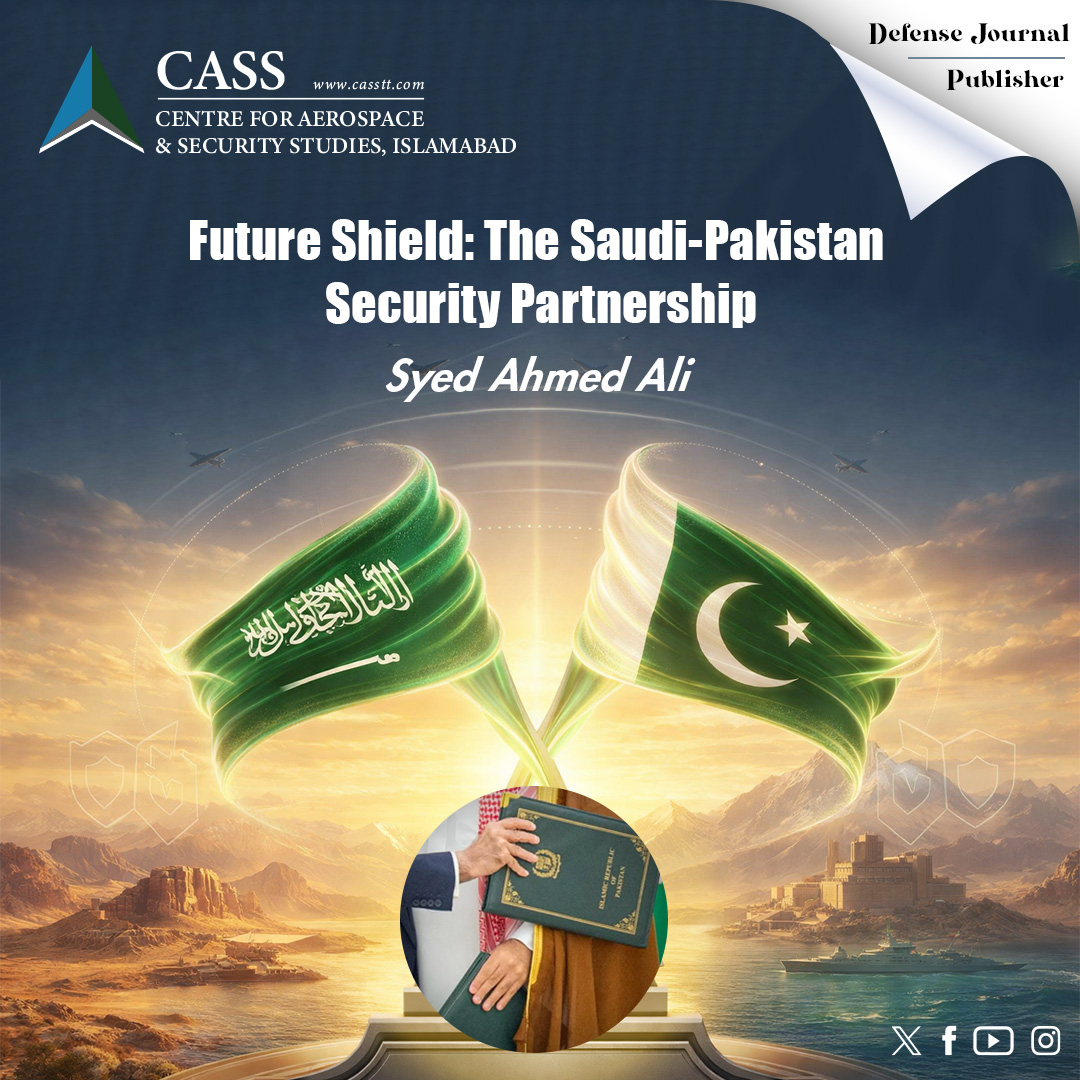
The SDMA provides a unique opportunity for both countries. Saudi Arabia gains a reliable defence partner along with one of the world’s most capable air forces. Pakistan would secure the cooperation and assistance of the Saudi government, which is critical for the acceleration of its military modernisation plans.
The pact definitely has the potential to reshape the balance of power in the region and provide strategic stability to Saudi Arabia and, by extension Middle East. However, its success hinges on a shared political consensus on regional security, a sustainable ecosystem for long-term operations, and integration of joint military capabilities. Navigating these challenges will determine whether SDMA could evolve into a regional security bloc or remain merely a transactional arrangement.
Syed Ahmed Ali is a research assistant at the Centre for Aerospace and Security Studies (CASS), Islamabad, Pakistan. The Article was first published by Defense Journal. He writes on technopolitics and can be reached at [email protected]