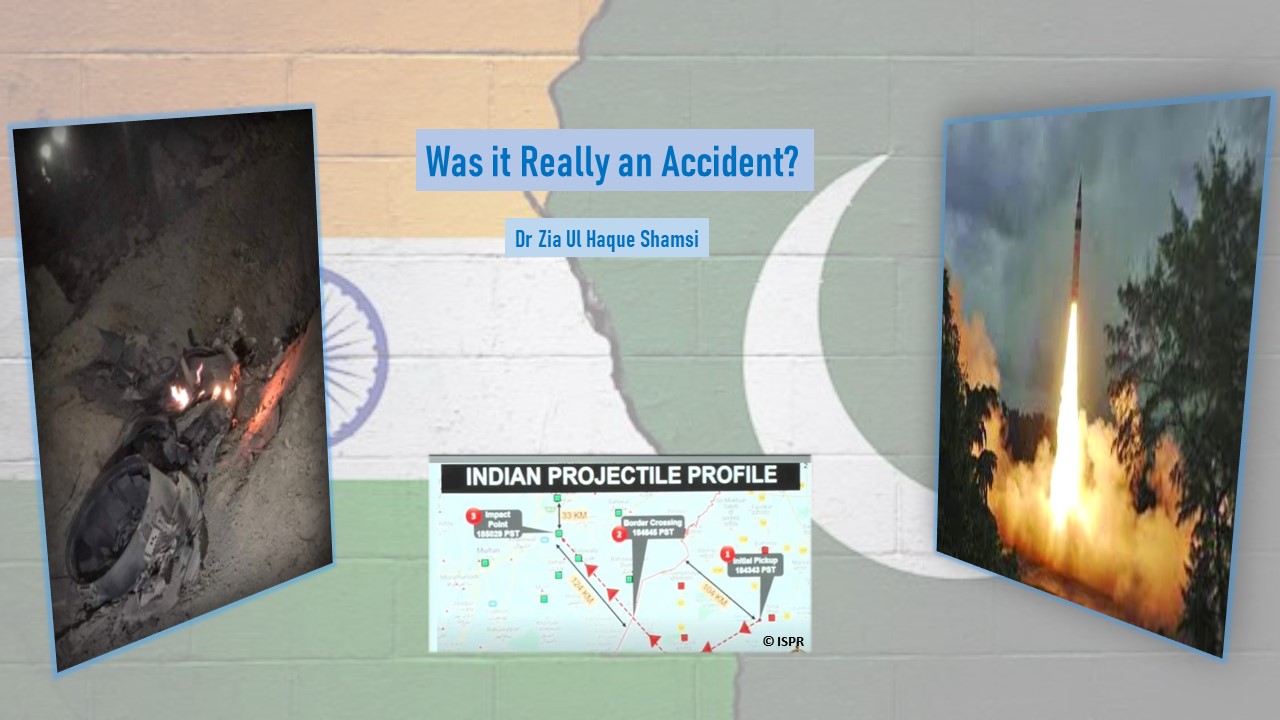
At a time when a full-scale war in Ukraine entered the 14th day, with Russian troops on the outskirts of Capital Kyiv, India accidentally fires a missile into Pakistan’s territory on the night of 9th March 2022. Interestingly, India did not issue any statement about the incident until Pakistan formally launched a complaint and carried out a comprehensive media briefing on the next day. The accidental firing of a very high-speed missile that flew at high altitude for more than 100 kilometres, that too into an arch rival’s territory, cannot be ignored. Therefore, Pakistan has called for a detailed investigation into the matter, and certainly, it would expect that India would share the details of the findings at an early stage.
Accidents may happen at any time and any place, but usually during tests or trials, for which the neighbouring countries are informed in advance. For this purpose, numerous safety instructions are issued and international protocols are observed, particularly with regard to aviation safety. Moreover, the potential landing sites of test missile is duly marked, usually in the sea or sparsely populated areas. However, this incident is unique in the sense that it did not happen during any tests or trials, but from an operational site.
This is an alarming situation because India’s safety record of its strategic material and assets has been under question for some time. The cases of uranium theft have become a routine, and surprisingly international nuclear watchdogs do not take any notice of such incidents.
As the narrative goes, Pakistan’s media reported burning wreckage of an unidentified object on the night of March 9, 2022. However, it was not clear until Director General Inter-Services Public Relations (DG ISPR) carried out a press briefing the next day and said, “It was a supersonic flying object, and most probably a missile, but it was certainly unarmed.”
This press briefing was jointly conducted with a Pakistan Air Force media representative, who explained the technical details of the incident. He said, “On March 9, at 6:43 pm, a high-speed flying object was picked up inside the Indian territory….From its initial course, the object suddenly manoeuvred towards Pakistani territory and violated Pakistan’s air space, ultimately falling near Mian Channu at 6:50 pm.”
According to the technical brief by the PAF, the point of origin was near Sirsa, whereas the point of impact was near Mian Channu in Pakistan. Sirsa is an operational base of the Indian Air Force located in Haryana State.
The Indian missile not only violated Pakistan’s airspace but endangered civil aviation safety as well. India’s missile crossed at least two active air routes and flew at altitudes that are usually taken by civil international airliners.
Pakistan’s response to the entire incident was very “sober.” It did not make any claims and only presented the fact. Pakistan has now asked India to explain the situation, concurrently, it remains operationally prepared to face any evolving situation.
However, the statement by India’s Ministry of Defence simply states that, “On 9 March 2022, in the course of routine maintenance, a technical malfunction led to the accidental firing of a missile. The Government of India has taken a serious view and ordered a high-level Court of Enquiry.” It further states that, “It is learnt that the missile landed in an area of Pakistan. While the incident is deeply regrettable, it is also a matter of relief that there has been no loss of life due to the accident.”
An analysis of a diplomatically structured statement clearly lacks logic and reflects a lack of professional approach on the part of its personnel handling sensitive equipment. It is necessary to mention that routine maintenance is always carried out with safety pins installed so accidental firing does not take place. Moreover, in case of technical malfunction, the missiles do not really achieve operational parameters and change course by 90 degrees and yet continue to fly for such a long duration.
Without casting any doubt on India’s intent, the investigation must look into aspects of an individual’s deliberate act also. While accidents may happen but this one is unique in many ways. It happened when no tests and trials were being conducted. Moreover, a technical malfunction during routine maintenance is not possible without sheer negligence or deliberate removal of safety pins by the operator.
It is necessary to highlight that the two nuclear neighbours do not enjoy full diplomatic relations since India revoked the special status of the State of Jammu and Kashmir by revoking Articles 370 and 35 A of India’s Constitution on August 5, 2019. In this situation, an irresponsible act by any state will have a greater probability of miscalculation and conflict escalation.
Therefore, it is necessary that India conducts a fair investigation into the missile-firing incident and shares the details of the findings with Pakistan at an early timeframe to avoid any speculations.
Dr Zia Ul Haque Shamsi is the author of ‘Nuclear Deterrence and Conflict Management Between India and Pakistan’ (2020) and ‘South Asia Needs Hybrid Peace’ (2021). He is presently working as Director at the Centre for Aerospace & Security Studies (CASS), Islamabad, Pakistan. The article was first published in Daily Times. He can be reached at [email protected].
Image Source: Etfa Khurshid Mirza