Book Review
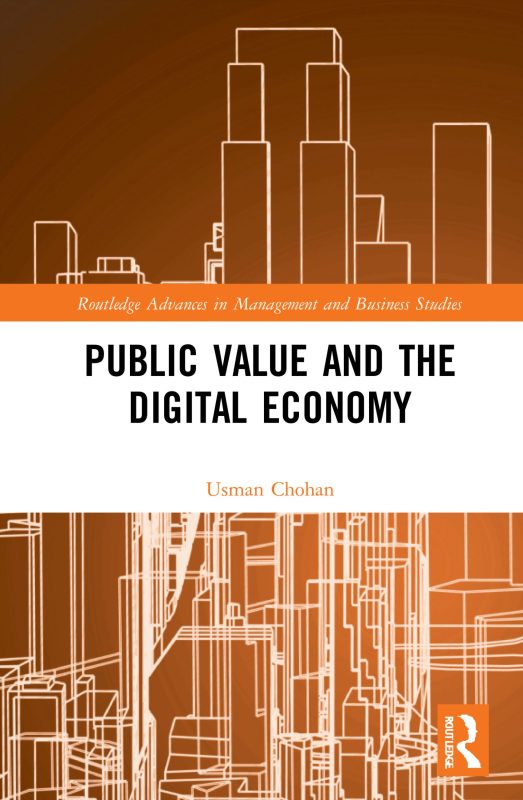
Usman W. Chohan, Public Value and the Digital Economy (London/New York: Routledge, 2021)
Reviewed by M. Mubashir Ehsan
Various practical learnings can be abstracted from the book, which ultimately converges towards digital inclusion and the integration of different social/technological systems. For example, Chohan illustrates the relationship between politicians and public managers (bureaucrats) and highlights the need to form a ‘Parliamentary Technology Office (PTO)’ as a way through which technical assistance can be provided to parliamentarians. The book draws a parallel to the Parliamentary Budgetary Office, which in practical terms can be beneficial for developing and emerging economies. He then explores another significant relationship – public managers and civil society. The Public Value literature has not explored this relationship comprehensively, but this subject has been increasingly gaining traction.
In Public Value and the Digital Economy, Dr Usman W. Chohan, Director Economic Affairs and National Development at the Centre for Aerospace & Security Studies, explores the digital economy through the lens of Public Value Theory (PVT), to answer questions related to creating and co-creating value at the managerial level. The author identifies a theoretical gap in the understanding of the relationship between the agents ‘who must co-create public value,’ and throughout the book, he emphasises the Value Co-Creation (VCC) approach and the relationship between different agents, i.e., public managers, politicians, civil society, and private interest.
Virtual assets (cryptocurrency specifically) are used across several developed and developing countries. The author, in this regard, highlights the debate related to innovation vs. accountability and freedom vs. security. This helps show how different values in a digital context need to be reconciled, which is a difficult balancing act. Chohan makes prescient observations on trends that are only now emerging, such as regulatory issues related to cryptocurrency that are discussed in the daily news only now, such as El Salvador’s currency switch.
Dr Chohan also highlights a significant link between ‘accommodative value co-creation through Public-Private Partnerships (PPP)’. In the realm of the digital economy, there are often cases where the public sector seeks assistance and collaboration from the private sector due to a lack of expertise in this domain. In practice, it is seen, at the government level, even in Pakistan, that there are working groups and projects formed through PPPs, especially in areas of digital transformation. Moreover, he explains the increasing power of tech companies serving their own private interests and how these companies avoid tax systems. The US, along with other developed economies, has amplified its focus on digital taxation recently, so his exhaustive explanation, about the ways to counter private monopolistic powers through strong digital taxation policies, rings very true.
The book also offers a futuristic vision using the interaction of PVT and the digital medium to explore governance aspects. Furthermore, it delves into new concepts like ‘Decentralized Autonomous Organizations (DAOs)’ by visualising a world where managerial functions are possible without humans. Dr Chohan highlights some of the limitations regarding DAOs but emphasises that this futuristic approach will enhance the value creation process through higher efficiency, greater transparency, and equity-focused results.
This publication is certainly worth reading as it offers an insightful perspective on how to explore the digital economy in detail without being confusing or difficult. In fact, it should be on the must reading list of those in public administration and economics, and particularly those eager to understand the rapidly evolving global digital economy through the Public Value Theory (PVT) perspective. The book presents a comprehensive literature review that zooms in at the micro level to understand the relationships between the different agents of society who can co-create value in a digital context.
M. Mubashir Ehsan is a former Researcher who worked at the Centre for Aerospace & Security Studies (CASS), Islamabad, Pakistan.