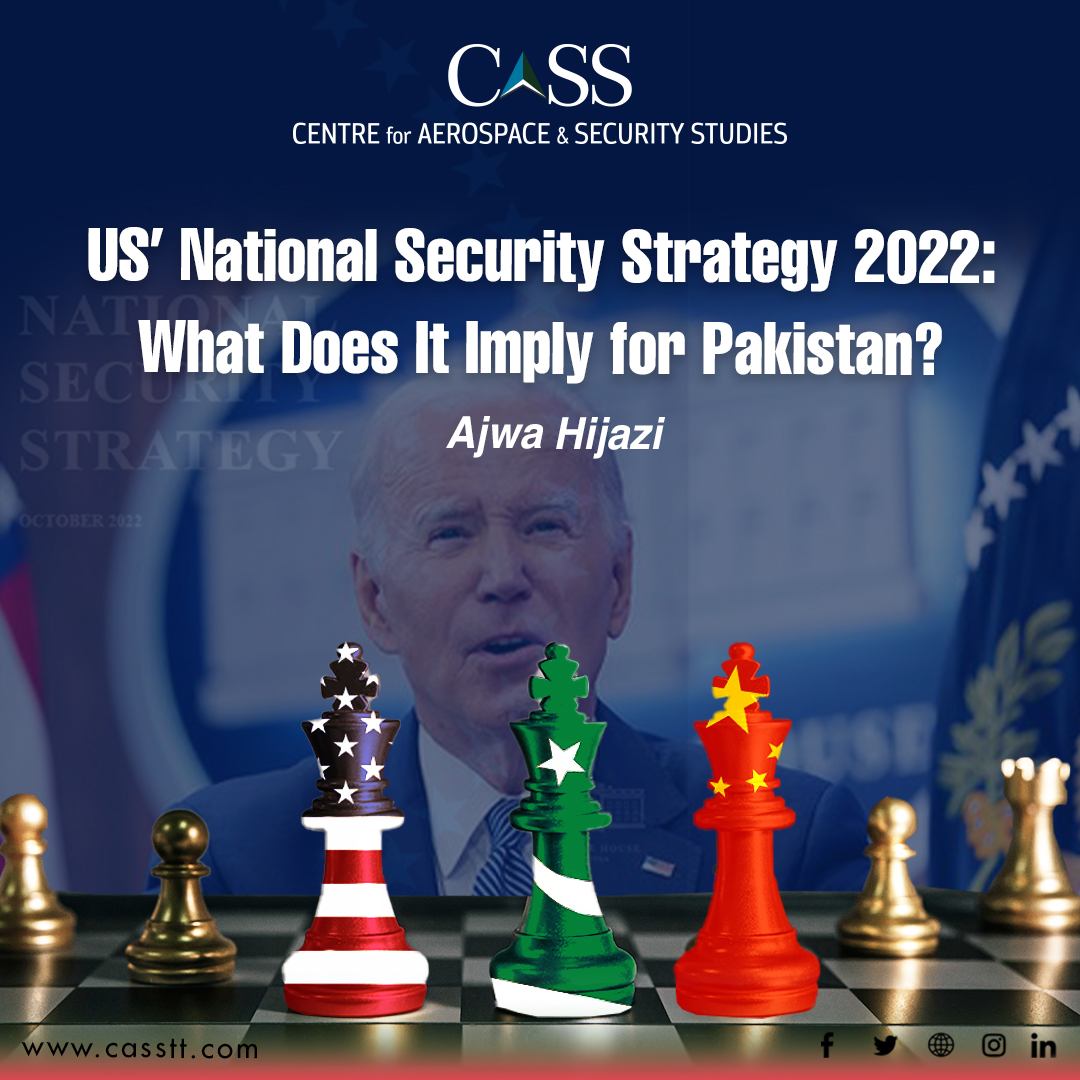
The United States’ new National Security Strategy (NSS) was published by the White House on 12 October 2022. The document encapsulates the two-pronged global challenge for the US – advent of competition between the major powers to navigate the international order and the burden of shared challenges that are transnational. The NSS 2022 outlines the trajectory of global engagement that the USA would follow in the coming decade. Therefore, it depicts the policy matrix of the country towards the regions and states that are important in its realm of foreign policy approach.
The 48-page document does not mention Pakistan. But the US policy about other states, especially those bordering Pakistan, would significantly impact the country. Pakistan has found itself in a situation where the US has indicated prospects of an inflexible policy towards three of its neighbours – China, Afghanistan, and Iran, and an intimate regime of cooperation with the fourth one, India. Moreover, while exclusively designating two chapters to them, the US has termed the ‘out-competing of China’ and ‘containment of Russia’ as its top priority.
For Pakistan, four policy implications can be derived from the new NSS, which will impact its future course of policy formation towards the region.
In the context of the USA’s growing entanglement with China and accelerated inclination towards India, Pakistan- the principal partner in the Belt and Road initiative (BRI) – would be facing the heat. To maintain its growing strategic comfort with the US, India is likely to cause more disruption in the China-Pakistan Economic Corridor (CPEC). The NSS reiterates US’ focus on a ‘free and open Indo-Pacific’ while combating rising China by posturing India against it. Consequently, it also reflects Pakistan’s diminishing geoeconomic and geopolitical importance in the eyes of Washington.
Another salient point in the NSS is regarding Iran. The US criticised Iran’s nuclear programme and its alleged policy of interference in Middle Eastern countries. Amidst the growing tensions between the US and Iran, there has been slow progress on the Joint Comprehensive Plan of Action (JCPOA). Additionally, Iran shares a southwestern border with Pakistan. Hence, the manifestation of any aggressive mode of action by the US towards Iran would pose challenges for Pakistan in the form of another unstable neighbouring country.
The US left Kabul in August 2021 after fighting its longest-ever war, spanning over two decades. Since the withdrawal, the US has increasingly tried to maintain an ‘over-the-horizon’ policy which refers to the continuation of air strikes and drone attacks in Afghanistan. In this new NSS, without mentioning Pakistan, it has been hinted that the US would ensure that Afghanistan does not relapse towards terrorism. For this end, the US cannot ignore Pakistan’s geostrategic importance to counter the stream of threats emanating from Afghanistan. In addition to that, US policy is likely to have a wide array of impacts due to the geographical and historical dynamics between Pakistan and Afghanistan. Hence, devising any Afghan strategy, without taking Islamabad on board, would be short-sighted.
Pakistan is not a direct stakeholder in the ongoing Russia-Ukraine conflict. However, in an inter-connected world, countries, even miles apart, cannot remain unfazed by significant international events. According to NSS-2022, the US aims to constrain the growing Russian ‘threat to the international system’. In light of this, the probability of any future restraint from the Biden Administration towards Russia is likely to diminish. Resultantly, the ongoing turmoil in Europe would increase. The impact of the energy crisis and mayhem in the international supply chains would also have consequences for Pakistan, like the rest of the world. Besides, for Pakistan, steering its role between the two impulsive superpowers would be a foreign policy challenge requiring clarity and diplomatic acumen by policymakers.
Not mentioning Pakistan in its 2022 Security Strategy may be part of Washington’s strategic shift regarding the region, but it cannot lessen Pakistan’s pivotal regional significance. Furthermore, the absence of any explicit agenda of demands creates an opportunity for both countries to move on a path of bilateral relations which is not overwhelmed with any prior set of expected compliances.
Ajwa Hijazi is a Research Assistant at the Centre for Aerospace & Security Studies (CASS), Islamabad, Pakistan. She can be reached at [email protected].