
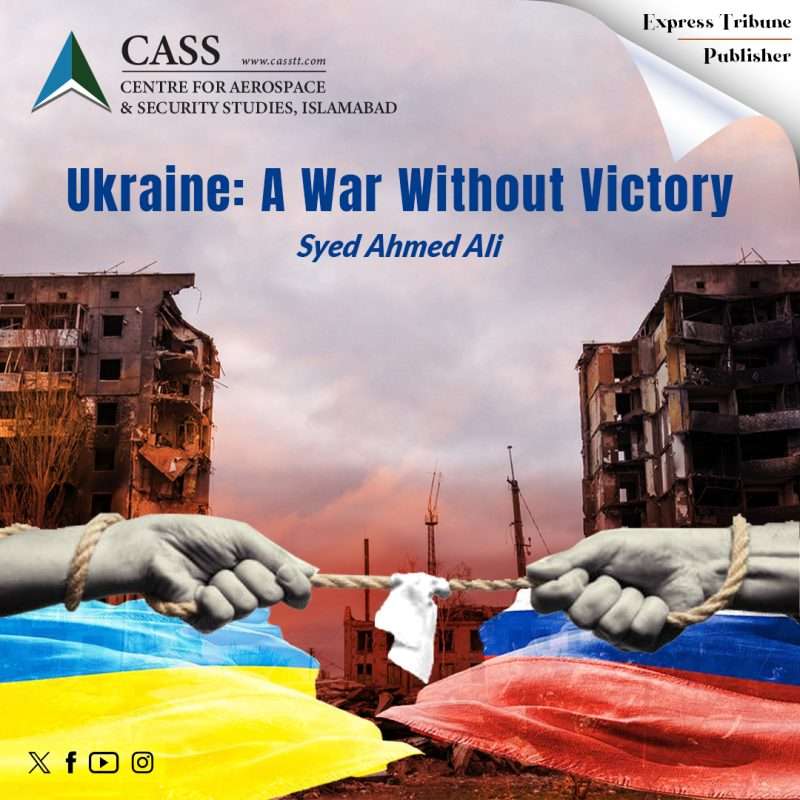
February 24, 2025, marked the third anniversary of Russia’s ‘special military operation’ in Ukraine, under President Vladimir Putin with the declared aims of ‘demilitarising’ and ‘denazifying’ Ukraine, as well as protecting residents of the Donbas region from alleged genocide. The special operation which started as a rapid offensive soon turned into a slow and protracted conflict that has devastated Ukraine and its people.
Ukraine has lost over 42,000 civilians, has 3.7 million Internally Displaced Persons (IDPs), and 14.6 million people in need of humanitarian assistance. Of the displaced population, 25 percent are children and roughly 50 percent are women, which accounts for 76 percent of total refugees in Ukraine. To make matters worse, refugees have no place to shelter as United Nations’ reports estimate that 2.5 million homes have been destroyed (that’s nearly 13 percent of its housing sector). There is now a massive migrant crisis in Europe as 6.9 million people have migrated from Ukraine to nearby Eastern European states.
On the military front, the Ukrainian Army, already having acute personnel shortages, faces even greater difficulties as it has suffered heavy casualties, having lost 46,000 men, with 380,000 wounded since the war began. In terms of materials and equipment, the Ukrainian Army has lost around 7,600 units of military hardware and 3,800 armoured vehicles, including 700 tanks, 800 Armoured Personnel Carriers (APCs) and 900 Infantry Fighting Vehicles (IFVs).
On the other hand, Russia has made significant inroads into Ukrainian territory, most notably in Donetsk, Luhansk, Zaporizhzhia and Kherson. However, these territorial advances have come at the cost of nearly USD 300 billion. In terms of manpower, according to Ukrainian sources, the Russian Army has lost a large number of troops. In terms of materials, the Russians have lost 2,600 tanks, 1900 APCs and 4,100 IFVs. Due to the inability of the Russian industry to replace these losses, Moscow has started relying on old Soviet reserves.
Ukraine has been dependent on its allies to sustain the war effort and counter the attrition of prolonged conflict. Europe has played a major role in supporting Ukraine, with the EU and its Member States providing nearly USD 145 billion in financial, military, humanitarian, and refugee assistance. Of this total, 65 percent has been granted as direct aid or in-kind support, while 35 percent has been disbursed as highly concessional loans. On the other hand, since February 2022, Congress has allocated or authorised nearly USD 183 billion for ‘Operation Atlantic Resolve’ and the broader US response to the conflict. Furthermore, as part of the G7 nations’ extraordinary revenue acceleration loans initiative, Washington has extended USD 20 billion in loans.
While Western support for Ukraine has been substantial, it remains insufficient given the overwhelming scale of attrition in the Russo-Ukrainian war. One key reason for this shortfall is the prevailing political calculus in Western Europe and the US, where leaders increasingly question whether military aid justifies its financial and strategic costs. This sentiment was particularly evident during Donald Trump’s election campaign, where he criticised continued involvement in the war, arguing that it did not align with US national interests.
The growing war fatigue in the West became a decisive factor in Donald Trump’s victory in the 2024 US presidential election. His return to office marked a pivotal moment in the Russo-Ukrainian conflict, as analysts speculated that a Democratic administration, led by Kamala Harris, would have pushed for increased military support, potentially prolonging the war. In contrast, Trump and the Republican leadership had pledged to bring the conflict to an end through negotiations. This shift in US policy materialised on February 19, when US and Russian officials met in Riyadh and agreed to establish a high-level delegation to negotiate an end to the war.
With the US and Russia now at the negotiation table, the war appears to be approaching its conclusion. However, the path to peace remains uncertain, as the involved parties hold divergent views on what constitutes a just settlement. President Trump wants a share of the revenue generated from Ukrainian mines. Russia on the other hand, wants Ukraine to hold elections as Moscow views the government in Kyiv as illegitimate. Additionally, Russia also stipulates that it will retain captured territory, which accounts for 20 percent of total Ukrainian territory. Ironically, amid the US-Russia negotiations, Ukraine was sidelined as President Zelenskyy wrestled to find his seat at the table. This was until his spat with President Trump last week. Ironically, amid the US-Russia negotiations, Ukraine was sidelined as President Zelenskyy struggled to secure a seat at the table – until his contentious exchange with President Trump last week shifted the dynamics.
The US’s position on UN resolution ‘Advancing a comprehensive, just and lasting peace in Ukraine’ further underscores the evolving nature of Washington’s approach to the war. The Biden Administration had previously taken a hardline stance on Russia’s actions, but Trump’s presidency has ushered in a recalibration of priorities. The change in rhetoric and voting patterns at the UN reflects a broader push to bring the conflict to a negotiated end, even if it requires concessions that were previously off the table. This shift raises critical questions about the future of Western support for Ukraine and the long-term implications of a potential peace deal.
The negotiations may mark the beginning of the end for the three-year war, but at what cost? Ukraine has lost 20 percent of its territory, including key mines, suffered thousands of casualties, and remains without any path to NATO membership. Russia, despite territorial gains has paid a steep price in military losses and economic strain. In the end, this war’s legacy may not be determined by territorial lines, but by the lasting consequences of a conflict neither side can claim as victory.
Syed Ahmed Ali is a Research Assistant at the Centre for Aerospace & Security Studies (CASS), in Islamabad, Pakistan. The article was first published in Express Tribune.He can be reached at [email protected].



