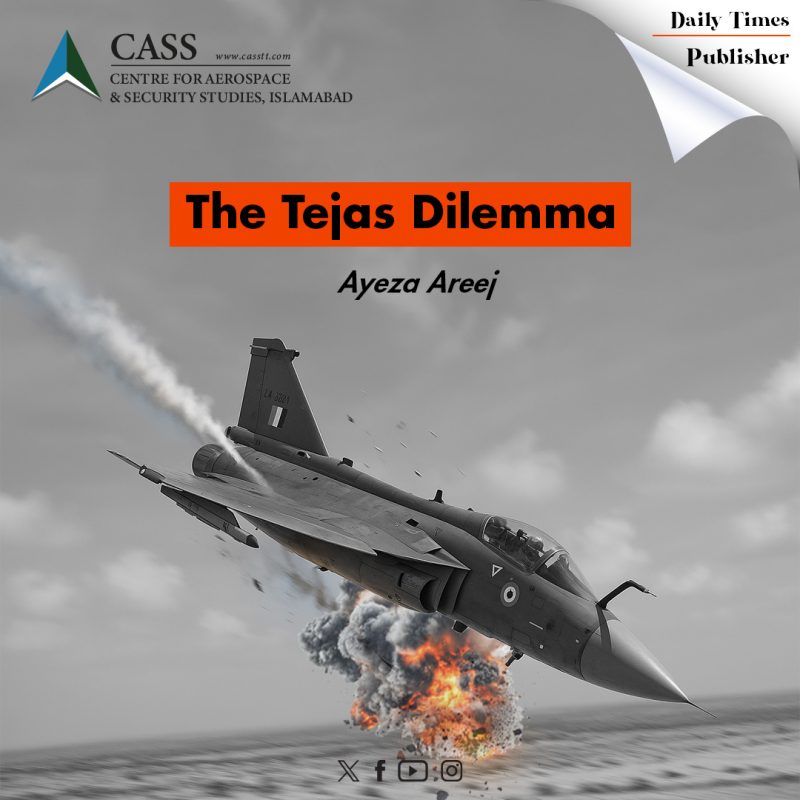
The tragic crash of Tejas at Dubai Airshow 2025 holds serious strategic repercussions for Indian Air Force (IAF) and Hindustan Aeronautics Limited (HAL). Tejas Light Combat Aircraft (LCA), a multi-purpose 4.5 generation jet, is not only viewed by India as a manifestation of its technological and strategic autonomy but also as a symbol of national pride. Nevertheless, HAL and IAF showed up at the Dubai airshow under considerable pressure after facing some unprecedented losses in the May 2025 conflict. For IAF, what further compounded the pressure was the presence of combat-proven JF-17 Thunder at Dubai Airshow. At this high-profile event, India wanted to project Tejas as the crown jewel and a hallmark of its defence indigenisation ambitions.
The Tejas LCA programme started in 1984 under HAL, with the initial aim of replacing the obsolescent MiG-29 and Mig-21 Fleet. Initially, India aimed to induct 180 Tejas Mark-1A over a period of 15 years. However, its sluggish development has taken decades and India was only able to induct 36 Tejas aircraft in 40 years, one per year, unable to catch up with global progress. During this period, countries have inducted fifth and sixth generation fighter jets while India is lagging far behind. Thus, despite massive expenditure, IAF has suffered from deficit of squadrons. Tejas was believed to fill these operational gaps and serve as a backbone of New Delhi’s aerospace ambitions.
Tejas has always been celebrated as an indigenous feat in India, yet this claim is sharply at odds with reality as many of its parts are imported. The aircraft is only 59.7 percent indigenous. For instance, F404-GE-IN20 engines are imported from United States and EL/M-2032 radars are acquired from Israel. Tejas uses 344 Line Replaceable Units (LRU’s) out of which 134 are imported from foreign companies. Apart from its lack of true indigenisation, the project has suffered prolonged production constraints, chronic engine delays, weak ground testing, component quality issues and bureaucratic hurdles, which ultimately undermines India’s strategic objectives. Even the IAF Chief repeatedly raised his concerns regarding the delays in delivery of Tejas and stressed on the production and induction inefficiencies.
The Dubai Airshow offered India, a flagship platform to bring Tejas into global spotlight and attract foreign buyers. However, the unfortunate crash has brought severe strategic setbacks for credibility of India’s aerospace industry. The crash gives rise to several fundamental questions regarding reliability, serviceability, quality standards and pilot training especially considering an earlier Tejas crash in Rajasthan in 2024. Such failures not only highlight New Delhi’s strategic lapses but also flag a discrepancy between operational reality and the flagship narrative.
IAF, internally, now faces more complex challenges. A thorough investigation is required to assess whether the failure was triggered by merely a technical fault, an error at the end of pilot or a result of systemic maintenance oversight. In such incidents, however, the initial tendency to blame the pilot is a part of the protectionist culture. However, IAF is now being questioned as it failed to meet safety standards of a home-grown product.
The incident has also created a complex challenge, which will significantly affect the international perception about Tejas programme. In such stringent professional domain of aviation, errors are not acceptable. Though an aircraft’s capability is assessed not only through aerobatic performances alone but more so for weapons and avionics deployed on the aircraft. Accordingly, reliability, airworthiness and quality of weapons are indispensable factors for considering defence procurements. India planned to export Tejas to Malysia, Indonesia, Egypt, Australia and other friendly countries. Yet, the accident will not only dampen future export prospects in a highly competitive market but also cause a decline in HAL shares (about 2.58% drop on the first day).
Delving deeper, the squadron strength of IAF fighter has significantly plummeted to approximately 29 squadrons from the sanctioned 42 squadrons. This will be further declined with the retirement of MiG-29 and Mirage 2000. While New Delhi envisioned to recover the gap with induction of Tejas, the situation now is uncertain. As a result of this fiasco, IAF is now facing a strategic dilemma. On one hand, if the IAF focuses on importing foreign fighter jets, it can fill its squadron deficit and improve operationability, however this would run the risk of damaging the credibility of its indigenous production in the long-run. On the other hand, if it prioritises the Tejas programme, it can continue to support both the national strategy of Atmanirbhar Bharat and political narratives surrounding indigenisation, yet in this scenario, it would likely face persistent operational shortfalls.
The Dubai Airshow 2025 has been a significant determinant for the future of Tejas Programme. It is likely to reshape the perception of IAF itself and potential importers of Tejas. Furthermore, the devastating episode has inflicted a substantial reputational setback for India in terms of its defence ambitions. Ultimately, it reveals to the world that the aviation domain requires precision and errors are simply not permissible.
Ayeza Areej is a Research Assistant at the Centre for Aerospace & Security Studies (CASS), Islamabad, Pakistan. She can be reached at [email protected].