‘Technology delayed is technology denied,’ argued Indian Air Force (IAF) Chief, Air Chief Marshal Amar Preet Singh, referring to the India’s Tejas Light Combat Aircraft (LCA) programme, stressing the need of timely technological developments. This remark underscores the prolonged delays in the LCA programme, initiated in 1984, which has delivered only 36 aircraft over four decades—averaging almost one per year. These delays have failed to compensate for the retiring fleet, leaving the IAF with only 31 fighter squadrons—well below the sanctioned strength of 42—most of which still consist of Soviet era aircraft. The addition of 36 French Rafale jets, while enhancing operational capabilities, falls short of counterbalancing growing regional air power forces.
On the one hand, Pakistan Air Force (PAF) operates with an advanced fighter fleet that includes advanced JF-17, J-10C and F-16 aircraft. JF-17 Thunder, the backbone of the PAF, is produced at Pakistan Aeronautical Complex (PAC) Kamra and has state of the art avionics, an AESA radar, a glass cockpit, advanced electronic warfare system, HOTAS controls, and lethal BVR weaponry. In addition, PAF has made plans to induct J-31 5th gen stealth fighters to its active operations within the coming years. On the other hand, Chinese People’s Liberation Army Air Force (PLAAF) continues its advancement with its operations of various advanced aircraft which now include the J-20 5th gen stealth fighter. It is predicted that J-20 fighter jet numbers will grow from today’s figure of 200 to 1000 stealth aircraft by 2035. Furthermore, China is actively pursuing the development of a sixth-generation integrated space-air fighter as recently showcased in 2024 Zhuhai Airshow.
In this strategic environment, India’s aging fighter fleet presents major challenges in potential air conflicts, making the IAF Chief’s frustration understandable. The LCA has failed to meet the IAF’s operational needs on time, facing issues such as engine availability, suboptimal performance, fly-by-wire flight control system issues, and avionics integration challenges. It is evident that LCA MK-1 or MK2 cannot obtain full operational clearance by 2030 and the next version, i.e. Advanced Medium Combat Aircraft (AMCA) will not become operational before 2035. Even at the time of Squadron induction, the question remains about whether the fourth generation LCA Mk-1A, Mk-2, or AMCA will be able to meet the operational requirements by the mid-21st Century, especially when sixth-generation stealth fighters and advanced stealth drones would be the centre of next generation aerial warfare using man-unmanned teaming.
This raises a critical question: What should India do?
During the February 2025 meeting between US President Donald Trump and Indian Prime Minister Narendra Modi, the US announced India’s potential purchase of F-35 stealth fighters.
The announcement serves two purposes: first, to pressurize India into purchasing the highly expensive billion dollars F-35s (approximately USD 100 million per aircraft), and second, to dissuade India from acquiring the Su-57 from Russia, which has reportedly offered production transfer rights. Thus, acquiring the F-35 would pose a complex dilemma for India, as beyond political manoeuvring, it demands significant budget allocations and specialised bases’ infrastructure. In addition, F-35 integration with the existing IAF ecosystem, comprising mainly Russian-origin equipment, would also be a major challenge.
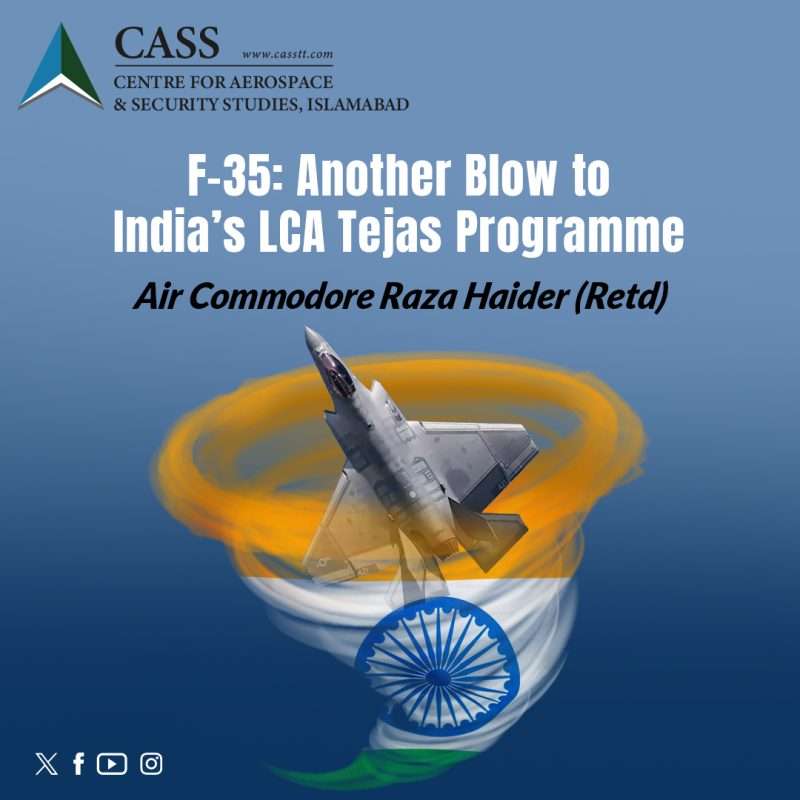
However, the greatest challenge of acquiring the F-35 would be its direct impact on India’s LCA programme. Although, F-35 is a very capable 5th generation fighter; however, it is known for its high cost in purchase as well as for high ‘cost per flying hour’ (almost USD 42,000 per hour) and its maintenance may become a financial drain for IAF. Diverting substantial budget and resources from the indigenous LCA and AMCA programmes towards the acquisition and operation of the costly F-35 would negatively impact both India’s aviation industry and the ‘Make in India’ initiative. Therefore, induction of F-35 would be another blow to the future of already delayed fourth generation LCA Tejas and AMCA programmes, which otherwise also necessitates a critical evaluation, especially considering their relevance in next generation operational needs of the IAF.
Air Commodore Raza Haider (Retd) is Director at the Centre of Aerospace & Security Studies (CASS), Islamabad. The article was first published in Express Tribune. He can be contacted at: [email protected].