
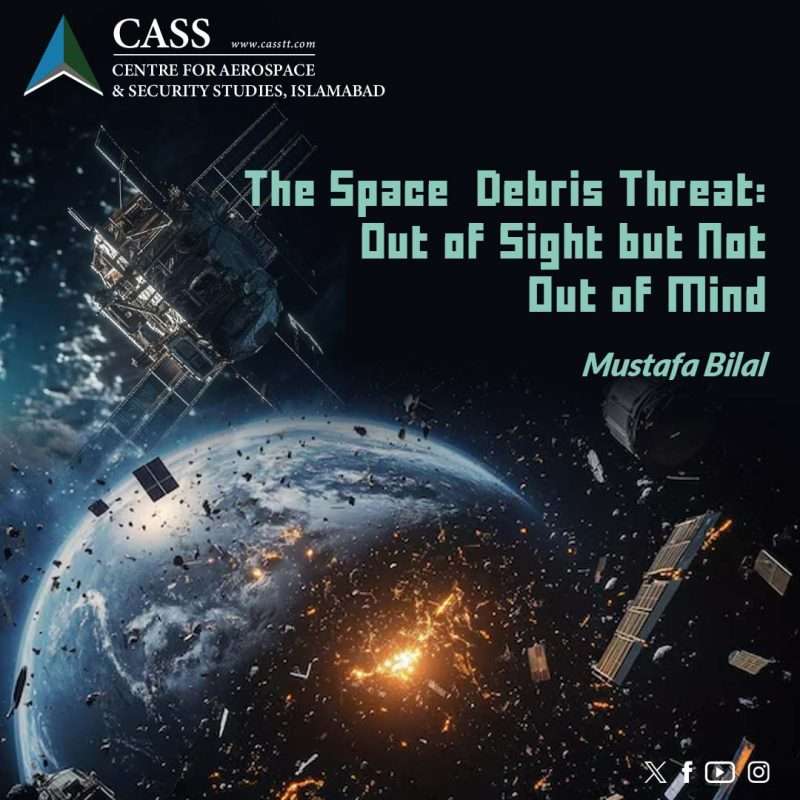
The International Space Station (ISS) has been featured in several Hollywood movies, from being hijacked by a hostile alien in Life to being ripped apart by space debris in Gravity. While the former scenario is detached from reality, the latter has been a real concern since 1978, when two NASA scientists first warned of such an incident arising from the increasing density of space debris that would result in cascading collisions. This threat still haunts humanity’s presence in space and on Earth as space debris comprising defunct satellites and spent rocket stages continues to increase. Fortunately, the ISS has not met the same fate as depicted in Gravity, but in 2021 it was damaged by space debris. Three years later in November 2024, the ISS manoeuvre to avoid impact with debris from a defunct satellite. Meanwhile, for Starlink satellites, which account for the majority of all operational satellites and operate in an increasingly congested low Earth orbit (LEO), such manoeuvres have increased to over 270 per day to avoid millions of pieces of space debris
To put the quantity of space debris into perspective, the European Space Agency’s (ESA) 2024 Space Environment Report estimated that nearly one million pieces of orbiting debris are less than 10cm, and almost 130 million pieces have frequently been reported as too small to be tracked. While their size may be minuscule, they pose a grave threat. According to the Aerospace Corporation, even blue-berry-sized space debris moving at more than 17,000 mph speeds can be dangerous. This danger was also underscored in the UNU-EHS Interconnected Disaster Risks 2023 report which highlighted space debris among the six risk tipping points. Consequently, unabating growth in space debris threatens satellites, which have become critical for multifaceted functions associated with modern life, such as navigation, communication, national security, weather forecasting, and disaster management. Space debris has thus been flagged as an escalating threat to human rights and sustainable development.
However, most people would dismiss this threat if they discovered that the chances of any particular person being hit were estimated to be less than one in one trillion. Indeed, anyone would think they have a better chance of winning the biggest lotteries. Although this might not always be the case as one family in Florida found out in March last year when space debris crashed into their house, penetrating both the roof and floor. This would not be a one-off incident as recently on December 30th, a large piece of space debris weighing 500kg crashed into a village in Kenya. While no one was harmed in both incidents, they highlight that even if the possibility of being hit by space debris is astronomically low, it is not non-existent. Moreover, the threat of being hit would only increase with time, given that the U.S. Federal Aviation Administration (FAA) has predicted that 28,000 pieces of space debris would be crashing down to Earth by 2035.
Despite such concerning predictions, there are still many challenges in mitigating space debris. Firstly, there is no binding international agreement on debris mitigation. On the contrary, Article 6 of the Outer Space Treaty deems debris to be the property of the launching state. Therefore, another state cannot just remove it out of goodwill. Although even if it was legally permitted, all debris removal efforts are also impeded by the tragedy of the global commons: individual states lack the incentives to remove debris, especially given enormous removal costs. This underscores that cooperation should be at the core of all efforts aimed at mitigating and removing space debris. However, currently less than 5% of satellite operators share intelligence about the location of their satellites. Increasing intensity of satellite breakup events exacerbates this challenge. There have been six such events this year which have created hundreds of pieces of space debris.
The silver lining is that there is at least increasing global awareness of the imperative of addressing the space debris threat. This awareness is reflected in the efforts of the United Nations Committee on the Peaceful Uses of Outer Space (COPUOS) towards minimising and preventing the creation of space debris. The World Economic Forum has also published debris mitigation recommendations stressing increased cooperation and transparency. In this context, active and passive debris removal technologies and practices are also being developed. For example, in 2025, the ClearSpace-1 mission will demonstrate feasibility of removing a large piece of debris. Moreover, on December 17th, space startups in India and Japan collaborated to study using laser-equipped satellites for debris removal.
Complementing the efforts of COPUOS and WEF towards tackling the space debris threat, ESA and NASA have formulated space sustainability strategies. Beyond individual space agencies, astropolitical coalitions like the Artemis Accords also stress a commitment to limiting, to the extent practicable, the generation of new debris by taking appropriate measures, including sustainable disposal of spacecraft. The emphasis on sustainably disposing defunct satellites is important considering the environmental issues concerning the projected launches of mega-satellite constellations. Hence, even if space debris is out of sight, the threat it poses should be in the minds of all international stakeholders in private space firms, space agencies, and policymakers, who should collectively endeavour to mitigate its indiscriminate dangers by overcoming the hurdles hindering effective cooperation.
Mustafa Bilal is a Research Assistant at the Centre for Aerospace & Security Studies (CASS), Islamabad. The article was first published in The News International. He can be reached at [email protected].



