
Having wasted nearly a year in political squabbling, and unable to take important decisions or focus on the economy, while also being battered by exogenous forces (floods, Ukraine war, soaring energy prices), Pakistan’s economy is now in a ramshackle condition. The reserves of the country have dwindled to less than USD 3 billion or three weeks of import cover, exacerbating the desperation of the public as widespread uncertainty looms. In that context, a team from the IMF came to Pakistan to engage in extensive negotiations over a ten-day period that ended on February 9th. The negotiations, from press coverage of the process, conveys the impression of tough to and fro that spanned a vast range of issues. The primary focus, however, was on arriving at a mutually agreeable macroeconomic framework that would address the country’s two major deficits: fiscal and current account.
At the conclusion of these negotiations, there was no immediate good news to present to the public, and virtual discussions continued between both sides. However, the Finance Minister went into a mostly empty National Assembly to present a ‘mini-budget’ with evidently tough measures to shore up the country’s macroeconomic position. Indirect taxation was the linchpin of the strategy, with the sales tax raised from 17% to 18%, fuel prices raised to PKR 272/litre from PKR 249 (along with hikes in other fuels). It is worth noting that, compared to the PKR 272 charged in Pakistan now, the average global price is closer to PKR 480, and so there is still room for the government to raise fuel prices to meet the shortfall. This will exact a severe toll on the common man, whose purchasing power is already being relentlessly compressed and who is already undergoing immense hardship. Meanwhile, gas prices would be raised at sequenced intervals, and taxes would be raised on unhealthy products. The construction industry was targeted with a raise of PKR 500/tonne to PKR 2,000, and the power sector’s hemorrhaging circular debt is to be targeted in a graduated manner.
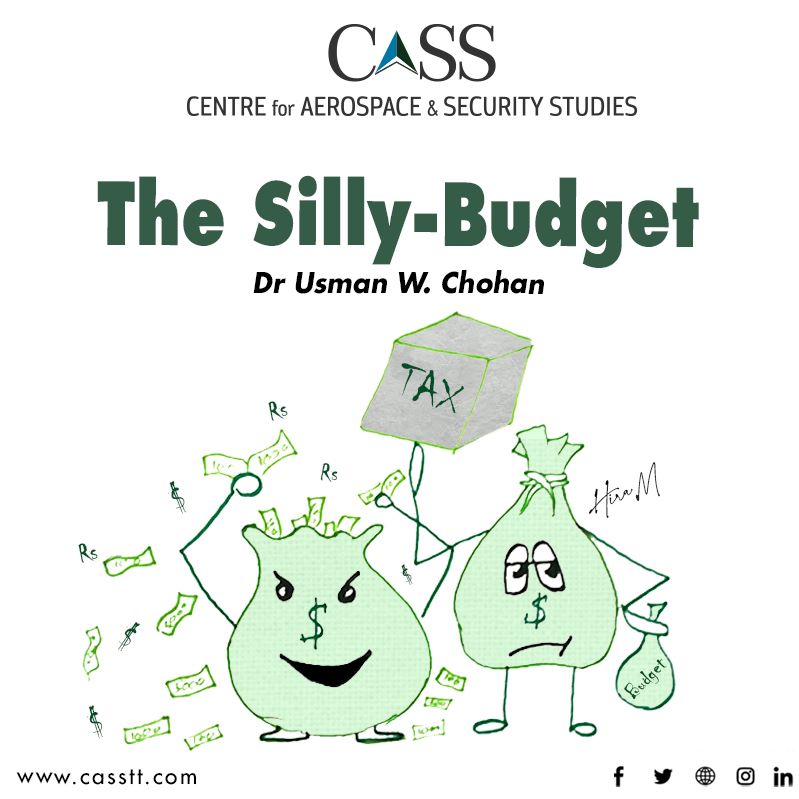
Although the subsequent messaging from across the political spectrum was negative in terms of rhetorical sympathy with the poor and the shrinking middle class, there were far larger shortcomings, in my view, of the measures announced in the mini-budget, which make it more of a ‘silly-budget.’ Above all, the measures fail to broaden the tax base, are shortcut in nature (indirect taxes), and squeeze existing taxpayers. To achieve fiscal sustainability, the bigger concern is how to bring the rest of the economic tiers within the fiscal fold. For example, only 30,000 out of 22 lakh retailers/traders pay tax in this country. The real estate market is also not being targeted even though it is a hotbed for speculative activity. At a deeper level, and 76 years wanting, is an agriculture tax.
These three sectors: real estate, retail/trading, and agriculture, follow special interest group logics, are close to power brokers and often claim seats in assemblies. Yet, shaking these three sectors up would address the lopsided and tenuous position of the macroeconomy.
It appears that indirect taxation is the shortcut instead of addressing the bigger problems of structural economic inequality. For example, civilian bureaucrats’ assets are up for public disclosure, but they are just a subset of the ‘elite’ that misgoverns the country. It is in seeing who else isn’t added to the roster along with civilian bureaucrats that more troubling observations arise. The commitment of the government to meaningful reform continues to appear dubious to the IMF, because at the same time that the government was negotiating its austerity programme, it was taking anti-austerity measures right, left, and center. By way of examples: the government continued to expand its cabinet through ‘advisors’ even though they are absolutely unnecessary; the Federal Board of Revenue (FBR) announced the purchase of 155 vehicles in the ‘luxury’ category (1500-2200cc) for itself; and the luxury housing societies continue their business-as-usual activities.
The fact is that, if this is austerity, it doesn’t go far enough. However, the political costs are already too high for this government, and it appears to most observers that the current dispensation cannot solve the problems that persist. As a result, the IMF has every right to remain dissatisfied, and so does the common man of Pakistan. While his purse is being squeezed, the country is bleeding due to supremely unwarranted perks and privileges. This is why the stopgap approach currently being undertaken is a ‘silly-budget’ rather than a ‘mini-budget.’ What is more, even at this crisis juncture, we are kicking the can further down the road, which will make our future IMF programme (the 24th one) even more challenging in due course.
Dr Usman W. Chohan is Advisor (Economic Affairs and National Development) at the Centre for Aerospace and Security Studies (CASS), Islamabad. He can be reached at [email protected].



