
WhatsApp_Image_2020-05-13_at_22.16_.53_

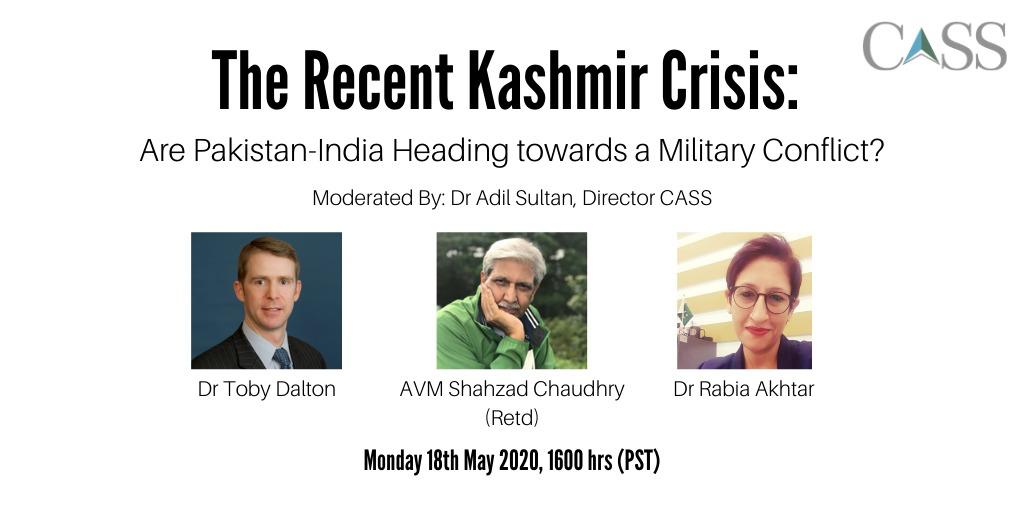
The India-Pakistan tensions along the Line of Control (LoC) are once again spiralling and could eventually end up into a serious military escalation between the two nuclear armed neighbours. The killing of a senior Indian Army officer and a leader of Kashmiri resistance forces have further heightened the tensions in the Indian Occupied Kashmir (IOK), for which India has once again blamed Pakistan. Owing to the growing international focus on India’s grave human rights violation in Kashmir and pogrom of the minority Muslim population in India, there is a likelihood that the right-wing Hindu extremist groups would try to deflect international attention and once again build a momentum for a military action against Pakistan.

To understand the evolving dynamics a webinar is being planned, which would aim to address the following key questions:

  • How serious is the current crisis and will it lead to a conflict?
  • What would be the role of the international community in preventing/ diffusing the crisis?
  • With the international community embroiled in managing the COVID-19 related crisis, would there be an incentive for the major powers to intervene and diffuse a military crisis, or both India-Pakistan will have to deal with it on their own?
  • With the international community embroiled in managing the COVID-19 related crisis, would there be an incentive for the major powers to intervene and diffuse a military crisis, or both India-Pakistan will have to deal with it on their own?
  • Does warmongering and hostile rhetoric make any sense in the current peculiar pandemic environment?
  • With India’s claims of surgical strikes being a “new normal” and Pakistan’s policy of “Quid Pro Quo Plus,” what could be the nature of a potential future crisis? And will a ‘surgical strike’ change the domestic Indian reality?
  • In view of the rising influence of Hindutva at the senior decision-making level, is there as a space to manage India-Pakistan relations through a dialogue?



Share this article

Facebook
Twitter
LinkedIn

Recent Publications

Browse through the list of recent publications.

The West: The History of an Idea

The world is witnessing the collapse of the Western order, if not the emergence of an alternative one. The idea of ‘West’ as against the rest is still at the root of contemporary understanding of world politics. Georgios Varouxakis, a remarkable voice on Modernity and Nationalism, has provided the historical origins and modern connotations attached with the idea of ‘West’. In his book ‘The West: The History of an Idea’, Varouxakis has argued that the West is not an eternal entity, rather it is a modern socio-political construct that emerged in the political philosophy of the early 19th century and evolved with the passage of time. The book provides an in-depth historical analysis of the idea to determine the roots of its modern interpretation.

Read More »

Space-Enabled Warfare in the 21st Century: Pathways for Developing States

Space has emerged as a distinct domain of warfare alongside land, sea, air, and cyber. Developed countries like the United States, Russia, and China possess offensive and support capabilities in space. In the shadowed expanse of Low Earth Orbit (LEO), where satellites operate like silent custodians, the 2022 Russian invasion of Ukraine transformed the nature of modern conflict. As Russian troops marched forward, the commercial satellites like Maxar and Planet, which are operated by Western firms, captured high-resolution imagery of Russian troops, providing real-time intelligence to Ukrainian commanders, unlike ever before.

Read More »

The US-Israel War on Iran: Objectives, Strategy, and Escalation Management

Zahra Niazi
‘States tend to overestimate themselves or the benefits and swiftness of war, and to underestimate their opponents’ capabilities, intentions, or the costs and duration of war.’ If anything, the 2026 war initiated by the United States and Israel against Iran shall be remembered in the annals of warfare among the most visible manifestations of this dynamic.
The war, immediately preceded by the January mass protests in Iran, did not represent a sudden rupture but rather the continuation of a 47-year-long confrontation and a more intense phase of the June 2025 war.
The US Secretary of War, Pete Hegseth, defined the war’s objectives as being laser-focused: to destroy Iran’s missile capabilities and its security infrastructure, while ensuring that it could never develop nuclear weapons. Beyond these stated objectives, among the priorities on the continuum also lay the objective of regime change, with both President Trump and Prime Minister Netanyahu explicitly calling on the Iranian population to take over the government at the outset of the war.

Read More »
