
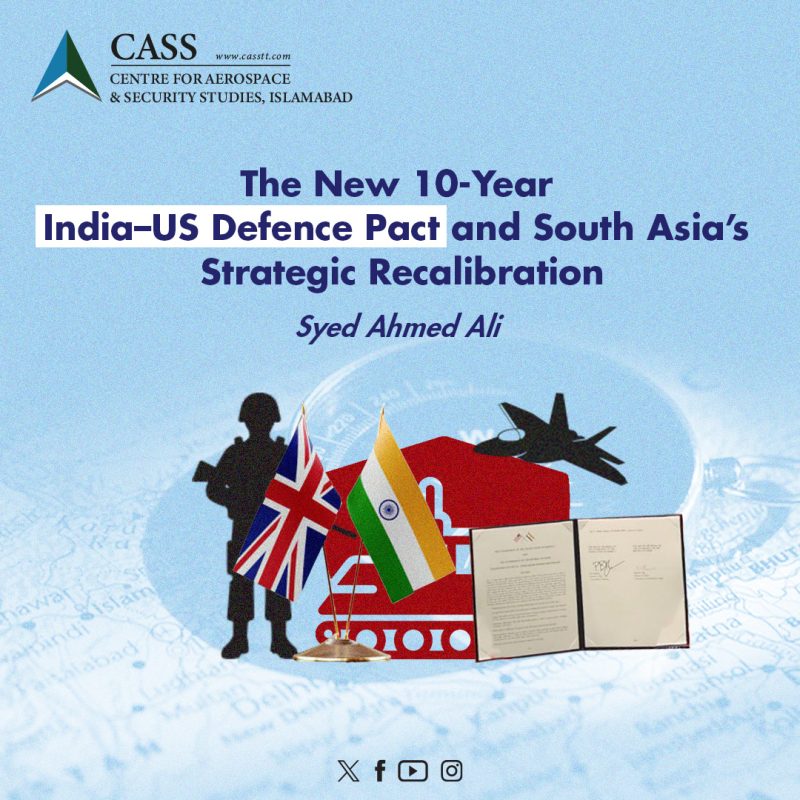
On 31st October, the United States Defence Secretary Pete Hegseth and India’s Defence Minister Rajnath Singh renewed the 10-year defence framework at the ASEAN Defence Summit in Kuala Lumpur. The defence agreement was previously signed in 1995, 2005, 2015, and 2025, has been recently extended to 2035. The pact serves two functions; firstly, it provides a framework to consolidate all the existing cooperation treaties like LEMOA (2016), COMCASA (2018), and BECA (2020). The second function is to provide a platform for future collaborative arrangements in new areas, such as joint defence production, the development of AI, and underwater and satellite communication. While the existence of the pact is not new, its renewal will, however, impact the security architecture of South Asia.
Since 1991, India has increasingly diversified its security requirements away from Russia and deepened its engagement with the United States. Currently, the US defence exports include P-8I Poseidon maritime patrol aircraft, MQ-9 Reaper drones, and GE F404 jet engines used in India’s local fighter HAL Tejas. In addition to increased defence imports, the United States and India have conducted joint exercises such as Yudh Abhyas, the Indo-Pacific Malabar Exercise, the Joint Air Exercise Cope India, the Tri-Service Exercise Tiger Triumph, and the Special Forces Exercise Vajra Prahar. Apart from military collaboration, India and the United States have recently signed a series of joint industrial cooperation agreements to boost New Delhi’s production capacity. In 2018, India was elevated to Tier 1 status for the Strategic Trade Authorization (STA), which provides access to advanced technology. In 2019, India and the United States signed an MOU for the Industrial Security Agreement (ISA), which enabled the transfer of classified information between defence industries. In 2023, a roadmap was launched to promote Industrial cooperation under the Initiative on Critical and Emerging Technologies (iCET) framework. In August 2024, last year, India and the U.S signed the Security of Supply Arrangement (SOSA), which would grant New Delhi a priority access to defence materials to prevent supply chain disruption.
The United States views India as a natural ally to curb Chinese influence in the Indo-Pacific region, and it supports this through defence assistance and mutual collaboration agreements. India, on the other hand, has often redeployed military assets intended for China to the Indo-Pak border. A notable example was observed in May this year, where an Indian P-8I maritime patrol aircraft was used to gather electrical and optical intelligence in the Arabian Sea. Access to high-end technologies through the iCET framework creates a unique challenge for Islamabad, where Indian military modernisation can be repurposed and used against Pakistan. Apart from technology, India can also utilise dual-use data agreements like BECA to gather critical intelligence on Pakistan’s strategic infrastructure.
Islamabad can look to diversify its strategic options to help balance Indo-US cooperation. Pakistan has abundant reserves of critical minerals like copper, nickel, zircon, and beryllium, which can be processed through a cooperative agreement with American companies. This will provide Pakistan with a steady supply of raw materials necessary for its manufacturing industry and promote the transfer of technology in the mining sector. Pakistan can also initiate cooperative agreements with various Shanghai silicon companies, which can facilitate joint production and technology transfer through a mutual cooperative agreement. Access to high-quality semiconductors is critical for consumer electronics, telecommunications, and the defence industry. To improve its navigation capabilities, Pakistan can arrange an agreement that can give access to Chinese satellite constellations. Through these measures, Pakistan may narrow the technological advantages India gains through its partnership with the US.
Pakistan finds itself amidst a great power competition between the United States and China, and must navigate through South Asia’s volatile environment. The Indo-US defence pact has a destabilising effect on the South Asian security architecture, as the ongoing arms race has primed the region for escalation. To deal with this challenge, Pakistan must adopt a balanced posture by maintaining a strategic equilibrium between China and the United States. To achieve this, Islamabad must engage with both countries while avoiding any broader entanglements. This will allow Pakistan to adopt a more flexible policy, enabling it to pivot between Washington to Beijing with respect to its national interests.
Author Bio: Syed Ahmed Ali is a research assistant at the Centre for Aerospace and Securtiy Studies (CASS), Islamabad, Pakistan. He writes on technopolitics and can be reached at [email protected]



