
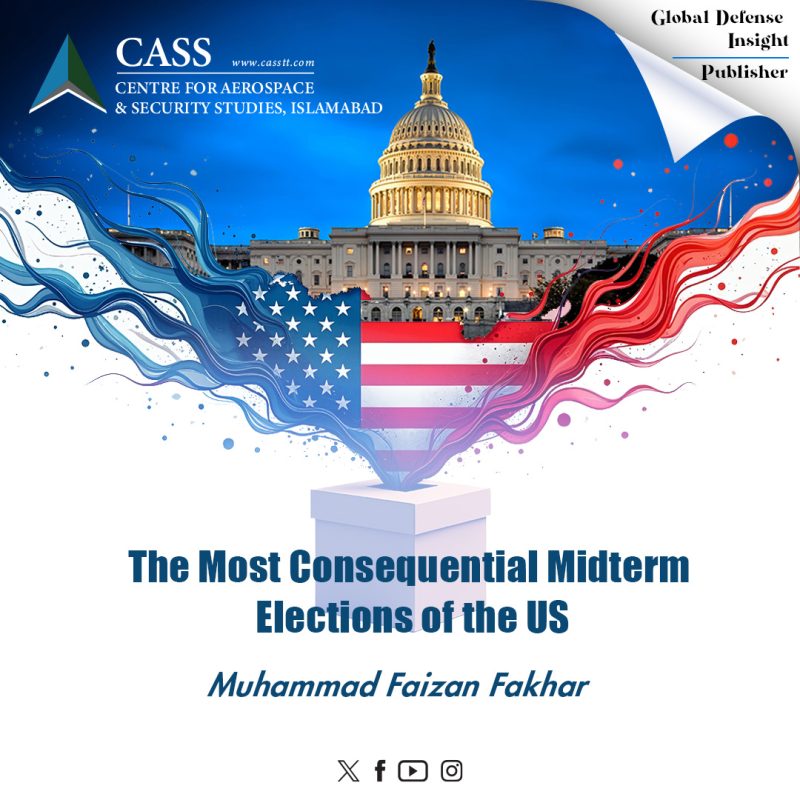
The US midterm elections will be held in November 2026, which can prove to be one of the most consequential midterms in the US history. The outcome of these midterms will influence the US economic strategies, domestic policies, as well as the global markets and geopolitical alliances. Being held amid escalating international tensions and deep domestic divisions, the result of these midterms will, therefore, carry considerable impacts extending far beyond Washington.
In the electoral process of the US, midterm elections are carried out near the midpoint of the four-year presidential term. During midterms, all 435 seats of the House of Representatives and one-third of the Senate seats are up for election. Thus, the results of these elections determine who gets to control the Congress. Since Congress influences everything, from legislation, spending, and oversight to the foreign policy direction of the US, the congressional control can, therefore, either limit or empower the policies of the incumbent administration. Consequently, any changes in the composition of the US Congress can bring a substantial power shift in the functioning of an administration. These elections not only serve as domestic check on the executive powers of the incumbent US administration but also as an indicator of public’s approval of the President’s policies. This midterm election is particularly significant due to the unprecedented national and international developments.
President Trump’s leadership style is marked by an assertive use of executive powers and regular confrontations with state institutions and even allies. So far, his second term has been defined by some bold moves on domestic and foreign policy fronts. The domestic political landscape of the US has become highly polarised under the Trump administration. As per the most recent polls, many US voters disapprove of President Trump’s flagship policies, with an approval rating falling to 36 per cent. Enforcement of his immigration policies has been one of the primary issues in the domestic politics of the US. Some of the key actions taken by Trump’s administration to enforce immigration policies include mass deportations, detentions, and strict asylum restrictions. These actions have caused outcry across multiple states of the US. In the year 2026 alone, at least eight people have died in Immigration and Customs Enforcement (ICE)-related incidents.
Massive protests and strikes have spread across the US after two US citizens lost their lives in shootings by ICE agents. Currently, the Trump administration is facing sharp condemnation by both sides of the aisle with democrats along with some of the Republicans calling for accountability of federal agents. These developments have also sparked debates about civil liberties, police brutalities, and federal overreach in the country. On top of this, the possibility of government shutdown also remains as the partisan differences on funding legislation grow stronger in the Congress. On the other hand, price hikes and increasing cost of living is also adding to the economic problems of the people. However, President Trump’s agenda has not only unsettled the domestic political landscape of the US but has also disrupted established international norms and long-term US alliances.
President Trump’s foreign policy approach is characterised by confrontational diplomacy, frequent policy reversals, the threat of the use of military force, and inconsistent messaging to allies and adversaries alike. The year 2026 began with a dramatic and bold military operation by the US in Venezuela. The US forces captured the President of Venezuela, Nicolás Maduro, and brought him to the US soil for trial. These actions were viewed as a clear violation of established international norms of state sovereignty and non-intervention. Moreover, such a direct intervention without any international or congressional backing could potentially cause further fractures in the international order. The US, under President Trump, has also been actively involved in some of the key contemporary issues in the Middle East. Tensions with Tehran are on the rise following the recent warnings by President Trump of military action against Iran over nuclear negotiations. These developments have added to the regional anxieties and drawn global attention towards stabilising the oil markets and achieving regional peace.
Similarly, the Greenland controversy triggered an international crisis as President Trump openly threatened European Union with 25 percent import tax and even hinted towards the use of military force to annex Greenland. Although President Trump reversed his stance at the 2026 Davos conference, his earlier statements ignited concerns of a wider US-trade war in the future. Moreover, this entire episode clearly reflected the approach of a confrontational diplomacy and President Trump’s potential to unsettle even the most long-standing alliance.
Economic and trade policy of the US is also a key point of concern for the international community. Under the second term of President Trump, steep tariffs, stringent sanctions, and protectionist measures have emerged as the principal manifestation of the ‘America First’ policy. However, the implementation of this policy has disrupted the supply chains and led to high economic costs for both the perceived US competitors and key partners alike. Tariff hikes have global ramifications as they can increase production costs and inflation as the global markets adjust to the changing US stances. Thus, the outcome of these midterm elections will be closely watched by the international community as they would signal whether such policies would persist or not. The midterm elections will serve as an early indicator for the US allies and adversaries of policy continuity or recalibration.
These upcoming elections could significantly alter the engagement of the US with the international community. If the Republicans are able to maintain their control of the Congress, the agenda of the current administration is likely to continue and could become even more assertive. On the other hand, democrats gaining a lead in the Congress could limit the executive freedom through intense oversight, especially in the areas of funding US military activities and trade negotiations.
Since any shifts in the political leadership and policy direction of the US have sharp implications for the entire world, the outcome of 2026 midterm elections will be noticed far beyond the domestic politics of the US. Changes in the trade, security and diplomatic policies of the US could result in new strategic partnerships and economic alliances across key regions of the world. Ultimately, the 2026 midterm elections of the US are far more than just a domestic contest, as they could become a pivotal moment in the global politics.
Muhammad Faizan Fakhar is a Senior Research Associate at the Centre for Aerospace & Security Studies (CASS), Islamabad, Pakistan.The article was first published in Global Defense Insight. He can be reached at: [email protected]



