
In the world governed by the nation-state system, Air power is considered to be an eminent symbol of national pride. The ability of a nation-state to develop air power by indigenous means signifies technological superiority of a state. In this context, India has ardently been promoting the self-construed narrative of indigenous defence production. The aim of this narrative propagation is two-fold: firstly, to promote Indian defence exports, and secondly, to immunise India from excessive dependence on foreign defence imports. However, the narrative seems to be falling upon its own foundations, reflected in the absence of Tejas in the Republic Day Parade of 2026.
The Republic Day Parade is a national symbol for the glorification of the defence and military capabilities of any state. Indian Republic Day Parade is also an annual ritual, but the 77th session was particularly significant as a comeback event after the embarrassing setback in the recent conflict against Pakistan. The ceremony was especially glorified under the emblem of ‘India for itself,’ yet the absence of Tejas dissolved the glory into disquiet and disappointment.
The 77th Republic Day parade strongly exhibited the paradox, where foreign fighter jets, including Rafales (French), Su-30MKI (Russian), MIG-29 (Russian), and Jaguar (UK), dominated the parade under the ‘Sindoor’ formation, yet the Tejas were not even allowed a glimpse. Tejas made their first and until now, the last appearance in the Republic Day parade in 2017. Even though the fighter-jets have been shelved for years, their absence in 77th session, in the post-2025 scenario, is an unintentional confession of the lack of institutional confidence. In 2025 India faced back-to-back embarrassing developments, from a major loss in air war against Pakistan in May 2025 to the tragic crash of Tejas at the Dubai Air Show. Therefore, the absence of Tejas has revealed more than India intended to project through the parade.
India’s indigenous fighter jet, Tejas, is the cornerstone of India’s Atmanirbhar Bharat strategy. As India’s first-ever indigenous, single-engine, multi-role, supersonic fighter jet, Tejas was a much-anticipated start to India’s vision of indigenous production. However, persistent delays in development and lapses in performance have raised serious concerns about the strategy of self-reliance in terms of defence production and the narrative around it. The Indian Air Force (IAF) chief himself criticised Hindustan Aeronautical Limited (HAL) and expressed disappointment over the delays in production, stating that the project is still not in the mission mode.
HAL justified the slippages in materialisation of the project due to the delays in engine supplies from a US-based firm. The justification indicates the extent of dependence on foreign technology and a major lapse in the attempt at self-sufficiency. Tejas, despite being an applauded achievement of Indian defence production, is a composite of foreign exported technologies.
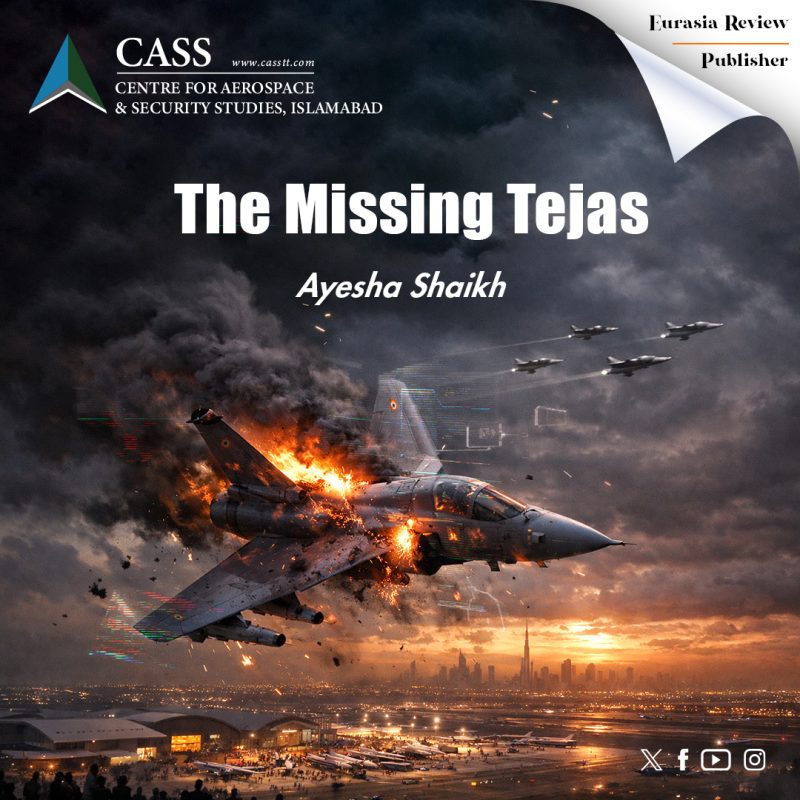
After witnessing the protracted delay in its production, when the fighter jet finally made it to its first international debut, it met with an embarrassing performance. From oil leakage to the subsequent tragic crash at the Dubai Air Show 2025, Tejas exposed the reason of long-held delay. Even though IAF and HAL readily attributed the accident to the pilot, who unfortunately lost his life during the plane crash, the Republic Day parade has revealed the other side of the story.
After repetitive, unfortunate accidents, first in Gujarat and then in Dubai, India has lost confidence in its indigenous fighter jets, as depicted by their absence in the national Republic Day parade. Even though Republic Day parades are the least demanding trial avenues for the fighter jets, with meticulously managed circumstances, HAL kept the jets reserved based on safety concerns over flying a single-engine jet in a densely populated area.
To add more to it, India’s growing foreign engagement for defence procurements further consolidates the confidence deficit. After the fall of Rafales in the May 2025 conflict, India has reached defence agreements with the United Arab Emirates (UAE) and the European Union (EU) to diversify its foreign procurements. This excessive ingress of foreign technology is likely to consolidate the dependence even more. Recession-induced demand and channelisation of budget towards foreign procurement, in addition to the confidence deficit, are thus likely to jeopardise the potential for indigenous defence development even more.
Thus, the Indian Republic Day parade, instead of being a manifestation of the state’s military prowess and strategic agility, has exhibited a trust deficit and incapability. Moreover, on a lighter note, as a superstitious nation, India should try to keep Tejas out of the parade to avoid any dark charms. Nonetheless, instead of earning India a place as a defence supplier in the global defence supply chain, it has highlighted India as a major defence market, yet not a reliable one. Thus, the dependence on foreign procurements will ultimately impact the indigenisation drive. Therefore, when a jet crashes, so does the vision of the state to depend on it for national defence.
Ayesha Shaikh is a Research Assistant at the Centre for Aerospace & Security
Studies (CASS), Islamabad, Pakistan. The article was first published in Eurasia Review. She can be reached at [email protected]



