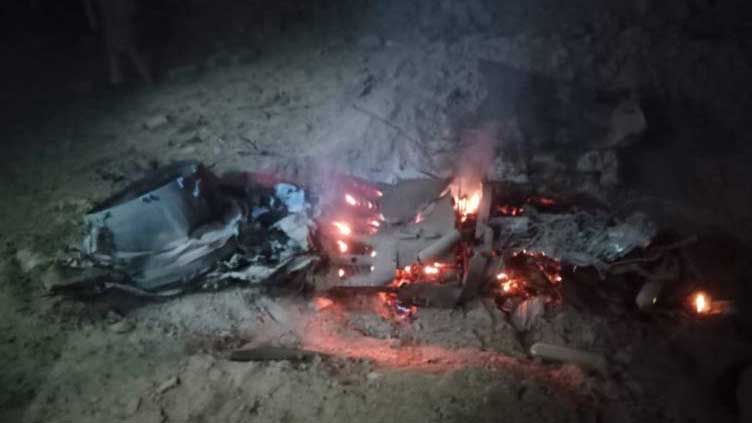
In a press conference on 10March 2022, Director-General Inter-Services Public Relations (DG ISPR) declared that Pakistan’s Air Defence Operations Centre (ADOC), detected a supersonic flying object on the evening of 9th March that was later confirmed as a BrahMos supersonic missile. According to ISPR, the missile which was continuously tracked by Pakistan Air Force Air Defense units since its launch, traveled for about 70 to 80 kilometers within Indian territory. It then took a sudden north western turn towards the Pakistan-India border, entering Pakistani air space and traveling 124 km inside Pakistan at an altitude of 40,000 feet and speed of up to Mach 3. The missile landed at Mian Channu, Khanewal district of Punjab province, with no human casualties but damaging some civilian property.
The next day Indian Press Information Bureau’s Defence Wing issued a statement stating, ‘On 9 March 2022, in the course of routine maintenance, a technical malfunction led to the accidental firing of a missile. It is learned that the missile landed in an area of Pakistan. While the incident is deeply regrettable, it is also a matter of relief that there has been no loss of life due to the accident.’
If the missile got fired inadvertently as officially claimed by India, then the Indian technical and technological capacity to control or mitigate a missile after accidental launch is questionable. This is a serious threat to regional stability as the geostrategic environment in the region is already tense and such a mishap could have triggered a full-scale war between two nuclear-armed states.
What’s worse, an article published in India’s The Print titled “Missile accidentally fired ‘during inspection’ at secret IAF base, Pakistan ‘didn’t track’” attempted to give the impression, citing anonymous sources, that the launch was deliberate and under controlled conditions and not an accidental. One of the article’s anonymous sources gives several statements that are contradictory in nature. The author states that it was a practice version of the BrahMos missile and it followed the trajectory that it would have in case of a conflict, but ‘certain factors’ played a role in ensuring that any pre-fed target was out of danger. The statement indicates an intentional activity with certain pre-determined objectives in mind. Now, if by using a practice missile, it is being indicated that no bloodshed was intended then the question arises, what was India trying to achieve through this cross-border international launch of a tactical ballistic missile?
Secondly, the author claimed that the missile was not launched from Sirsa but some other ‘secret’ satellite base whereas the flight path shown at the media brief of ISPR identified that the missile was picked up by Pakistani radars over that area. The author has completely disregarded/missed the technical/technological aspects of the theories of radars, capabilities of air defence assets and international diplomatic norms.
Thirdly, the article claims that India had already informed relevant Pakistani authorities of the accidental launch long before ISPR held a press conference on Thursday night. It further adds that the source refused to divulge the specific time and official level at which Pakistan was informed. However, there is absolutely no mention of any such communication in any of the official statements issued by the Government of India (GoI). Since Pakistani officials stated that no information was passed on through any channel, be it the military hotline or any other mode, and the so-called sources in the GoI insist that information was passed to Pakistan; then proof of official communication, including its time and the offices used should be made public. Why is this information being kept secret?
Fourthly, the author (citing sources) claimed that because the missile traveled for 124 kilometers inside Pakistani airspace and the ISPR media briefing was held after more than 24 hours had passed since the missile landed, it is indicative that Pakistan was unable to track the trajectory of the missile. This blatant lie was addressed, during the ISPR media brief, where Air Vice Marshal Tariq Zia, through visual data, publically displayed the missile trajectory and it being tracked by Pakistan’s air defence assets. Thus, the author’s claim holds no ground, rather it highlights his absolute ignorance regarding the military and technical capabilities and procedures. Lastly, the article also states that Pakistan has sought details of the missile’s flight path and how it changed its direction mid-flight. These details have been asked for not because Pakistan does not have this information but to ascertain how this so-called ‘mishap’ happened and what management processes were adopted to avoid this cross-border ‘attack’.
The article in The Print is, therefore, is highly misleading, technically incorrect and has unsuccessfully attempted to dispel the notion that Indian authorities failed in maintaining, securing and safeguarding her strategic assets.
Whether this entire incident is an intentional act or a mishap, such irresponsible behaviour by India could have led this region into full-fledged war with disastrous consequences. India, under Prime Minister Modi, has become a rogue state with no respect for international law and on multiple occasions, the BJP government has undertaken similar misadventures (such as the failed Balakot strikes) to divert public attention from internal issues of misgovernance or to gain political mileage.
The real tragedy remains that while internationally, India’s narrative on the missile launch was accepted; had a mishap of this nature happened from Pakistan’s side, the international response would have been altogether different.
The writer is a researcher at the Centre for Aerospace & Security Studies (CASS), Islamabad, Pakistan. The article was first published in Strafasia. He can be reached at [email protected].
Image source: Dunya News. 2022. “India admits mistake of missile in Pakistan’s Main Channu.” Dunya News. March 11. https://dunyanews.tv/en/Pakistan/644945-India-missile-Pakistan-Mian-Channu