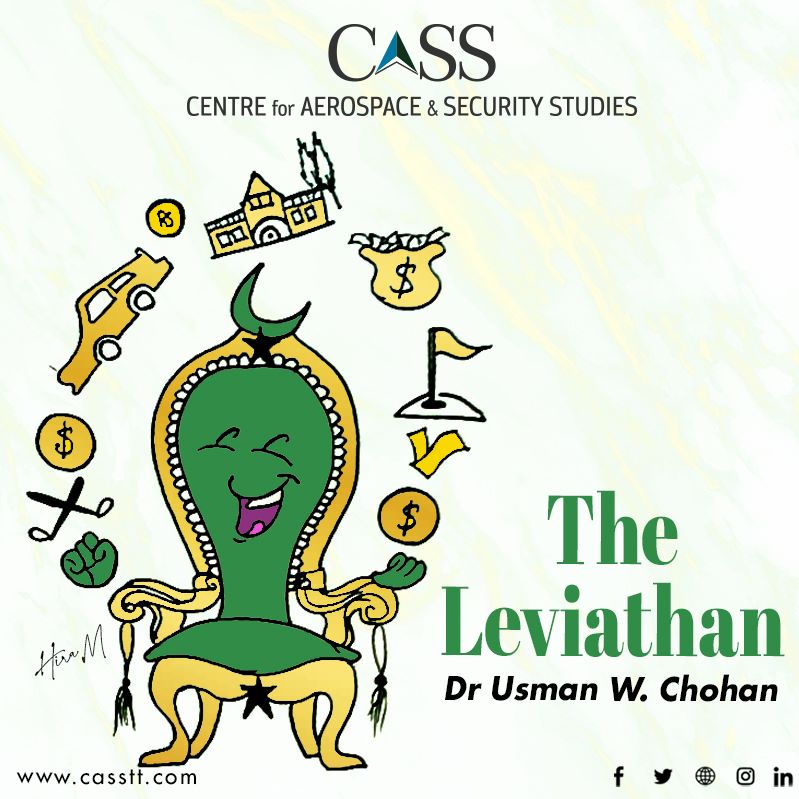
One of the most important areas of contention between Pakistan and the International Monetary Fund (IMF) has been on the privileges of government functionaries, and it has, therefore, entered the popular discourse in mainstream and social media in recent times. However, the swelling of provincial and federal bureaucracy has happened over a very long period, beginning with its rudiments in an extractive colonial system, whose vestiges have not just survived but thrived 76 years later. In echoing a significant left-wing corpus of research, it could be argued that having a large government would make sense, if it were creating significant public value. However, there are no Pakistani citizens who could make the claim that the government is providing adequate public value, and this would also be the admission of government officials as well. This is why the right-wing argument of smaller government, of curtailing the Hobbesian ‘leviathan’ of the state, makes sense in Pakistan’s context.
It is a source of consternation that the current size of the Cabinet, for example, comprises 88 people including advisors and special advisors. To put it in perspective, the United States has a cabinet of 25 persons (including the Vice President) who run not just America, but the world. The fleet of UK government vehicles is less than 50, but the Sindh government alone has a fleet of 25,000. There are politicians, judges, generals, and civil bureaucrats who travel with retinues half the size of the UK government vehicles. The number of restricted golf courses, clubs, and other high-maintenance areas relegated to officer coteries, and their usage is drawn at the expense of the public purse. The Lahore Gymkhana has a 50-year lease for its prime estate that is equivalent to PKR 5,000 payment (USD 18) per year for the entire estate. The list of such abominations is unceasingly long, but it culminates in the fact that Pakistan’s economy is at the juncture it is at today, because of these.
In a recent seminar held at CASS, the obscene size of the public sector was highlighted by various speakers on public sector deficiencies. The conclusion was that we live very much in the Raj, but in fact in a ‘Raj on steroids’ as one speaker put it. What has long been lambasted as ‘VIP culture’ in Pakistan is, in fact, a deeper malaise of public disvalue by the government. It is very much the case that all of the 20th Century right-wing critiques of the government’s burden on the economy, whether they apply to the US anymore or not, certainly do apply to Pakistan.
There was a movement in the 1980s known as New Public Management (NPM), which argued for the sorts of reforms that slimmed down government and brought it to heel by grounding it in a private sector mindset. In the West, NPM has gradually receded and lost credibility, largely because the scope of reforms went too far. However, the essence of NPM still has an important target market in Pakistan, where an NPM mindset is really the first step towards curbing the leviathan.
As the recent negotiations with the IMF illustrate, the key areas of reduction will involve (1) squeezing the general public (commodity levies); and (2) cutting the size of the leviathan (the government). The former is an unfortunate aftereffect of the latter. But the impact has to come from an altered psyche. Pakistan must win its freedom struggle, 76 years after 1947, from a colonial Raj. The youth must aspire to something other than a sarkari naukri (‘bureaucratic gig’) as the be-all-end-all of career life. With the dismal public value provision of government, it isn’t the ultimate aspiration, nor the premature welfare base upon which to occupy a desk, do shady deals, and enjoy public-funded (or IMF-funded) perks. The summation of what must be done in government is that whatever is being done now, the opposite must be done going forward.
Dr Usman W. Chohan is Advisor (Economic Affairs and National Development) at the Centre for Aerospace and Security Studies, Islamabad, Pakistan. He can be reached at [email protected].