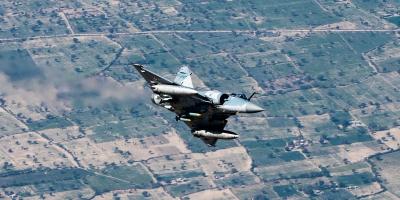
On Feb 28, 2019, the Indian Ministry of Defence arranged a joint press briefing to salvage the reputation and professionalism of the Indian armed forces following their own foolish and unbelievable ‘surgical strike’ in Balakot area of Pakistani side of Azad Kashmir, Pakistan’s counter strike in response, not only was highly successful but also yielded the ultimate prize of two Indian Air Force fighters being shot down and one pilot being captured. Maj Gen Surinder Singh Mahal, Rear Adm T S Gujral and AVM Kapur were paraded before the press to provide incontrovertible ‘evidence’ to prove that IAF operations were highly successful while PAF’s were a failure.
What they implicitly managed to prove was the exact opposite. The press briefing started two hours late. The three services’ representatives appeared confused and under-confident. They were being forced to say something when they had nothing to say. They couldn’t provide evidence about the damage they had caused during the surgical strike, or of the F-16 they claimed to have shot down. They sought take moral high ground that they had attacked non-military targets while Pakistan had escalated the conflict by attacking military targets. When the media pressed for details, the spokespersons tried to hide behind the scope of the briefing and operational confidentiality. To a question as to what Indian forces would do henceforth, the answer was: ask him [sic] meaning Pakistan.
The earth-shaking evidence that was shown was a damaged part of an AMRAAM 120C missile. The details imprinted on the shown part when checked with indicated that these missiles had been sold to Taiwan.
Thus the only truth they were able to establish was that F-16 did undertake some operations. That’s hardly a fact worth mentioning. Once taken on, they couldn’t prove that F-16 had been shot down. As a Pakistani observer it was heartening to see the disarray the PAF operations had caused in the Indian armed forces, especially to IAF. The later would be forced to reevaluate its strategy and tactics. They would oscillate between desperation neither to respond and caution nor to repeat their mistakes.
The press briefing illustrated the truism: that truth gets out of a crack, while falsehood gets stuck in a doorway. In the instant case, it seemed to stick in the throats of the Indian spokespersons. The truth is that whatever PAF has claimed as its success, is backed by evidence, which would be released at an opportune time. The Indian armed forces may seem to be winning the war of trolls on social and electronic media, but the PAF has won the first two rounds. Without being triumphant, PAF realises and awaits the challenges of the ongoing hostilities. As always, the righteousness of its cause to defend the nation, it is prepared for the long haul. India on the other hand carried out aggression following a pre-meditated conspiracy by Narendra Modi to carry out a false-flag operation, killing its own soldiers with the malicious intent to blame it on Pakistan. Whatever ensued on Indian media was a make-believe narrative aimed at getting votes for BJP in the imminent elections by stoking anti-Pakistan sentiments. Only time will tell that whether PAF had thwarted Modi’s reelections?
The writer is the President at the Centre for Aerospace and Security Studies. He can be reached at [email protected]