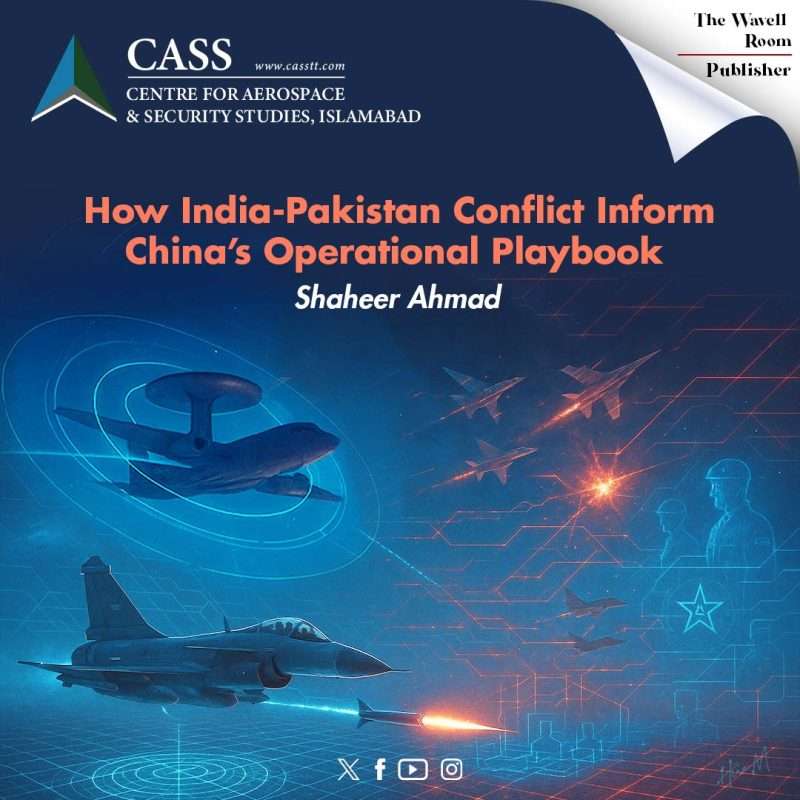
The four-day India-Pakistan (7-10 May 2025) military crisis showcased a real-world glimpse of how near-peer militaries will face each other on the future battlefield. This high-tech military showdown was of immense significance for the People Liberation Army (PLA), which has been monitoring the global conflicts—the Russia-Ukraine war, the Nagorno-Karabakh conflict and the Syrian civil war—to draw operational lessons, adaptation tactics and foresight to prepare for the potential conflicts in its backyard.
Featured between the two nuclear-armed rivals, the conflict witnessed the employment of advanced weaponry such as long-range beyond-visual-range-air-to-air-missiles (BVRAAM), surface-to-air-missile (SAM) systems and top-of-the-line fighter jets inventory. Pakistan deployed its top-of-the-line J-10C Vigorous Dragon and JF-17 Thunder fighter planes, HQ-9 air defence system, and PL-15 BVRAAM against India’s premium inventory comprised of Dassault Rafale, Su-30MKI, and MIG-29s. During the intense aerial exchange, Pakistan’s downing of five Indian fighter jets, including top-of-the-line Rafales, demonstrated its sophisticated tactics, employment modalities and peacetime readiness.
The crisis came as an optimal moment for China, which has not been in active combat since 1979. The successful demonstration of Chinese high-end weaponry against the relatively superior Western weaponry underscores China’s preparation and anticipation of future conflict with strong adversaries.
In 2019, China’s State Council published a white paper, China’s National Defence in the New Era, which noted that the international military landscape is witnessing rapid transformation. The document emphasised multi-domain and trans-theatre operations to facilitate jointness among all service branches. To achieve synergy among its service branches, the Chinese military has integrated cyber, space and information domains under the multi-domain warfare (MDW) concept. It has also developed a robust data link architecture to enable the seamless integration between fighter jets, airborne early warning and control (AWACS) aircraft and other supporting units. These data links augment combat efficiency by supporting coordination among various assets, allowing rapid target data sharing and providing missile guidance. Theoretically, they also help the Chinese military to overcome the bottleneck of information processing during live combat. The more interoperable these data links are, the faster the execution of the OODA loop in real-time combat.
In the 100-hour India-Pakistan conflict, both sides were engaged in what the Chinese called ‘system-to-system’ confrontation. Pakistan’s indigenously developed Link-17 enabled it to execute a sequenced kill chain in a multi-domain environment. During peacetime, Pakistan has enhanced its situational awareness by integrating its ground radars, fighter jets, and AWACS aircraft. Relatedly, it has been engaged in a series of large-scale exercises such as Indus Shield. This peacetime readiness allowed Pakistan to simultaneously lock, target and destroy the enemy’s airborne assets in a high-speed environment.
According to the South China Morning Post, Pakistan Air Force deployed ‘A’ launched by ‘B’ and guided by ‘C’ method to stage an ‘air ambush’ for the Indian fighter jets. Visualising hypothetically, Michael Dahm, a prominent aerospace expert at the Mitchell Institute, stated that Pakistan’s kill chain may have started with the locking of the Indian airborne targets by a ground-based radar. Then, a J-10C Vigorous Dragon launched its PL-15 BVRAAM from a standoff distance, and finally, an AWACS guided the missile to the target by using a midcourse data link. This kill chain is comparable to what the US is trying to create among its services through the Combined Joint All Domain Command and Control (CJADC2) concept.
On the contrary, India posseses an assortment of Russian, French and Indian systems in its inventory. The variety in these assets causes the issues of integration and interoperability that make India’s mainstay weaponry vulnerable in a high-staked combat environment.
The recent military crisis demonstrates that China is aptly reading the evolving intricacies of the future battlefield. The contest between the high-tech systems of the near-peer rivals has demonstrated that future warfare will involve a kill chain-vs-kill chain scenario in a multi-domain environment. Instead of annihilating the opposing forces, targeting the adversary’s operational systems, command and control nodes and paralysing its kill chain is central to achieve a strategic paralysis.
The military face-off thus served as a trailer for China regarding the impending conflicts between the near-peer adversaries. It demonstrates that the mere firepower exchanges and territorial jurisdictions cannot encompass the comprehensive competition in physical and non-physical domains. The PAF’s employment of Chinese weaponry in a multi-domain concert resonates with China’s system-versus-system warfare, where destruction of the operational system is key to render the adversary impotent on the battlefield. Seeking to learn without fighting, the PLA’s advancements in joint and all-domain capabilities show its anticipation of how future conflicts will unfold in its geopolitical courtyard. By accelerating military innovation in peacetime, China has established its operational art and playbook to fight the first war of the fourth industrial revolution.
Shaheer Ahmad is a Research Assistant at the Centre for Aerospace & Security Studies, Islamabad. The article was first published in The Wavell Room. He can be reached at [email protected]