
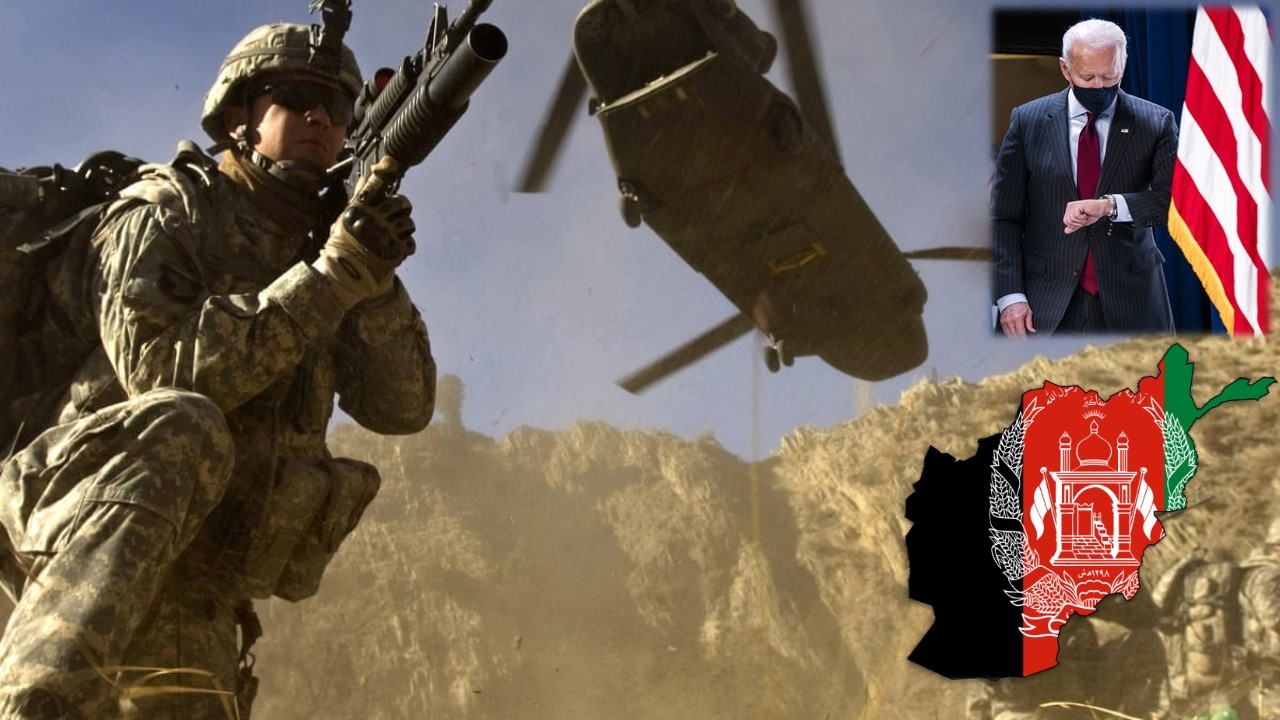
Following signing of a peace agreement between the US government and Afghan Taliban on February 29, 2020, which established a timetable for withdrawal of US forces from Afghanistan in May 2021, the new Biden Administration has reviewed its Afghanistan strategy. In the light of the US government’s latest Interim National Strategic Security Guidance 2021, which outlined its vision for how it would deal with the world, the Biden Administration had indicated a firm commitment to end America’s “forever wars,” including in Afghanistan, and has now announced to withdraw all troops from Afghanistan by September 2021.The interim security guidance also called for an advanced force posture in the Indo-Pacific, given its importance due to US interests in the region, with China seen as one of its largest competitors and Russia as a secondary threat.
Without a closer study of Afghanistan’s current and changing defence, political, and economic landscapes—and their effects on US strategic goals—the future of US policy cannot be effectively assessed. Observers of Afghanistan today are unanimous in their assessment that the security situation in the country is deteriorating. The national political situation is bleak, and widespread corruption in government institutions continues to undermine the regime’s effectiveness and legitimacy. The economic situation is difficult and unlikely to change substantially or rapidly. Therefore, there is no absolutely no doubt that the country’s security and economic situation has been waning continuously after 9/11.
In past US policies on Afghanistan, President George W. Bush, e.g., made it clear after the 9/11 attacks that he wanted a swift, mainly military-focused response. The main goal was to reduce the risk of attacks on the US and its allies from Afghan territory. The military operation went on despite the fact that Afghanistan was on the verge of collapse in 2009 and the US lacked a proper counterinsurgency (COIN) strategy. During his presidential campaign in 2008, Barack Obama made Afghanistan a key part of his national security agenda, and in December 2009, he chose the heavy footprint option by sending an additional 30,000 troops to Afghanistan as part of a troops’ surge. Following the inability of this surge to deliver a clear victory, the US began a drawdown in July 2011, with the NATO war mission officially ending in December 2014.
In 2015, Afghanistan’s overall political situation was described as a stalemate. Although the Afghan Taliban had battlefield success, they were unable to convert this into a significant political gain, such as overthrowing the Afghan government. Afghanistan remained stuck in a protracted conflict with no end in sight for either side.
The Afghan war entered a new phase with President Donald Trump’s election in 2016. Some critics, including White House aides, had suggested that the US should send more conventional troops to break the conflict’s years-long impasse. The Trump Administration’s first step in charting a new course for the war was to determine a clear and actionable goal. For the military’s continued involvement, Trump agreed to move from a timeline-based approach to a conditions-based approach.
The Trump administration began direct talks with the Taliban in July 2018, without the participation of Afghan government officials, reversing a long-standing US policy of prioritizing a “Afghan-led, Afghan-owned” reconciliation process. On February 29, 2020, after more than a year of official talks between the US and Taliban leaders, the two sides reached an agreement, laying the groundwork for American troops’ withdrawal and talks between Kabul and the Taliban.
Hark 2021! Biden’s challenge in Afghanistan is now one of the most difficult. The so-called peace agreement, on the one hand, is in jeopardy, given the increase in attacks in and around Kabul. Furthermore, Afghan leadership is also suspicious about the Taliban’s intentions and the peace settlement. As a result of all of this, Washington began sending mixed messages. Though Biden was once one of the most vocal advocate of withdrawal from the “endless” Afghan war, he took time to review his Afghan Policy. As per his latest statement, he will not follow the deadline of May 2021 for troops’ withdrawal, rather has chosen a new date September 11, 2021, which will complete two decades of the US’ longest war in Afghanistan.
The Afghan Taliban, who had warned of resuming attacks on the US and its allies in case the deadline set by President Trump last year was not followed, are yet to unfold their revised strategy given this new Biden date. However, they have refused to be part of any US-backed future engagement.
The overall scenario suggests, first, that the Biden Administration is making serious efforts on the ground to make the withdrawal of its forces in Afghanistan possible, but it will take a lot of tough and timely decisions for these efforts to bear fruit. Second, the US has realized that hard power has not resulted in goodwill or advancement of US interests in the region. Third, it is clear that the US is constantly reviewing its Afghan strategy, which suggests that the recent announcement of withdrawal is the result of a well-calibrated policy thought process.
As the US prepares to leave Afghanistan and revise its global engagement policy, pressure on Pakistan has significantly increased to play its vital role to restore peace in the region. Pakistan’s Foreign Office Spokesperson has urged that the troops’ withdrawal must coincide with the ongoing peace process and should be in coordination with the stakeholders in Afghanistan.
President Biden has also asked countries in the region such as Pakistan, India, Russia, China and Turkey to do more which signifies that the US now has priorities that are beyond Afghanistan’s internal stability. No matter what those priorities are, the aim of the US military should be to leave Afghanistan in a way that prevents the country from becoming a safe haven for foreign terrorists again. The fundamental problem has always been that without a stable and secure Afghan government in control of its entire territory, terrorists would continue to seek refuge in Afghanistan—and no Afghan government has ever been able to defend the country on its own.
Etfa Khurshid Mirza is a researcher in the Nuclear and Strategic Affairs program at the Centre for Aerospace & Security Studies (CASS). Her area of interest is emerging technologies and warfare.The article was first published in International Affairs Forum (IAF). She can be reached at @sky_limiter.



