In what is being seen as a major White House initiative to bring countries back together on issues of climate change, the Biden administration has released a list of 40 countries that will serve as participants in the Leaders for Climate Summit. Surprisingly, Pakistan is not on the list of countries invited to participate in this widely trumpeted two-day event. Given how proactively the Pakistani government has moved on climate resilience, this seems to be an unusual oversight from the Biden administration, and may help us to venture guesses as to why the White House would slip up in this manner.
The first guess might be that Washington is rallying allies together to seek a common front on climate action, but then it would not have invited rival powers such as China and Russia. The second guess might be that major polluters would be given invites only, but then little minnows like Antigua and Bhutan, which are also doing quite well in keeping a low carbon footprint, would not really need to be given an invitation. A similar third guess would be that large populations in the third world would be a downscaled priority, but then the White House wouldn’t invite the Congo or Nigeria, which it did.
So what is the yee-haw logic behind making an obviously flawed invitation list on such an important issue? Pakistan has the fifth-largest population on earth, and ranks 8th in the Global Climate Risk index. It is also a country that has put climate change as front-and-centre in its national security calculus. This was a fact evidenced at the prestigious Islamabad Security Dialogue, where I moderated Session #2, focusing on economic security. Not only did climate change feature as a key theme in the session on human security (Session #3), where the Ministry for Climate Change’s head Malik Amin Aslam was a panelist, but the theme also featured equally prominently in Session #2’s deliberations on economic security.
One of our panelists, the eminent Harvard professor Joe Aldy, was a key figure in the Obama administration’s efforts to tackle climate change, and his discourse centered Pakistan’s economic concerns around the need for climate resilience. He argued that climate security and energy security were both foundational guarantors of economic security in the 21st century, and four other panelists shared his observations by also emphasizing the importance of climate in our economic security. In other words, the most significant and recent national conference that deliberated on Pakistan’s security strategy forcefully described climate action as an issue of capital importance, and that too through several lenses (human security, economic security, etc.)
Evidently, Pakistan is not a country that takes its climate-based responsibilities and future challenges lightly. Its government has been proactive in pushing climate-friendly policies, generating eco-oriented employment (e.g. tree plantation), and raising public awareness about the societal imperative for climate resilience. Therefore, the omission of Pakistan from the list of invitees to the Leaders for Climate Summit is grossly unwarranted. In fact, not only is Pakistan a conspicuous omission, but an equally glaring one is the Philippines,which also has a large population strewn across a climate-vulnerable archipelago, but it also ranks higher than Pakistan on the Global Climate Risk Index; and its government is also undertaking a wide-range of eco-sustainable projects in various domains to build climate resilience.
It appears that the Biden administration’s approach to solving the “wicked problem” of climate change resembles the yahoo approach of a cowboy, and that too in two distressing ways. First, it is a cowboy-mentality in its “shoot from the hip” approach, inviting a mish-mash of 40 countries out of a global community of 193 nations, several of which are not even climate-significant. Secondly, and worse still, is that the Biden administration appears to be actively politicizing the domain of climate action. This is an outburst and aftershock, perhaps, of the excess politicization of climate policy within the United States, as the earlier Trump administration’s gun-blazing onslaught on climate efforts showed. Biden’s administration is picking willy-nilly countries for dialogue on climate, when in fact it should be acting as a world leader, leaving the politicization of climate coalitions to the side.
This is especially true because climate change is an issue where so many countries, independent of their stance towards the US government or the American people’s gross overconsumption of the earth’s resources, would be happy to meaningfully engage. In the same way that cowboys would deliberately antagonize native peoples and create politicized divisions over lands before stealing them, the Biden government is unnecessarily politicizing the domain of climate action, when what is really needed is a united global effort that recognizes climate-friendly governments and nudges eco-unfriendly ones. Given that the summit is to take place virtually in late April, it still isn’t too late to invite more countries, including Pakistan, to join hands in a laudable goal.
The writer is Director for Economics & National Development at the Centre for Aerospace & Security Studies (CASS). This article was first published in DailyNHT Newspaper. He can be reached at [email protected]
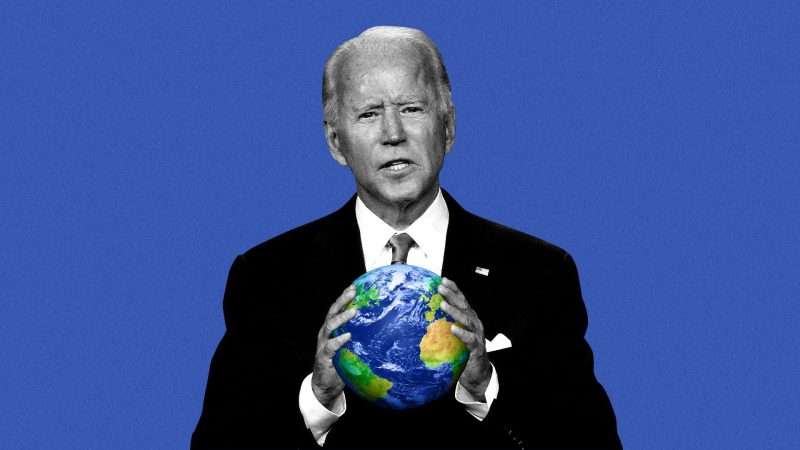
Image Source: Aïda Amer/Axios. Getty Images photo: Win McNamee