
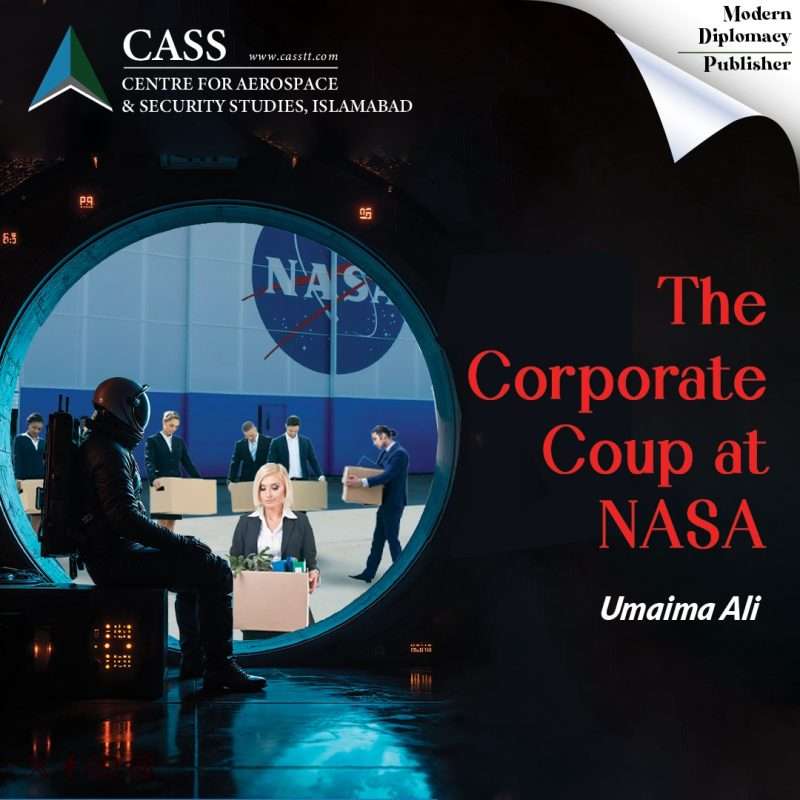
‘Houston, we’ve had a problem’ — these famous words were first spoken from space in 1970 during NASA’s Apollo 13 mission after a catastrophic explosion. Today, it seems Houston has a problem again — but this time, it is not in space but right here on Earth.
For more than 60 years, NASA has pushed the boundaries of scientific and technical limits to explore space. It has seen successes, failures, and even successful failures. Today, it faces the closure of three key offices and the elimination of 23 positions as part of an ongoing workforce reduction initiative under President Trump’s Department of Government Efficiency (DOGE) Workforce Optimisation Initiative. Elon Musk, the world’s richest businessman, is leading this effort. DEI (Diversity, Equity, and Inclusion) at NASA is being dismantled, and Musk claims to have saved USD1 billion in DEI contracts. This Musk-Trump shake-up begs the question: Is NASA’s increasing dependence on private corporations marking the beginning of its decline?
Leadership changes at NASA undermine the agency’s independence. NASA’s Acting Administrator, Janet Petro, was appointed by President Trump in January. Soon after, Petro named Michael Altenhofen, a longtime SpaceX employee, as Senior Adviser at NASA. This move raised concerns about conflicts of interest between NASA and Musk, frustrating high-ranking staff and eroding trust in the agency’s current leadership. Over-reliance on the private sector will lead to reduced government accountability and less transparency in decision-making. Notably, Trump has nominated billionaire Jared Isaacman, another SpaceX investor and close ally of Musk, to become NASA’s next administrator. In the long run, private influence over NASA could transform the national-interest-driven institution into a profit-driven business.
Downsizing NASA scientists, reducing diversity, and changing leadership might initiate a brain drain from the United States (US). According to a NASA employee, the brain drain will affect not only current missions but engineering and science for generations to come. A brain drain might sound like a reshuffling of talent, but for science, it is a fracture. According to employees, NASA is losing top experts due to increasing surveillance, political scrutiny, and fear-driven resignations. Inevitably, skilled engineers and scientists leaving NASA due to job cuts could migrate to foreign space programmes. For example, in the 1990s, the return of developed world-trained skilled professionals contributed to Taiwan’s growth in the semiconductor industry, which originated in Silicon Valley.
NASA has been collaborating with the private sector since its inception. Around 85% of NASA’s annual funding is spent on private sector contracts. Under the Trump Administration, NASA is being steered toward a Mars-centric agenda, allowing Musk to pursue his long-term vision of colonising the planet. This shift comes as Musk, Isaacman, and advisors of Trump criticise NASA’s moon programme, such as its USD 24 billion Space Launch System (SLS). Due to budget overruns and delays, Boeing, the primary contractor for SLS, plans to lay off employees. If SLS is abandoned, SpaceX will be the primary beneficiary.
Historically, NASA has prioritised reliability and mission-specific design while Starship prioritises reusability and scalability. Ironically, not long ago, NASA attempted to rein in SpaceX by pressuring it to change its business model. Today, the power dynamic has reversed — Musk’s Mars-first strategy is being imposed on NASA. The question is: if NASA follows Musk’s lead on Mars today, will tomorrow’s NASA adopt SpaceX’s ‘fail fast, learn fast’ business model?
Despite private sector influence, the state has a stake in the game, with SpaceX potentially becoming the Pentagon’s stairway to move military cargo around the globe. This dual-use dynamic was further reinforced in February 2025 when NASA awarded SpaceX a USD100 million contract to launch a new space telescope and USD300 million for its Pandora mission launch. These government deals provide SpaceX with direct access to defence and intelligence. While the downsizing of NASA serves Pentagon interests to some extent, SpaceX gains the most.
The Trump-Musk overhaul of NASA risks undermining US space leadership at a time when China’s space programme is rapidly advancing. Notably, Starship’s technical risks could delay the attainment of NASA’s objectives. China’s state-led model has already achieved a historic milestone as the country becomes the first to return samples from the far side of the Moon through Chang’e-6 mission. In addition, China aims to send astronauts to the moon by 2030 and retrieve the first samples from Mars.
Running NASA on commercial lines will also have security implications. The ‘Musk-confidence’ under the Trump Administration could make NASA lose regulatory control over mission priorities and technology development. Traditionally, corporate leaders operate through lobbying or advisory roles, but Musk is now shaping NASA and federal policy directly and visibly and not from behind the scenes. When President Obama was elected in 2008, a panel led by Norm Augustine, former head of Lockheed Martin, concluded that Constellation was unsustainable, so NASA’s priorities were shifted to lower Earth orbit. Unlike Augustine’s independent assessment, Musk and NASA’s interdependence has already reshaped the agency’s direction.
It is important to continue public and private collaboration rather than giving complete control of a public institution over to the private sector. This dual-track strategy could leverage the efficiency and innovation of private companies while preserving core, government-led programmes. A balanced portfolio can safeguard mission-critical capabilities and reduce dependency on any single commercial partner. A key lesson here for Pakistan is to capitalise on the private sector’s efficiency by fostering Public-Private Partnerships (PPPs) in space technology while ensuring that government-led programmes retain strategic decision-making authority.
Umaima Ali is a Research Assistant at the Centre for Aerospace & Security Studies (CASS), Islamabad.She can be reached at [email protected].



