
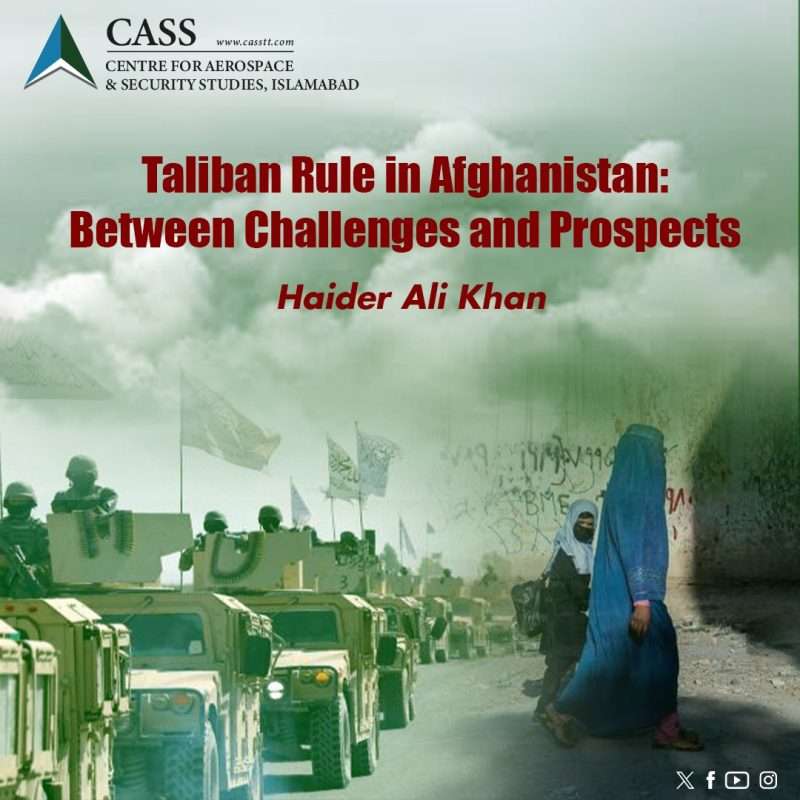
Afghanistan stands at a crossroads, grappling with governance, international isolation, and economic challenges – a precarious situation with deep ramifications for regional security. Challenges mainly stem from the complexity of the Afghan social structure, long periods of political instability, and a history of conflict. On the other hand, Afghanistan’s geostrategic location offers opportunities for regional trade and connectivity. Regional stakeholders too, have vital interests in Afghanistan’s stability, however, the country must overcome issues of inclusivity, institutional reform, and international legitimacy.
At present, Afghanistan seems to have achieved relative stability as compared to the times of the Taliban takeover in mid-2021. Major resistance to the regime has been curtailed, but this remains contingent on strict control and harsh measures. However, the Afghan people are beset with economic degradation, humanitarian crisis, and a lack of institutional framework, which could potentially destabilise the country.
Re-modelling the governance structures has produced mixed results so far. Part of the reason for reforming governance was to abolish structures established by the former Afghan republic. One of the most notable changes was restructuring the judiciary. The Islamic Emirate has invoked the Hanafi interpretation of Sharia which presently serves as the law of the country.
Findings from a recent World Bank report highlight the critical challenges Afghanistan faces in its trade and tax structures. Trade disruptions have heavily impacted Afghanistan’s export economy, causing a drop in coal and food exports. Interestingly, Afghanistan’s internal revenue collection has seen growth, primarily through inland taxes and non-tax revenues, including passport fees and mining activities. This dual dynamic underscores the need for Afghanistan to improve domestic revenue mechanisms to offset external trade dependencies and enhance economic stability.
International recognition remains a challenge to the regime’s legitimacy, however, regional engagement with Afghanistan is growing. The Afghan Deputy Prime Minister met his Russian counterpart Alexei Overchuk last month to discuss trade, commerce, and transit. Moscow also announced the decision to delist the ‘Islamic Emirate’ from its blacklist. China’s acceptance of the Emirate’s Ambassador has also been a positive development in the Sino-Afghan relationship. Moreover, talks between Kabul and Beijing are underway to include Afghanistan in Belt and Road Initiative projects. Meanwhile, the IEA is also keen to revive projects like CASA-1000 which are crucial for regional connectivity.
Internal security remains a leading concern for the IEA. The Islamic State-Khorasan Province (IS-KP) has emerged as a great challenge. In fact, IS-KP poses a threat to all regional governments, including the Taliban regime. Since its emergence in 2015, the majority of its attacks have occurred within Afghanistan. Just this month, IS-KP managed to assassinate Khalil Haqqani, the country’s Minister for Refugees and a leading figure of the Haqqani network. There are growing internal fractures within the Taliban leadership in Afghanistan, which are undermining their ability to govern effectively. Afghanistan’s history of leadership divisions and power struggles, including the Soviet invasion and Taliban’s fall in 2001, reflects a recurring pattern of fragmentation.
The Tehrik-e-Taliban Pakistan (TTP) has experienced a resurgence since the Afghan Taliban’s return to power in 2021, presenting a complex regional security challenge. Analysing this conundrum through a socio-political lens is crucial, as ideological and cultural affinities within certain factions of the Afghan Taliban have fostered sympathies toward the TTP.
The Taliban face an urgent need to establish stable institutions to effectively govern Afghanistan. Thus far, they have struggled to form a hierarchical governance structure codified under a written constitution or mechanisms for power distribution. The contentious status of women’s rights, particularly access to education, remains a significant barrier. Gender and ethnic exclusion not only hinder Afghanistan’s societal progress but also obstruct the international recognition the Taliban seek to integrate the Islamic Emirate into the global order.
Stronger diplomatic relations and bilateral trade are essential for Afghanistan’s economic recovery and regional stability. Free Trade Agreements with neighbours could help Afghanistan overcome its geographic limitations and isolation. However, before pursuing outward engagement, the Taliban must first address internal factionalism, which risks further destabilising the country. Meeting the demands of the international community, including addressing human rights concerns and fostering inclusivity, will be essential for cultivating durable ties and ensuring regional peace.
Haider Ali Khan is a Research Assistant at the Centre for Aerospace & Security Studies (CASS), Islamabad, Pakistan. He can be reached at [email protected].



