
‘Democracy for me, but not for you.’
‘Nuclear weapons for me but not for you.’
‘Sovereignty for me but not for you.’
‘Privacy for me, but not for you.’
All is fair in love and war, and apparently also ‘national’ interests. The term ‘national interest’ has conveniently been used and abused in the name of practicality, hailed as an international ‘doctrine of necessity’ of sorts (in the Pakistani sense). Circumstances that supposedly ‘necessitate’ unpleasant actions are perhaps the product of such prior actions taken – anarchy begetting anarchy. In International Relations Theory and Practice, the widespread acceptance of realpolitik and a so-called national interest as a modus operandi has implications for global realities, where human beings become the collateral. Surveillance is one such practice that normalises violating the human right to privacy for state interests.
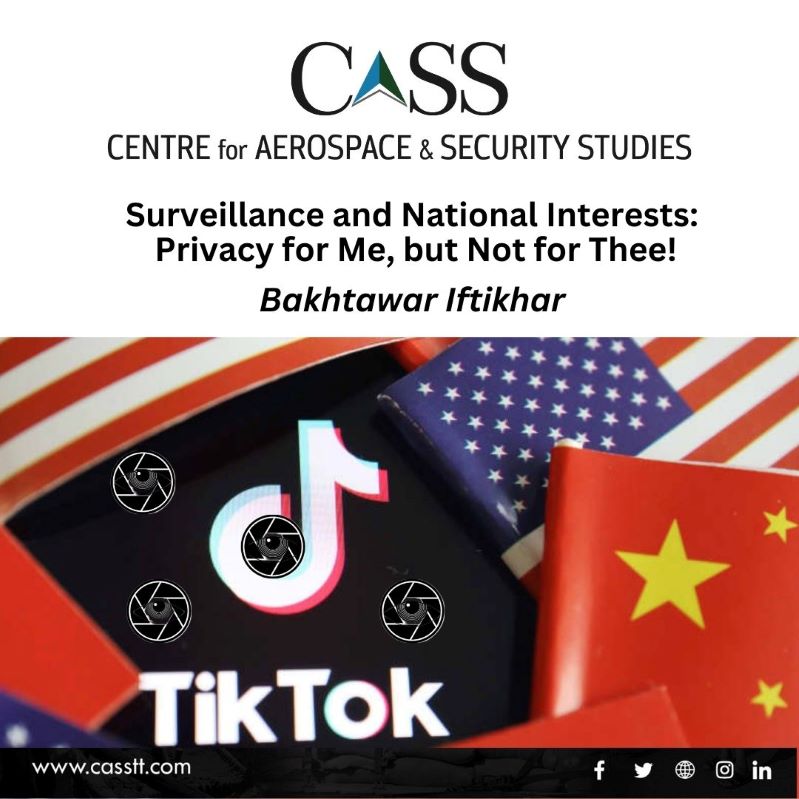
TikTok has been under fire, with similar ‘national’ privacy concerns against China’s surveillance by the United States citing apprehensions about espionage – echoing a ‘Cold War’ rhetoric. Introducing legislation for the ban, Senator Mark Warner referred to the risk of insecure Information and Communication Technology (ICT) software and hardware that could provide ‘backdoors into sensitive American Intelligence’. Moreover, he warned against social media’s role in ‘maligned influence operations’, probably referring to how content recommendations may be used to propagate ‘misinformation’.
Due to Article 7 of a law passed by the Chinese government in 2017, facilitating vaguely defined intelligence-gathering operations, ByteDance (the parent company of TikTok) may share sensitive user information. Thus, US national interests threatened by this law appear to be driving the ban. The company denies the allegations and has spent about USD 1 billion to address concerns, consulted several ‘savvy friends’ and even formed a separate entity called ‘TikTok US Data Security’ (USDS) to avoid the ban in US. Furthermore, it has been insisting through Project Texas that it can save US data on US soil on a local server provided by Oracle similar to its European Project Clover in order to ensure ‘a level of data sovereignty’.
Yet, even if TikTok addresses the concerns, this is likely to have little impact because geopolitics takes precedence; the ban is said to be more China-driven than TikTok-driven. It is no secret that the threats apparently posed by TikTok are no different than that posed by technology at large.
Amid the US’s anti-China spree, while TikTok defends its business interests and China accuses the US of exaggeration, the most neglected aspect is the human right to privacy. As indicated by Article 12 of the Universal Declaration of Human Rights of 1948 ‘No one shall be subjected to arbitrary interference with his privacy, family, home or correspondence’.
In 2013, whistle-blower Edward Snowden revealed how targeted surveillance became mass surveillance and how the Five Eyes Alliance was used to bypass domestic surveillance regulations and spy on other’s populations. Ironically, all Five Eyes have placed some form of restriction on TikTok, citing threats of Chinese surveillance.
The US is also known for its surveillance practices. For example, spying on Angela Merkel and other senior officials of even its own allies. More recently, an unsealed court document revealed that the Federal Bureau of Investigation (FBI) misused surveillance tools over 278,000 times under the Foreign Intelligence Surveillance Act (FISA) Section 702. In one case, it dug out communications, without a warrant, of 19,000 donors to a congressional candidate and also tracked about 100 civil rights protestors after the police killed George Floyd. Thus, even US citizenship does not shield one from falling prey to abuse of power in the name of surveillance. This implies that the US is not opposed to conducting its own surveillance activities, but rather expresses concerns specifically about alleged Chinese spying. In the digital realm, this reflects an extension of realpolitik, where the violation of rights holds little significance for any actor involved.
This tug a war reminds one of William Pitt’s age-old assertion that ‘Necessity is the plea for every infringement of human freedom. It is the argument of tyrants: the creed of slaves.’When a zero-sum mindset prevails at the inter-state level, where regard for oneself is equated with disregard for another, this also becomes a norm at the intra-state level. With accelerated technological advancement, citizens’ freedoms are coming under greater threat, regardless of nationality. One could hope for the global civil society to champion the cause, but even activism falls prey to vested interests.
There may not be permanent friends or permanent enemies in International Relations, but fundamental principles ensuring human well-being should not falter depending on whom one is engaging with. Even if ‘nuanced’ justifications are added in scholarly discourse, the fundamentals of human well-being should not be dispensable.
A better measure of national interest, as implied by Snowden in his memoir ‘Permanent Record’ is as follows: ‘The freedom of a country can only be measured by its respect for the rights of its citizens… of personal or individual freedoms that during the American Revolution was called ‘liberty’ and during the Internet Revolution is called “privacy”.’
Bakhtawar Iftikhar is a Research Assistant at the Centre for Aerospace & Security Studies (CASS), Islamabad, Pakistan. She can be contacted at: [email protected]
Image Design: Mysha Dua Salman



