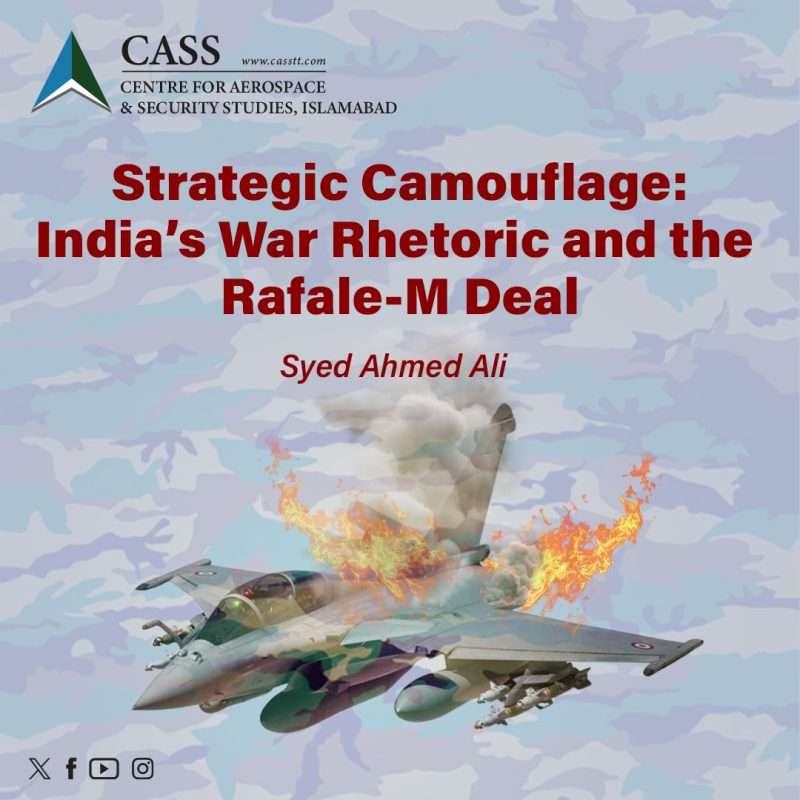
On 28April 2025, India and France officially signed a USD 7.4 billion contract to purchase 26 Rafale-M (Marine) aircraft. This purchase comes at a time when Pakistan and India are engaged in a military standoff, in the aftermath of the Pahalgam incident. The incident has sparked a flurry of military activities, from military strikes to accelerated production schedules. The Indian media has framed purchase of Rafale as a reaction to ongoing hostilities with Pakistan. However, upon closer examination, acquisition of the Rafale-M appears to serve a broader strategic purpose rather than being driven solely by war rhetoric.
The Rafale platform is not new to India, which already operates the Rafale-C in its Air Force. In 2016, Prime Minister Modi announced a deal to purchase 36 Rafale jets for Euro7.86 billion. The agreement quickly became embroiled in controversy, with opposition parties alleging corruption. They criticised the government for favouritism in its offset policy and for approving a significant increase in the per-unit cost of the aircraft. These allegations led to a petition in the Indian Supreme Court, which reviewed the claims but ultimately dismissed them. In 2019, following Pakistan’s Operation Swift Retort, which exposed operational gaps in the Indian Air Force, Prime Minister Modi used the incident as political leverage, arguing that the Rafale jets were vital to national security. Under mounting political pressure, the Supreme Court cleared the deal of wrongdoing, paving the way for India to receive all 36 Rafale jets by 2022.
The Rafale-M deal reflects a familiar pattern in which India’s war rhetoric and media-driven hysteria are used to justify and hasten defence procurements. Approved by the Indian Cabinet Committee on Security on 9 April, the deal gained renewed urgency after the Pahalgam incident on 22 April, for which Pakistan was swiftly blamed. In its aftermath, Indian media outlets called for military retaliation and portrayed the Rafale as a decisive counter to the Pakistani Air Force. This narrative quickly unravelled when the Indian Air Force launched multiple missile strikes into Pakistan on 7 May. In response, the Pakistan Air Force promptly intercepted and shot down five Indian aircraft, including three Rafales, using beyond-visual-range (BVR) missiles.
Apart from Pakistan’s technically superior BVR capabilities, the Indian Rafale-M offers limited strategic value in the context of a conflict with Pakistan. Designed for carrier-based operations and long-range naval missions, the Rafale-M is intended to support India’s maritime force projection, particularly in the Asia-Pacific. However, in an Indo-Pakistan scenario, India already possesses a network of airbases near the border and along the Arabian Sea, making carrier deployment unnecessary and unnecessarily risky. Aircraft carriers are typically employed when land-based operations are constrained by distance or logistics – conditions that do not apply to Pakistan. The platform’s true relevance lies in the Asia-Pacific theatre, where India seeks to counterbalance China’s growing naval presence and requires modern carrier-based aviation for operational reach. The purchase of the Rafale-M appears to support India’s broader military posturing against China, particularly in the Nicobar Islands, where the Indian Navy requires modern carrier-based aircraft to counter platforms like the Chinese J-15 and J-35, both equipped with BVR missiles.
The purchase of Rafale-M may mark a new chapter for Indian naval aviation, but it spells doom for its local aviation industry, particularly Tejas-N. Tejas-N is a naval variant of the Indian Light Combat Aircraft programme designed to conduct aircraft carrier operations. In 2016, Tejas-N failed its aircraft carrier test, as the aircraft was overweight and its single engine did not have the required thrust. In 2019, the Indian Naval Chief Admiral Karambir Singh expressed the desire to operate a Twin Engine Deck-Based Fighter (TEDBF). He stated that if HAL Tejas can make qualitative improvements by 2026, the Indian Navy will induct Tejas-N. TEDBF fighters have a significant edge over single-seat fighters, as they have greater thrust, which increases both their operational range and payload capacity. This is one of the reasons that the Indian Navy prefers Rafale-M over its indigenous counterpart. Another reason could be the strong operational history of the French aircraft, given that this platform has operated in numerous countries like Qatar, Egypt, and Greece. The induction of Rafale-M could be a stopgap between modern and indigenous naval aviation. However, upon closer analysis, it is clear that once Rafale-M enters service, convenience and logistical factors will lead to further procurement of the foreign aircraft.
The preceding analysis suggests that India’s framing of the Rafale-M purchase was a form of strategic camouflage. The Indian media’s inflammatory rhetoric served to spin Rafale-M’s purchase as a reaction to the military standoff. In reality, the purchase of Rafale-M was a long-term decision to acquire a TEDBF fighter to counter Chinese naval aviation in the Asia-Pacific region. However, the acquisition of the Rafale-M comes at the expense of India’s indigenous aviation industry, which continues to be crushed under the competitive pressure of established international defence suppliers.
Syed Ahmed Ali is a Research Assistant at the Centre for Aerospace & Security Studies (CASS), in Islamabad, Pakistan. The article was first published in The News International. He can be reached at [email protected].