
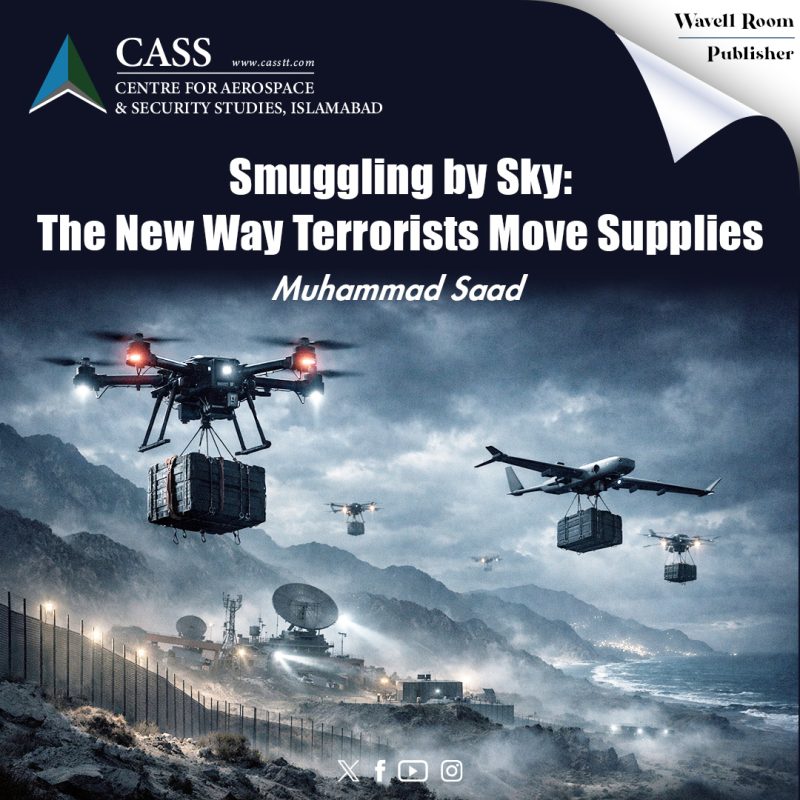
Necessity is a dark cloud which tends to give birth to innovation in the turbulent arenas of contemporary conflicts. Having said that, a very low profile yet dramatic change is underway in the airspace of conflict zones, which is being used by terrorist and insurgent groups using commercial unmanned aerial vehicles (UAVs). It is not just to conduct occasional attacks, but to provide a system of permanent, industrial-level resupply operations. This development makes fortified borders and patrolled roadways even more obsolete across the Sahel to Yemen and South Asia. What started as experimental applications of shelf-storey drones has evolved into a stable aerial logistics chain that can transport 300-800 kilograms of explosives, electronic parts, munitions and vital materiel each week over hundreds of kilometers of enemy-controlled land.
This is not a tactical gimmick. It is a strategic turn, whereby low-frequency, high-load flights, as a rule fixed-wing UAVs with 5–20 kg and 100-400km per flight, establish continuous logistical pipelines. These drones are now built using parts that cost less than 2500 US dollar each with jam-resistant navigation, including SpaceX Starlink ROAM terminals that can provide satellite-based freedom even in electronically hostile environments. These operations create long-range air bridges that evade ground interdiction and exploit vast uncontrolled airspace, unlike headline-grabbing isolated attacks.
For instance, the Islamic State in the Greater Sahara (ISGS) has wreaked havoc across the Mali-Niger-Burkina Faso tri-border region in the Sahel. ISGS uses nocturnal relay chains of short-hop drone hops to ferry ammunition and IED precursors through deserts, where the use of ground troops becomes risky due to the ambushes of French-supported forces or local militias. A 2025 report by the Institute of Security Studies states that Sahelian terrorist cells, armed with Chinese-sourced commercial quadcopters as well as fixed-wing drones, acquired via Algeria and Libya, have adapted drones with longer battery life and thermal imaging. This has maintained offensive operations in remote outposts, regardless of Wagner Group patrols. This phenomenon has contributed to the UN estimate that terrorism based in Sahel contributed to more than 40 per cent of global terrorism fatalities in the first half of 2025.
The Houthis have also developed the infrastructure of drone logistics, turning it into a geopolitical asset in Yemen. They launch payloads more than 300 km from mountain strongholds to reach the adjacent territory, bypassing both heavily monitored land and sea borders. In October 2025, the Pentagon evaluations and U.S. naval intercepts in the Red Sea verified the shipments of dismantled drone engines and guidance kits that were delivered in parts by UAVs. Every sortie is less than a thousand dollars, and interceptor assets are over a hundred thousand dollars, continuing the Houthi campaign against Bab-el-Mandeb shipping and disabling multibillion-dollar border walls.
This trend extends to South Asia, where Tehrik-i-Taliban Pakistan (TTP) confronts Islamabad on the Durand line. Although Pakistan has maintained fencing and towers since 2017, TTP forces in Afghanistan’s Kunar and Nangarhar provinces carry out nocturnal sustainment flights of small arms, batteries and IED components directly into Pakistan’s Khyber Pakhtunkhwa (KPK) province. A recent analysis by the Pakistan Institute for Peace Studies recorded a 30% surge in TTP attacks this year. This escalation has forced the military to divert resources to counter-drone efforts, exposing the futility of physical border barriers against overhead supply.
These instances underlie the fact that the traditional method of counter-terrorism doctrine possesses deep flaws, as it has always focused on road and depot raids. Aerial resupply democratises the geographical terrain, making geographical isolation an insurgent’s asset. Non-state actors stockpile in ungoverned locations, launch from makeshift pads, and drop payloads far from checkpoints. This tactic disperses defensive burdens and creates unsustainable cost imbalances.
Therefore, this dual-use proliferation has accelerated the threat. Heavy-lift motors, long-range transmitters, flight controllers and AI pathfinding software are openly available on the internet. There are various ways lethal drone technology diffusion occurs. Numerous proxies transmit drone designs over encrypted lines. Most private military companies unknowingly pass on operating instructions in the Sahel. Meanwhile, Afghan workshops from the Taliban era supply various South Asian groups. The $30 billion dollar commercial drone market is unwittingly equipping the adversaries beyond regulatory reach.
In order to counter this challenge, there is a need for systemic recalibration. As a primary step, implement a lower tier of layered passive defense. These will include relatively inexpensive RF sensor networks in conjunction with high-power microwave systems (abstractions of the Israeli Iron Dome and the M-LIDS in the USA) to electronically intervene to destroy drones over wide areas.
Secondly, expand supply chain intelligence and sanctions, beyond the expected U.S. Treasury 2025 sanctions on various networks, toward low-end exporters and against IED precursors, satellite modules, and advanced microprocessors. Third, liberalise export controls to give priority to so-called intellectual enablers and establish a UN convention to serialise, trace, and include remote kill switches on drones with over 100 km range. Finally, introduce mandatory transponding and geo-fencing in vulnerable areas along the expected trade-off between legitimate commercial exploitation of these areas and the unregulated access of non-state actors to control airspace.
The skies of Sahel and Yemen and the vicinities of the Durand Line are no longer vacant and secure but are battlefields and whoever arrives first, owns it. The low-priced drones have given a massive edge to insurgents and terrorists working at a fast pace. Unless governments and armies are able to move fast (with more advanced sensors, smarter regulation and cheaper methods to bring down drones), they will continue to lose ground, funds, and control. In such a war, the side, that adapts quickly, always succeeds. States should make those adaptations now, before the sky is forever compromised.
Muhammad Saad is a Research Assistant at the Centre for Aerospace & Security Studies (CASS), Islamabad. He can be reached at [email protected]



