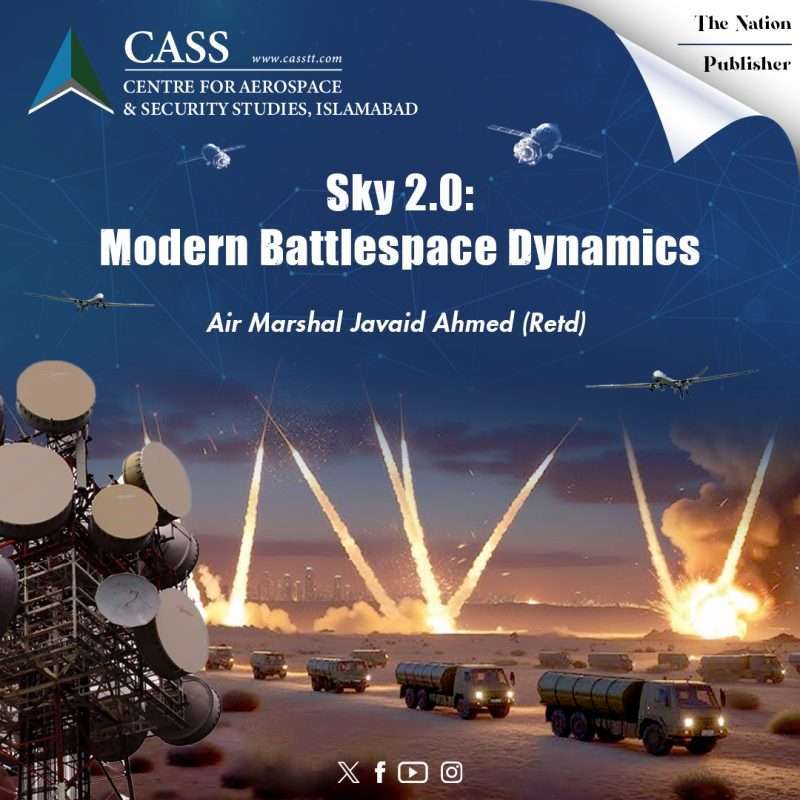
Has Iran’s loss of air space control directly contributed to its vulnerability to American and Israeli strikes? Conversely, did Israel’s more advanced air defence network genuinely afford it greater deterrence against similar threats?
In Iran’s case, the shock of losing aerial dominance paved the way for surprise incursions: once drone swarms and stealth aircraft muted its radar networks, targeted strikes demolished vital research sites, and precision missiles silenced key scientists and commanders. The very loss of ‘who’s up there’ spelt catastrophe.
Yet even Israel’s much-touted Iron Dome has shown cracks. Despite early warnings, Iranian missiles slipped through, leaving swathes of damage in their wake. It’s a stark reminder that no matter how advanced the shield, determined attackers can still find a chink in the armour.
So, what is the future of modern warfare? Will mastery of the skies and every domain within them become the ultimate linchpin of military success?
A closer examination uncovers an even older precedent: some 1,400 years ago, tradition holds that divine clay projectiles rained down from the heavens to annihilate Abraha’s forces: an early, almost mythical example of an ‘air strike’ reshaping the course of history.
Fast‑forward to 2025, and the sky has undeniably become the new decisive battlespace. The Israelis operate with near‑total impunity over Gaza, Lebanon and Syria, even slicing through Iraqi airspace to strike Iran. The US exerts a stranglehold across the Middle East, projecting power from roughly 19 widely dispersed air bases under the guise of a regional security umbrella. In Europe, Russia and Ukraine wage combat largely through aerial and drone operations. Ukraine’s ‘Operation Spider Web,’ in which satellite‑linked drones managed to reach 1,400 kilometres into Russian territory to destroy strategic bombers, remains fresh in our minds this month. Closer to home, the Pakistan Air Force’s swift domination of an intense air engagement, downing six Indian jets in under an hour, marks the largest single‑day air battle since World War II.
From divine intervention to drones and stealth aircraft, history and modern conflicts alike underscore one truth: mastery of the skies is now, and will remain, the linchpin of military success.
But what does the modern concept of air control or superiority imply?
The first pillar of aerospace‐domain supremacy lies in control over the electromagnetic spectrum. This invisible battlespace, spanning radio frequencies, microwaves, infrared and even visible light, carries every command signal, radar ping and satellite downlink. From geostationary reconnaissance satellites and high‑power airborne radars to ground‑based jammers and laser communication links, today’s most sophisticated forces include a seamless web of sensing, denial and deception. American and Israeli innovations, in particular, have pushed this envelope: adaptive spectrum‑sensing algorithms, rapid beam‑steering phased arrays and precision electronic‑attack pods now allow them to cloak their own assets, blind adversary sensors and secure unimpeded connectivity across thousands of kilometres. This was demonstrated during the Iraq, Libyan and Syrian conflicts and the current attacks on Iran, where most radars and electronic warfare equipment could not work to its designed capability due to an electromagnetic onslaught. In the future, with cognitive EW, directed energy and electromagnetic pulse systems, spectrum control will become even more critical and challenging.
Long‑reach, laser‑sharp air‑launched weapons deliver the second punch: AIM-series, China’s PL and Russia’s R version missiles, and Europe’s Meteor dominate air‑to‑air kills, while AGM, Scalp, Storm Shadow and Kh‑series can now strike ground targets with surgical precision. Israel routinely fields US ordnance. The deep penetrating 30,000-pound, GBU 57’s employed against Iran’s Fordow, Natanz and Isfahan nuclear plants belong to a special class of weapons which can only be employed under complete aerospace supremacy conditions.
On the other hand, Iran’s Emad, Fatah and Khorramshahr missiles characterise the third pillar of modern aerial warfare: surface‑to‑surface ballistic strikes that slam into targets at hypersonic speeds. Arcing through the stratosphere and mesosphere before diving unpredictably, their blistering re‑entry velocity and terminal manoeuvrability have rendered even Israel’s vaunted air defences and the US‑supplied interceptors, ineffective. By demonstrating a retaliatory capability once thought impossible, these missiles not only shattered strategic assumptions but also compelled Washington’s deeper involvement in the conflict.
It would also be naive to assume that space has not been weaponised. AI‑driven satellites now feed real‑time, sub‑meter imagery into the kill‑chain, slashing decision cycles and enabling pinpoint strikes. This combination of space and Artificial Intelligence (AI) played a crucial role in the precision assassinations of Iranian leaders and nuclear scientists, a textbook application of Colonel John Warden’s Five Rings targeting model.
The US-Israel-Iran standoff maps out tomorrow’s warfare: a battle for aerospace supremacy. Future conflicts will play out in the skies and beyond: AI‑guided satellites duelling nano‑enhanced, quantum‑hardened ballistic weapons in the stratosphere. Any nation intent on preserving its sovereignty must now pour resources into cutting‑edge aerospace dominance or cede control of the ultimate high ground.
More dangerous prophesies point to satellite-to-ground weaponry, lasers, the growth of passive data systems and continuous cyber protection mechanisms. In the lower sky spectrum, the battle for supremacy would be fought between unmanned systems taking on UAVs and manned aircraft controlled from hardened sub-surface control hubs. Consequently, no ships, aircraft carriers or boots on the ground would be possible without control of the sky. For Pakistan, the future battle scenario is already here and in its neighbourhood.
Air Marshal Javaid Ahmed (Retd) is President of the Centre for Aerospace & Security Studies (CASS), Islamabad and former Vice Chancellor of Air University. The article was first published in The Nation. Email: [email protected]