Did the Pakistan Air Force (PAF) win the air war of May 2025? Definitely yes.
Consider a first-shot opportunity between two gunslingers. The advantage to the shooter is remarkable.
Now, imagine the planning that went into the first strike of India’s Operation Sindoor. The element of surprise, time to strike, choice of the best aircraft, the luxury of pinpointing targets, deciding the weapons for the attack, and finally putting all Indian military assets on full alert.
Accordingly, the media brief was ready for telecast in the morning with videos of alleged terrorist hideouts destroyed by strikes. The stage was set with a 40 ft podium lined with nine flags, a foreign secretary in the centre flanked by two lady officers. Almost a ready-made movie set.
On the word go, the Indian Air Force (IAF) launched 70 aircraft to hit Pakistan. The pack had Rafales in lead, the pride of the Indian Armed Forces, inducted in a lemon-aded, coconut-ted, Sindoor-ed ceremony at Ambala in September 2020.
Lights, camera, action — and the IAF met its nemesis.
In an hour of the most intense Beyond Visual Range (BVR) air combat since World War II, the IAF was detected, engaged, checkmated, and found wanting.
The Rafales and their wingmen from three continents met the fortified wall of Bunyan-un-Marsoos patrolled by the PAF.
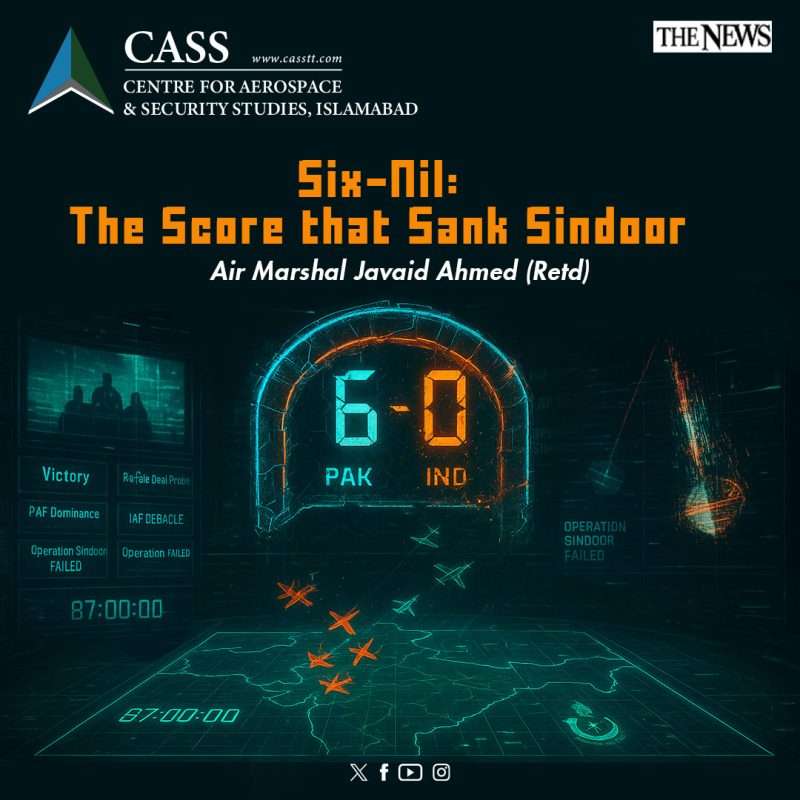
In all, besides its pride, the IAF lost six aircraft and a drone, limping back 300 km, to recoup, reassess, and relaunch after a week — with no show in the skies, granting air superiority to the PAF.
The IAF never got a chance to fly in the war again.
The 87th hour ceasefire put an end to a near-vertical escalation between two nuclear-armed neighbours and provided a face-saving to a Sindoor bleeding leader.
The Indians conveniently forgot that the PAF has a legacy of marksmanship: target practice on quite a few IAF jets. From the early 1950s to as recently as 2019, Pakistan has graciously hosted a number of Indian pilots, beginning with Squadron Leader Sengupta in 1954 and, most memorably, Wing Commander Abhinandan in 2019.
For Pakistan, it was clear after the 2019 Operation ‘Swift Retort’ that the Indians would try another stint after the embarrassing Abhinandan episode. Accordingly, both air forces prepared for the next duel. The IAF, playing the two-front card, received the best aircraft in the market, the Rafale, complete with lethal arsenal for air superiority, the S-400 for air defence, and an array of military satellites for pinpoint accuracy and Intelligence, Surveillance and Reconnaissance (ISR).
To execute operations, a brainiac group of the Cabinet Committee on Security led by Mr Modi, Amit Shah, Ajit Doval, and the service chiefs, developed a ‘fail-proof’ strategy. It was fine-tuned to perfection, meticulously strategised, war-gamed, and simulated through countless practice runs. What could possibly go wrong?
The PAF, with its modest budget, had invested in J10 Cs, the PL-15, associated technologies and Pakistan’s indigenous prowess to fight the next battle through Multi-Domain Operations (MDOs) — a doctrinal vision of the Air Chief, a leader who leads from the front.
Unknown to the Indians, the PAF had transformed in the last few years. The aerial war machine was networked, integrated, and trained to shoot intruders at long ranges and attack deep when ordered. With first-shot capability, the PAF air strategy aimed not only to deter but to defeat the fourth largest air force in the world.
It was all over within the first hour of this modern, tech-intensive air spectacle, which saw three Rafales, a Su-30, a Mirage 2000, a MiG-29, and a Heron UAV unceremoniously dropped from the skies. A masterstroke by the PAF, no less.
The resulting strategic paralysis in India was hard to miss: best captured by a press conference so lacklustre, it seemed even the spokesperson had given up. With a war-winning belligerent narrative shot down, the press brief by the well-rehearsed Indian group fumbled. The embarrassed presenters failed to take any questions. The furious Indian media, baying for blood, went into full meltdown, tearing into the Foreign Secretary, and even turning their guns on Colonel Sophia, the Army representative, whose real ‘offence’ seemed to be her religion.
What exactly were Modi’s objectives?
What was the war strategy and planned endgame?
In fact, as events unfolded after the six-nil air battle debacle, it was clear that the Indians had lost the war. Operation Sindoor had backfired. As for the other services, with air superiority lost, the Indian Army decided to remain away from the sweltering heat of May. The Indian Navy, after testing the waters, realised that its ships and the aircraft carrier were all sitting ducks.
The drones and subsequent surface-to-surface missile attacks were India’s last-ditch effort to salvage pride and were highly escalatory. These were responded in kind with strategic restraint. Pakistan’s Armed Forces hit numerous targets deep inside India and all along the Indo-Pakistan border. A reach beyond Delhi, and the destruction of S-400 batteries, depicted the depth and lethality of Pakistan’s arsenal.
Since then, hundreds of Indian spin doctors have been cooking up narratives almost every day to soothe public anger. From ‘fighting China and Pakistan together’, to shooting down multiple PAF aircraft and destroying PAF air bases, fake media masters are now driving Modi’s political agenda. However, barring the Israelis, the accounts have not found any global traction. The sane world has transformed with access to multiple news sources and independent analysts, where the truth always surfaces.
To date, the perpetrators of the crime in Pahalgam remain at large. The trigger-happy Modi continues to pedal a hollow victory narrative, inventing slogans such as ‘Operation Sindoor on hold’ for gullible crowds. The opposition is at the throats of BJP seeking details of aerial losses. The Rafale deal of 2020 is being probed again. As, the world watches, India fumbles in its foreign policy, losing its international clout and status of a responsible power. Meanwhile, their misadventure raises the bar for a serious escalation in a nuclear environment once again.
Air Marshal Javaid Ahmed (Retd) is President of the Centre for Aerospace & Security Studies (CASS), Islamabad and a former Vice Chancellor of Air University. The article was first published in The News. Email: [email protected]