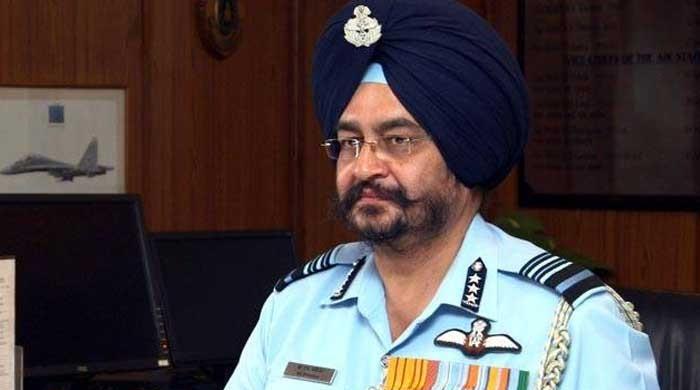
On March 3, 2019, Air Chief Marshal (ACM) B S Dhanoa, Chief of the Air staff of IAF, addressed a press conference on the occasion of the award of national colors to IAF Station, Hakimpet and Base Repair Depot. He praised these units for their contribution and congratulated them on gaining the recognition of the state for the same. He also eulogised some of the achievements of the IAF during the 1971 War. The press
corps present, however, was more interested in the IAF’s performance during its surgical strike at Balakot and the subsequent aerial engagements with PAF. The air chief though, would have none of that and put it beyond the media’s reach by stating that he would not comment on ‘ongoing operations’.
A discerning viewer could well understand the reason for the stance he adopted. Plain and simple, the IAF had no evidence to show for their performance. On the effectiveness of the ‘surgical strike’, when a reporter persevered by saying that independent international media had found no damage or casualties, the air chief retorted nonchalantly that IAF reports indicated that the strikes had been successful. He added that the IAF was not in a position to clarify the number of casualties. “The government will clarify that. We don’t count human casualties”, he said. Later he conjectured that if IAF had not hit the targets, why would Pakistan have responded, not realising that Pakistan responded because IAF had violated Pakistan’s sovereignty by lobbing weapons across the international border. And then he did allude to a Mig-21 of IAF shooting down a PAF F-16. Both the IAF and PAF know the truth but the former, in an effort to hide their failure have leaned on this falsehood. Though they have been clever. Fearing that the press would again insist on evidence from IAF to support their claim, and IAF not being in a position to provide the same, conveniently put the burden of proof on the already embarrassed Wing Commander Abhinandan. A pilot and his fighter, after having shot the F-16, should have been able to show the video recording but since this feat was imaginary, they conspired to say that Abhinandan had shot the F-16 before becoming a victim himself. A disappointed government and media accepted this story, fully knowing that the story had a big hole. To substantiate this false story, they had to declare Abhinandan a national hero. God has strange ways of bestowing honor and ignominy on humans. A pilot downed and captured by the “enemy”, returns to find that instead of being embarrassed to face his service and colleagues, he has been declared a hero based on the myth of achieving an F-16 kill.
The point to understand here is that this ceremony for award of colors, must have been planned way before the events of 26/27 February, 2019. ACM Dhanoa, took this opportunity to paint the IAF in a better light by enumerating some of its achievements till 2018 and before. However, the public and the media were disturbed over the events of early 2019, where the IAF lost two aircraft each to PAF action, technical failures and mid-air collision. One helicopter was lost to friendly fire and a fighter to a bird hit. But due to “ongoing operations”, ACM Dhanoa was not willing to discuss these. Most of the comments on the YouTube video of this conference by Indians were negative. They accused the ACM of being ignorant, not telling the truth and being used by Narendra Modi for political purposes. One of the most important traits of leadership is integrity. What would be the effect on the morale of IAF personnel when it’s known that the service and its head willfully indulge in falsehood?
The PAF has refrained from chest thumping over what it achieved on 26/27 February, 2019. Professionalism demands that but equally, it demands not distorting the truth. Unfortunately for India, the world sees it now as a rogue state, egged on by a hyperactive, nationalist media. From the false-flag operation of Pulwama, to the fictitious surgical strike to the farcical claim of shooting down of a Pakistani F-16, everything has turned out to be detrimental to the hitherto fore narrative of “incredible” India. Now their spokespersons and officials have become incredible or rather not believable. All attempts made at salvaging the damaged ship tends to sink the rescue vessel too. The longer these futile attempts continue, the worse the situation will become because one day the truth will be known with evidence. The PAF has diverse sources and resources to prove the claims it has made and at an opportune time they would be made public. That may still not convince the Indian public, media and politicians because the era of “death of narratives” entails that facts can be ignored. The mighty can be wrong, can “manufacture” evidence to mold a false narrative and make it appear to be the final truth but can mankind, the world and the region find peace, harmony and prosperity? I think not!
The writer is a former Air Chief and President of Centre for Aerospace and Security Studies.