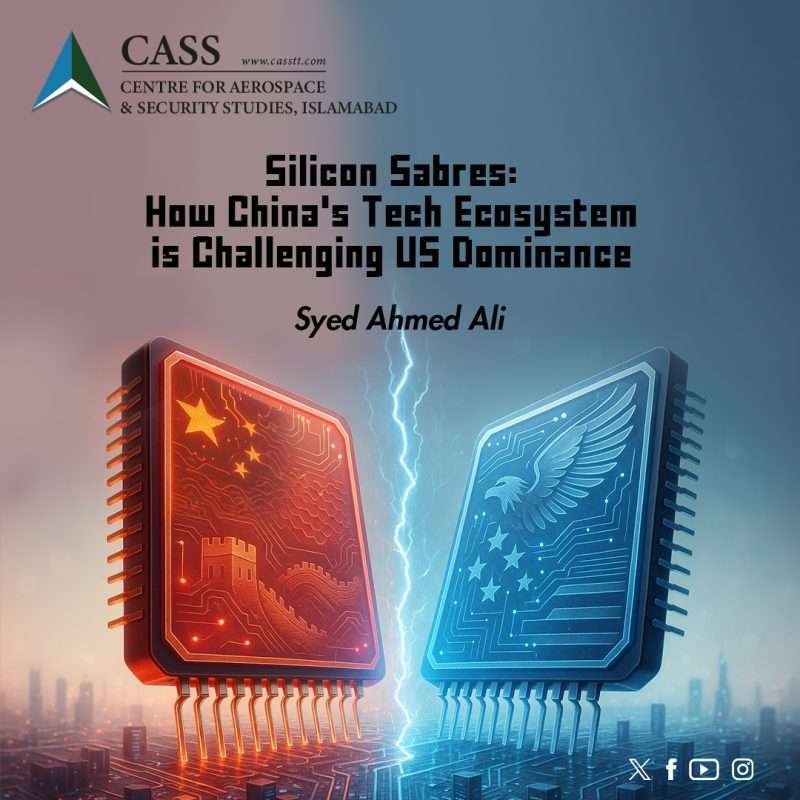
Warfare is no longer defined by traditional firepower, but by information in the form of satellites, fibre optics, and silicon chips. The modern battlefield demands weapons that are long-ranged, accurate, dynamic, and intelligent. These weapons are supported by tech ecosystems that provide essential services, making such capabilities a reality. For decades, the United States has dominated the technological ecosystem. This has enabled Washington to degrade the capabilities of its adversaries. However, as China’s ascendancy unfolds, the US finds its technological supremacy challenged. China’s burgeoning tech ecosystem is increasingly viewed as a viable alternative to American technology dependence, which is slowly shifting the global balance of power.
The Chinese military-industrial complex (MIC) has come a long way from self-sufficiency, to indigenisation, to becoming a major player in the arms market. Currently, 4 out of the 10 largest defence companies are Chinese. These companies are producing equipment like VT-4 main battle tanks, J-20 stealth fighter jets, Dong Feng (DF-21D / DF-26) anti-ship ballistic missiles, and the HQ-9 (Hong Qi) air defence system. China also has the largest shipbuilding industry, whose capacity is 230 times larger than the US. However, despite the impressive might of the Chinese MIC, only a handful of states import its products. 61% of China’s total arms exports go to a single country: Pakistan.
Pakistan’s regional security challenges have compelled it to import arms from China and collaborate on projects like the JF‑17. Recent deployment of the Chinese J‑10C under Operation Bunyan-un-Marsoos demonstrated the platform’s combat effectiveness, rattling the international arms market and proving that Chinese weaponry can rival Western systems. This growing credibility of Chinese weapons has enabled the country to penetrate new markets. Iran has recently shown interest in purchasing Chinese J-10Cs in an attempt to rebuild its air force and reduce dependence on Western weapons systems.
Modern weapon systems, such as missiles, rely on satellite systems for navigation and situational awareness. For much of the late 20th Century, most military powers were vulnerable to US satellite jamming capabilities due to their reliance on GPS (Global Positioning System). China experienced this firsthand when GPS interference caused one of its ballistic missiles to overshoot during the third Taiwan Strait Crisis. Understanding their vulnerability, the Chinese started their own global navigation project in 1994 called ‘BeiDou’. China launched its first BeiDou satellites in 2000, which provided navigation services exclusively to the mainland. In 2022, the constellation expanded to 45 satellites, 30 of which are third-generation satellites that serve over 1.1 billion people.
BeiDou has become an alternative navigation system to the GPS. China currently shares military-grade access to its BeiDou satellite navigation system with Pakistan, Iran and Russia. Iran in particular, due to its hostility towards Israel, is vulnerable to the US global navigation system. To secure itself, Iran signed an agreement in 2021 to gain military grade access to BeiDou. As a result, in April 2024, Iranian missiles saw a remarkable improvement in their accuracy landing within metres of their Israeli target. States are rushing towards the BeiDou, not only because of its technological sophistication but because it represents strategic autonomy from Washington.
China has not only established an independent technological ecosystem in space but has also mirrored this approach on land by developing a self-reliant supply chain for rare earth minerals. It dominates the industry: extracts 70% of global rare earth minerals, refines 85% of them, and manufactures 90% of rare earth magnets. This is particularly significant as these minerals are essential for production of modern weapons like hypersonic missiles, F-35’s, and nuclear submarines.
With the ongoing trade-tariff war between Washington and Beijing, the Chinese government imposed export control restrictions on rare earth minerals in April. The Chinese government has a wide arsenal of tools to challenge the White House in this trade war, such as licensing restrictions, tariffs, export quotas, or outright bans. Such measures represent a significant risk to US national security, as these policies may jeopardise its MIC supply chain. This can be particularly troubling for the US as it effectively means that Washington and its allies will not be able engage in long-drawn-out conflicts that deplete their arsenal.
The Chinese military-industrial complex, satellite system and rare earth minerals offer a viable route of strategic autonomy from the US tech ecosystem. It gives states the liberty to pursue policies that Washington frowns upon. China, with a dominant hold over the rare earth mineral industry, has a secure supply line for its high-tech industry. This allows Beijing to outproduce the US and supply its allies with critical weapon systems. The only constraints China faces are a smaller customer base and establishing credibility at par with US weapon systems. With the recent battlefield success of Chinese systems such as PL-15 and BeiDou, this gap is closing fast.
Syed Ahmed Ali is a Research Assistant at the Centre for Aerospace & Security Studies (CASS), in Islamabad, Pakistan. He can be reached at [email protected]