
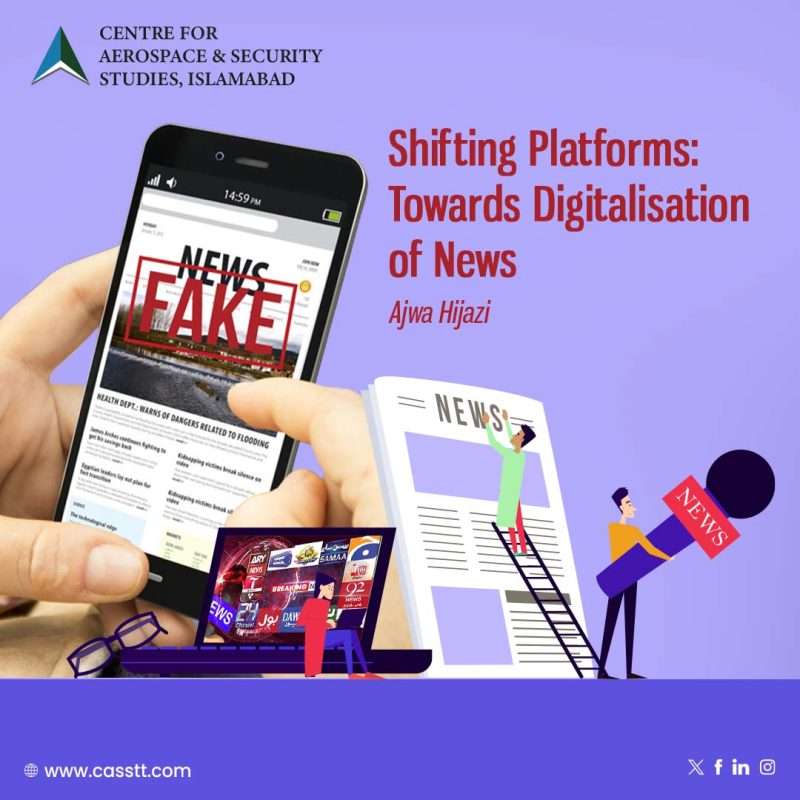
Like the other facets of life, the news media industry has not remained stagnant to rapid digitalisation and internet penetration. The mainstream news media has traditionally been seen as the watchdog in any democratic set-up. However, the advent of the internet revolutionised the media industry landscape. Like the rest of the world, the Pakistani media has also evolved manifolds over the past two decades. From starting with one state-owned TV channel to the liberalisation of the news media industry in 2002, Pakistan is presently at the cusp of the digitalisation of news.
The Internet affected the established media in several ways, especially their audience base. In Pakistan, over the past few years, the majority of people’s media consumption has shifted from mainstream sources (print/television) to digital platforms. Several reports and studies have pointed out that there has been a decline in the time spent on watching TV channels. The average television watch time in Pakistan was eight hours between 2009 and 2010. However, in 2023, this percentage dropped to 50% as Pakistanis now spend one to four hours on TV. The gradual decline in the relevance of the television industry has cast shadows of uncertainty on the future of TV news in Pakistan.
Similarly, the print industry has been struggling to maintain its presence in recent years. Before the liberalisation of broadcast media in the early 2000s and the proliferation of online news platforms, there were around 1600 newspaper vendors in Rawalpindi and 700 in Islamabad. However, the plunge in sales has caused a drop in the number of vendors to 900 and 480, respectively. These statistics highlight mainstream news media’s challenge to remain relevant as consumer preferences shift toward digital platforms.
The shift in news consumption patterns is driven, firstly, by the transformation of Pakistan’s digital environment, marked by the increased presence of mobile phones and internet connectivity. According to the Pakistan Telecommunication Authority (PTA), as of June 2023, Pakistan had around 200 million mobile phone users and 90 million internet users. Second, at the end of January 2024 more than 70 million Pakistanis were using various social media platforms (Facebook, YouTube, TikTok, X, etc.). The rise in digital media is redefining journalism, especially among the young demography, where online platforms and social media are being consulted as the primary sources for news and current affairs content. Third, digital media is characterised by unparalleled reach and accessibility, allowing real-time updates and content editing. This has prompted many local journalists to move to digital media, seeing it as a more viable career option, which in turn has fuelled the growth of digital journalism. In recent years, apart from the rise of digital news platforms, there has been an increase in the number of journalists (both budding and seasoned) who have created YouTube channels to disseminate their analyses.
However, there has also been a rise in digital content characterised by sensationalism, clickbait, and fake news. This trend is driven primarily by competition for online advertising revenue and audience attention. As a result, the credibility of digital media journalists is compromised, as they are responsible for disseminating fact-checked news and presenting it in a non-sensational manner.
Furthermore, there is a general perception that people have unhindered and unfiltered freedom of expression on social media platforms. Ironically, according to a former editor of a mainstream local print newspaper, that is where one sees lack of ethics and fake news. A simple screenshot claiming that a military or political leader has resigned, or a fabricated notification of holidays before a major religious or national festival, can quickly spread and potentially cause significant political and economic impacts. People tend to believe fake news and become victims of sensationalist journalism due to a lack of digital literacy and confirmation biases (which force them to consider the news that aligns with their pre-existing notions and disregard any contradictory information).
Digital media has created a complex and fast-paced environment where the veracity of every piece of news is clouded with the prospect of misinformation or disinformation. While a few domestic media outlets have started fact-checking reports to counter fake news, a lot more needs to be done. Given the global extent of fake news, Pakistan recently advocated for international measures at the United Nations to combat deceitful content online. In the future, the government could try to diplomatically mobilise UN member states to initiate consensus for a multilateral framework in this regard. Regulating digital media is a strenuous task for any government. It requires comprehensive legislation that clearly defines fake news and proposes proportional penalties that do not hamper the right to freedom of expression. Moreover, regular media campaigns on digital literacy, focusing on fact-checking, are necessary. In Pakistan, the rapid digitalisation of news places significant responsibility on three crucial stakeholders: journalists, civil society, and the government. Responsible journalism and inclusive, well-thought legislation by the government are essential in today’s climate. Meanwhile, the public must also take responsibility and be discerning in their consumption of news from digital platforms.
Ajwa Hijazi is a Research Assistant at the Centre for Aerospace & Security Studies (CASS), Islamabad, Pakistan. The article was first published in The News International. She can be reached at [email protected].



