‘What all could have happened if we had Rafale?’ This statement by Indian Prime Minister Narendra Modi surfaced after the 2019 India-Pakistan aerial showdown. The Indian Air Force’s (IAF) failed airstrikes near Balakot met a swift broad daylight response by the Pakistan Air Force (PAF) under Operation Swift Retort. The retaliatory strike by the PAF showcased how a capable and professional air force can outclass a larger adversary through resolve, effective strategy, superior tactics and advanced technology. The IAF lost two jets, including a MiG-21 Bison and a Sukhoi-30MKI, along with the capture of its pilot, Wing Commander Abhinandan Varthaman. Amidst the fog of war, an Indian surface-to-air missile (SAM) system shot down its own Mi-17 helicopter due to the PAF’s electromagnetic suppression and disruption, killing all 6 airmen on board.
In a bid to avoid such humiliation in future, the IAF proceeded with the procurement of 36 Rafale jets to address capability gaps and plug operational limitations. It also emphasised the significance of self-reliance and operational autonomy. For this purpose, Hindustan Aeronautics Limited (HAL) was tasked to expedite the development of indigenous Advanced Medium Combat Aircraft (AMCA) and Light Combat Aircraft (LCA) to address the issue of ageing squadrons.
Even after the induction of Rafales, the IAF struggled to keep pace with the regional peer air forces. Following the Pahalgam crisis in 2025, the Indian government amplified nationalist rhetoric and blamed Pakistan for the attack. Using the Pulwama playbook, India launched a series of strikes, from stand-off ranges against targets in Punjab and Pakistani-administered Kashmir, dubbed as Operation Sindoor, resulting in the loss of civilian lives and infrastructure. The strike package featured India’s top-of-the-line Rafale jets along with Sukhoi-30MKI, MiG-29K and Mirage-2000s.
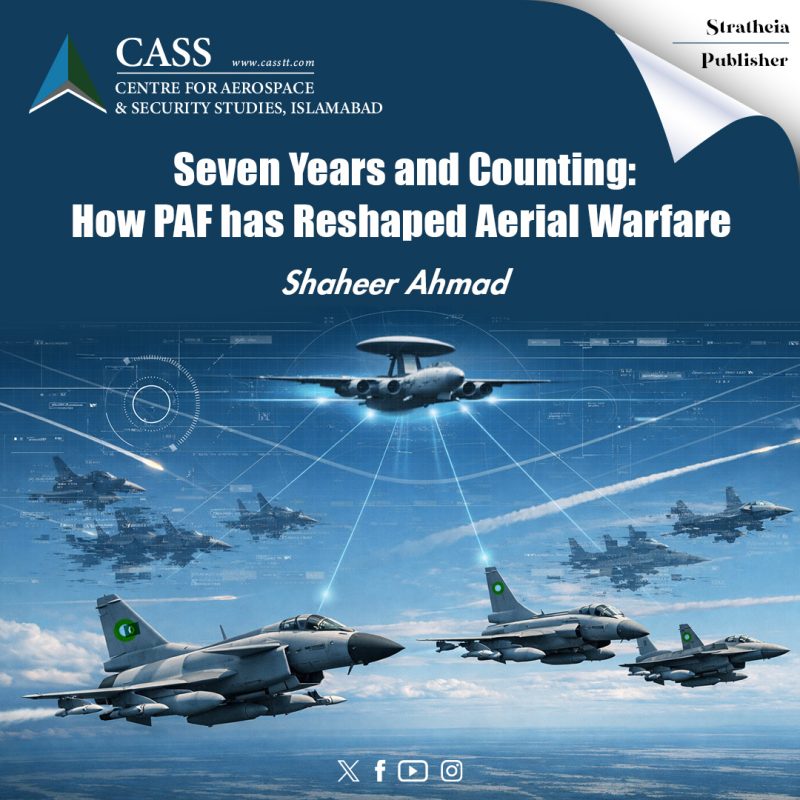
Within minutes, the PAF decisively reacted by converting its defensive counter-air operations (DCA) to Offensive Counter-air operations (OCA). Leveraging its advanced electromagnetic capabilities, the PAF detected and tracked up to 72 Indian aircraft. In response, 42 high-tech aircraft, including J-10Cs, JF-17 Thunders and F-16 Fighting Falcons, were deployed to face off the Indian formations.
In a sequenced kill chain, the forward J-10C aircraft maintained radar silence and obtained targeting data from AWACS planes operating at standoff range. The PAF’s integrated sensor fusion provided a real-time transparent image of the Indian airborne assets by tracking and identifying the movement of every single aircraft. When the target geometry became perfect, the J-10Cs activated their radars, releasing PL-15 beyond-visual-range-air-to-air-missile (BVRAAM) from well over 150 kilometres away, resulting in the loss of seven Indian fighter planes, including four top-of-the-line Rafale jets, a Su-30MKI, a MiG-29K and a Mirage-2000.
The PAF’s overwhelming operational tempo allowed it to achieve cognitive superiority against the IAF. The unprecedented loss of fighter aircraft resulted in an operational pause and redeployment of the aircraft to the rear bases. This was later acknowledged by India’s chief of defence staff, General Anil Chauhan, on the sidelines of the Shangri-La Dialogue at Singapore. Deprived of air cover, the IAF resorted to the use of unmanned aerial vehicles (UAVs) and missile warfare, making operational paralysis of the IAF the most prominent outcome of the conflict.
The PAF’s strength rested upon real-time sensor fusion, aggressive interception, rapid decision-making and integrated jointness among its platforms. On the contrary, the IAF platforms were undoubtedly potent, but fragmentation in India’s battlefield networks hindered their interoperability and combat efficiency. The IAF failed to integrate its heterogeneous systems, causing fatal delays and exposing operational vulnerabilities.
During the episode, the PAF established deterrence by precisely hitting India’s counter-force targets. The PAF’s employment of graduated airpower forfeited the IAF’s bid to establish control of the air, granting PAF de facto aerial supremacy over its rival. Shooting down India’s perceived centre of gravity, the Rafales, granted PAF cognitive leverage over the numerically superior IAF.
The PAF that fought the May 2025 conflict emerged as a multi-domain, agile and network-centric entity that prevailed over a much larger adversary. Due to spectrum ascendency, the PAF’s seamless Observe-Orient-Decide-Act (OODA) loop enabled its fighting platforms to hit the target with surgical precision. From strategic successes of Operation Swift Retort to the May 2025 conflict, the PAF proactively simulated futuristic warfighting concepts, combined indigenisation with advanced procurements and augmented its network-centric capabilities. Having an integration-over-inventory mindset, the PAF’s superior strategy, incremental tactics and advanced technology enabled it to prevail over a much larger adversary.
Shaheer Ahmad is a Research Assistant at the Centre for Aerospace & Security Studies, Islamabad. The Article was first published by Stratheia. He can be reached at [email protected]