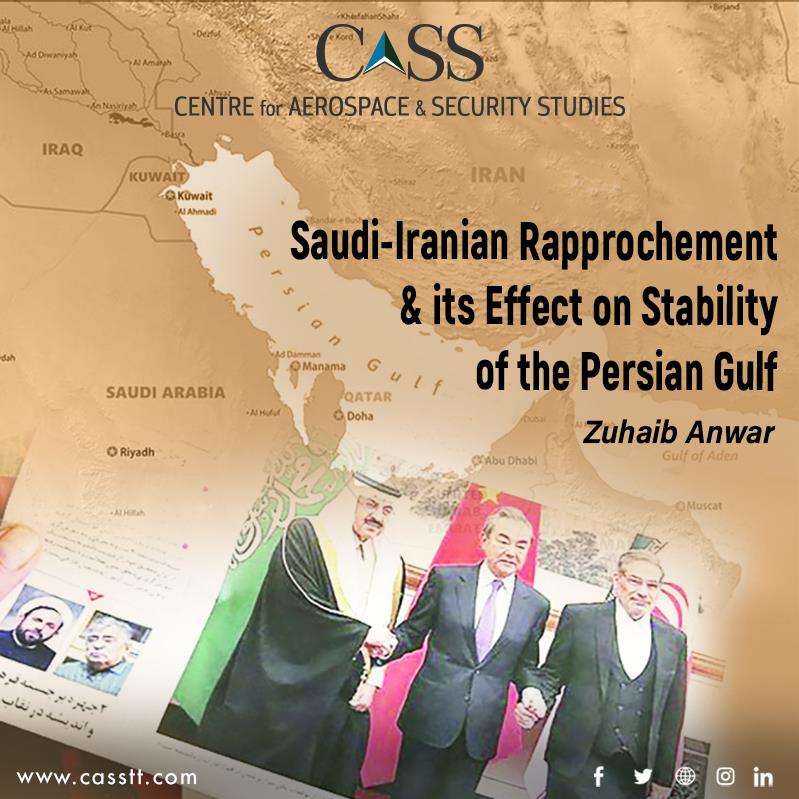
In a major diplomatic breakthrough, achieved through silent mediation by China, Saudi Arabia and Iran agreed to normalise relations. In a joint statement on 10 March, the two countries agreed to reinstate diplomatic relations and reopen embassies within two months of signing of this agreement. They further agreed to respect each other’s sovereignty and stop interfering in each other’s internal affairs. Both sides also agreed to reactivate their 2001 Security Cooperation and the 1998 General Cooperation agreements. The March joint statement was followed by the Saudi monarch’s invitation to Iranian President Ebrahim Raisi to visit Saudi Arabia and a telephone call between the foreign ministers of the two countries to convey well wishes upon the beginning of the Holy month of Ramadan. Later, the Foreign Ministers held a meeting in Beijing and agreed to continue the process of reopening of diplomatic missions in their respective countries. This announcement was followed by a visit of a Saudi technical delegation to Tehran.
Relations between the two sides went cold in 2016 after the execution of a Shia cleric Nimr al-Nimr by Saudi authorities and the subsequent attack on the Saudi Embassy in Tehran. However, they have long been embroiled in a struggle for regional leadership, which is evident from their support of rival sides in regional conflicts. Apparently, there has been realisation on both sides that tensions need to be reduced and that constructive relations are a need of the hour.
On the Saudi side, there was cognizance that Saudi and US interests in the region do not converge anymore, therefore, the US was no longer interested in safeguarding Saudi Arabia or honouring the ‘Oil for Security Agreement’. As US dependency on oil supplies from the Kingdom has shrunk, therefore at the peak of Houthi drone and missile attacks on Saudi targets, the US announced removal of its anti-missile defence systems from the Kingdom. Similarly, the US no longer classifies Houthis as a terrorist group and has limited its support of the Saudi-led offensive in Yemen. It has also implicated the Saudi Crown prince in the murder of Jamal Khashoggi. The Biden administration released an intelligence report in February 2021 about the alleged role of the Saudi Crown Prince in the assassination. More recently, Saudi-US relations further deteriorated after the former refused to increase oil production when prices were rapidly rising because of the Russia-Ukraine War.
On the Iranian side, Iran is also interested in ending its isolation and engaging with regional and extra-regional countries. After Saudi Arabia broke relations with Iran, other regional countries like United Arab Emirates (UAE), Bahrain, Kuwait etc. also restricted their relations. Thus, to end its regional isolation, Iran may now be finding it pragmatic to engage with Saudi Arabia.
Since the agreement, things have been moving very fast in the Middle East on this front. The regional scenario appears to be changing. Countries that had severed relations with Iran, in solidarity with Saudi Arabia, have started the process of normalising relations, e.g., Kuwait appointed its ambassador in Tehran after six year in 2022; while UAE, Jordan, Egypt, and Bahrain all are in talks to improve diplomatic relations.
This normalisation could have a positive impact on regional hotspots where both countries have been involved in pursuance of their perceived interests. In Yemen war, Iran and Saudi Arabia support opposing sides, making this conflict a proxy contestation. In Lebanon, Tehran has long backed the powerful militia Hezbollah; whereas Riyadh backs political groups that oppose Hezbollah. Similarly, in Syria, Iran backs Syrian President Bashar al Asad’s regime, whereas Saudi Arabia backs rebels that seek to topple the minority government. The normalisation of relations between Iran and Saudi Arabia could open avenues for these countries to end their internal conflicts. Saudis and Iranians could also use their influence in these countries to bring the warring/opposing parties to the negotiating table.
The desire of both countries (Saudi Arabia and Iran) to become regional leaders had turned the Middle East into a conflict zone. This rapprochement is a ray of hope not only for the people of their respective countries, but more importantly for the people of Yemen, Syria, Lebanon etc., as it could lead to peace and stability. However, one needs to remain mindful that opposing and anarchic regional and extra-regional players such as Israel and the United States might attempt to spoil this initiative as peace between these two regional powerhouses does not suit their stated as well as covert interests.
Zuhaib Anwar is a Research Assistant at the Centre for Aerospace & Security Studies (CASS), Islamabad, Pakistan. He can be reached at [email protected].