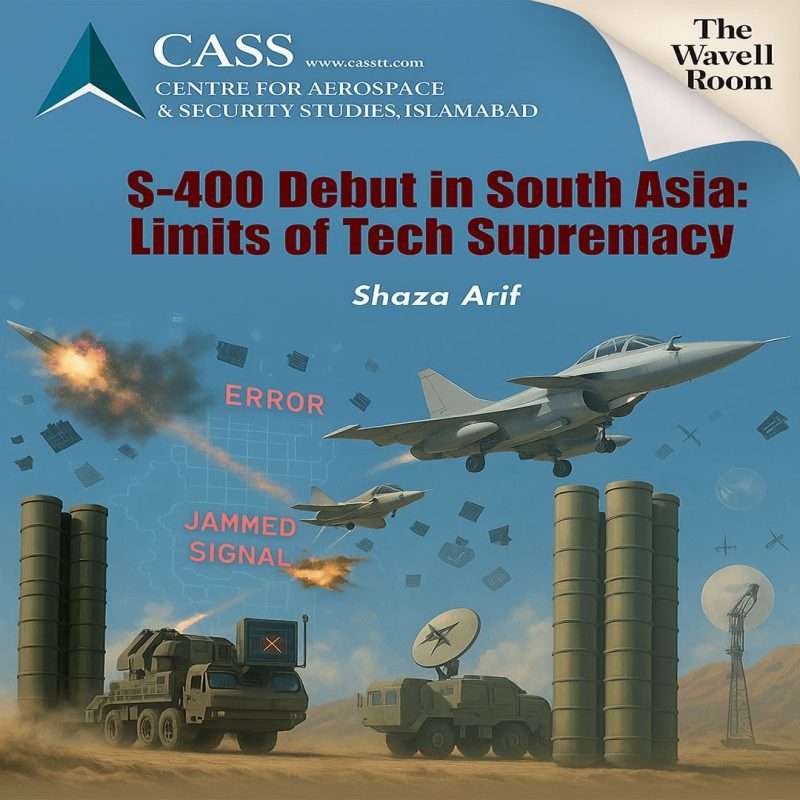
Amongst contemporary systems, the Russia’s S-400 has been perceived as one of the most advanced Air Defence Systems (ADS). With a layered defence of 4km, 120km, 250km and 400km respectively, the system is claimed to cover a wide array of aerial threats ranging from aircraft, Unmanned Aerial Systems (UAS), ballistic and cruise missiles.
In South Asia, the S-400 was perceived as a one-stop solution for protecting India’s airspace against aerial threats. In fact, the system was tagged as Sudarshan Chakra in India, signalling divine power. Till now, three batteries have been deployed by India near the border region, with the remaining two expected in late-2025 and 2026. The technology is meant to augment India’s layered defence system comprising Prithvi Air Defence System (PAD), Advanced Air Defence System (AAD), Barak-8 Medium-Range Surface-to-Air Missile System, Aakash Area Defence Missile System, and National Advanced Surface-to-Air Missile System II (NASAMS-II).
The system made its South Asian debut during the recent Indo-Pak standoff, where aerial capabilities were tested extensively through the deployment of aircraft, missiles, and advanced drones. A key takeaway from the episode is the evident penetrability of the system, despite official claims of its reliability, exposing critical operational vulnerabilities. While such high-profile systems may serve symbolic or deterrent functions, their limited coverage often creates exploitable gaps, enabling intrusion by aerial assets.
It has been claimed that a Chinese-made CM-400AKG air-to-surface missile, launched by a JF-17 was used against the S-400 batteries in Adampur and Poonch, inflicting damage to the radar components. In order to refute the claim, Prime Minister Modi’s media team used an image of an S-400 launcher in the background of his address at Adampur base. However, the image of intact launchers does not negate Pakistan’s stance. Merely attacking the launchers is not the only way to render an ADS ineffective given that the same can be achieved via attacking its radars, sensors and network nodes. The fact remains that during combat, the S-400 failed to intercept or protect against the downing of six Indian aircraft by the Pakistan Air Force (PAF). Notably, Pakistani JF-17s, operating well within the S-400’s stated engagement envelope, evaded detection and successfully penetrated the defensive shield to strike at the system’s radar. This reflects PAF’s effective use of deception, low radar cross-section platforms, strong electronic jamming, and BVR strike capabilities.
The fog of war further complicates air defence operations. On May 7th, India deployed nearly 70 aircraft against 42 advanced Pakistani jets creating overlapping tracks that strained their ADS. Low- and high-altitude threats can also challenge the system’s readiness, with success rates varying across different target types, including ballistic and cruise missiles. Integration is further hampered by India’s multi-origin arsenal from the United States, Israel, Russia, and France, which limits interoperability and network cohesion. Compounding this is the lack of seamless coordination between the Indian Army, Navy, and Indian Air Force (IAF), undermining unified ADS performance. Furthermore, hypersonic technology adds a new layer of complexity for any ADS.
While the S-400 is technically mobile, its relocation is logistically complex and resource-intensive. Each battery comprises heavy transporter-erector-launchers (TELs), multiple radar units, command and control vehicles, and trained personnel making rapid redeployment during conflict both time-consuming and operationally demanding. Relocation also creates a vulnerability window that can be exploited through preemptive strikes. In future aerial engagements, such gaps are likely to be targeted, further exposing system weaknesses.
This recent Indo-Pak conflict demonstrated the notable role of aerial assets in shaping the trajectory of modern armed engagements. In the past, saturation attacks in the Russia-Ukraine conflict, Iran-Israel and Israel-Hamas conflicts have also highlighted limitations of the ADS where even robust systems failed to intercept incoming aerial targets. In the South Asian context, where adversaries are in close proximity, such vulnerabilities become even more pronounced. Although large-scale saturation attacks have yet to occur, they remain a critical factor that could redefine regional air defence dynamics. It is also important to assess whether India has acquired the 40N6 missile from Russia, as this component is critical to achieving the S-400 system’s extended 400km engagement range. If the 40N6 missile has been withheld, it could substantially limit the system’s operational effectiveness.
Technologies like the S-400 can create a false sense of invincibility, potentially encouraging states to engage in riskier military postures or cross escalation thresholds they might otherwise avoid. These perceived advantages often mask critical vulnerabilities, which become evident in operational contexts, prompting a reassessment of the actual utility and role of such systems in potential conflict scenarios. While having advanced technologies is important, optimal performance can only be realised through effective training, innovative integration, improved concepts and leadership. In combat, a fully integrated kill chain influences the overall outcome of an engagement rather than a platform versus platform contest. The ADS vulnerabilities that have now come to light are likely to impact future procurement patterns of the S-400.
The recent Indo-Pak crisis has punctured the hype surrounding India’s S-400 acquisition, revealing the limitations of even the most high-tech air defence systems. It serves as a stark reminder that technological superiority alone may not offer perfect security. Strategic overreliance on such platforms inevitably carries with it a margin of vulnerability and in high-stakes conflict, that margin can prove decisive.
Shaza Arif is a Senior Research Associate at the Centre for Aerospace & Security Studies (CASS), Islamabad. The Article was first published in The Wavell Room.She can be reached at [email protected].