
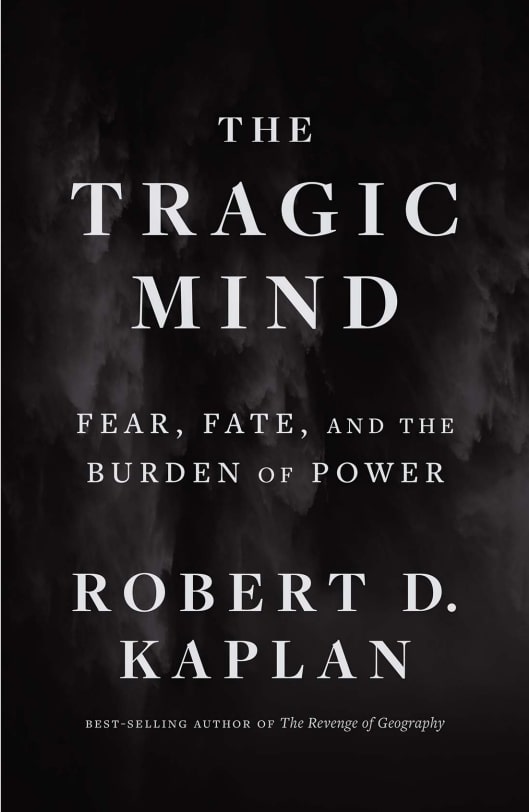
Robert D. Kaplan, The Tragic Mind – Fear, Fate and the Burden of Power (New Heaven and London: Yale University Press, 2023)
Reviewed by Khansa Qureshi
Robert D. Kaplan in his book ‘The Tragic Mind – Fear, Fate and the Burden of Power’ weaves together his decades of experience as a correspondent covering conflicts, wars, revolutions, and other political upheavals across the world to literary insights and lessons drawn from the ancient Greek dramatists, Shakespeare, German philosophers, and the modern classics. He assesses how certain world events may have had different results if various global leaders employed ‘tragic’ thinking in their decision-making and deduces that reading literary pieces of historical eminence instil in leaders’ cognizance the risks associated with the ‘terrible power of irrational’ (p. 22) and the need to adopt humility while making political decisions.
The author basically urges policymakers to ‘think tragically in order to avoid tragedy,’ where ‘thinking tragically’ means acknowledgement of limited and constrained policy options and a realisation that any chosen course of action would be a choice of lesser evil instead of choosing something outrightly righteous (p. 4). Kaplan argues that decision-makers who keep into consideration ‘tragic’ options while formulating policies tend to act more prudently – an approach that may produce positive results. He deduces that the greatest statesmen must think tragically (p. 8).
According to the writer, the political and humanitarian crises at the global level could have been avoided by employing conscious thinking which he terms as ‘anxious foresight’ or ‘constructive pessimism’ which requires ‘tragic sensibility.’ For example, he explains that the United States (US) escaped the wars in Afghanistan and Iraq nearly unscathed owing to its geographic distance from the war-torn countries. This allowed the country’s policy elite to pay little reputational, emotional, or psychological price for their poorly conceived actions enabling them to conveniently shrug off responsibility without the much-needed introspection (p. 97). Kaplan is of the view that due to such circumstances, the tragic sensibilities needed to avoid making choices in the future which may have tragic outcomes have not taken root in American political thinking. Due to this reason, the US shows little hesitancy in sending troops from one conflict to another – a factor that also points to the importance of lived experience in managing foreign relations and avoiding the worst outcomes.
In numerous countries, especially in the developing world, where internal conflicts and rivalries often drive actors to engage in all-out hostilities against their adversaries, it is crucial to consider Kaplan’s thesis that employing military force, or resorting to a guns-blazing approach, should not be the default strategy. This perspective offers valuable lessons in such complex situations. Kaplan argues that ‘Every villain is not Hitler,’ and ‘Passion should not be allowed to distort analysis, even as social media does exactly that’ (p. 115). In intrastate conflicts, resorting to hasty decisions against rivals can impact national interest and cause divisions within a nation just as it can embarrass invading great powers by not employing a ‘tragic-enough’ policy mindset.
Kaplan views Shakespeare’s works as a valuable source of wisdom for understanding political events. He asserts that ‘while an understanding of world events begins with maps, it ends with Shakespeare. Maps provide the context for events and the vast backdrop on which they are acted out. But the sensibility required for understanding those events – the crucial insight into the passions and instincts of political leaders – is Shakespearean’ (p. 1). However, one needs to acknowledge the limitations of relying solely on classic literature for policymaking. Being well-versed in literary works may not necessarily provide a policymaker with a predefined set of policy options or make the decision-making process any easier. While Shakespeare’s insights into human nature and political dynamics can be valuable, they do not guarantee straightforward policy choices or eliminate the inherent difficulties of decision-making.
‘The Tragic Mind’ is an insightful, thought-provoking read that pushes the need to cultivate a sense of self-restraint. In fact, it is a warning for those sitting in powerful positions urging them to avoid bringing chaos upon one’s own nation, particularly those who find themselves at the helm of affairs during times of crisis. Kaplan rightly contends that even when a ruler uses their power to enforce control over the populace, they are still haunted by a sense of wariness, loneliness, and fear regarding the intentions of the people they govern. He highlights that in authoritarian regimes, the dictator himself experiences the greatest fear and isolation. Despite the appearance of stability and control, the ruler is acutely aware of the potential for a sudden shift in the people’s attitudes and behaviours, as they can eventually rebel or resist (p. 65).
Kaplan’s book also serves as a deeply personal reflection on his own actions and their consequences. He acknowledges his role in delaying the US’ humanitarian response to mass murder in the Balkans. Additionally, he confesses to having played a part in propagating the war in Iraq, which resulted in countless loss of life (p. 13). These mistakes have haunted him and burdened his sleep for decades. Such introspection is one of the strengths of this book as it shows a willingness to openly acknowledge and reckon with past mistakes and moral dilemmas that have shaped his life and career. In today’s information age, the increasing trend of relying on sensationalism and half-baked theories to ‘break news’ has plagued the mainstream media across the world with often dire outcomes. ‘The Tragic Mind’ should be eye-opener for journalists to uphold journalistic integrity, pursue truth, and champion rightful and just causes.
Although some of the decision-making processes that Kaplan advocates in the book received mixed response, the fact that he ultimately wants the suffering of people to be lessened and to prevent catastrophic wars, makes the book an important read particularly for decision-makers in societies marked by absolute power, scarce transparency, and limited accountability in policymaking.
Khansa Qureshi is a Research Assistant at the Centre for Aerospace & Security Studies (CASS), Islamabad, Pakistan. She can be reached at [email protected]



