
The crisis of February 2019 was far more than a transient border skirmish; it was a fundamental clash of two divergent conceptions of strategic thought under a nuclear overhang. Indian objectives were clear: to win the election and try to create space for punitive actions for bigger aims under the nuclear threshold with the pretext of labelling Pakistan as a terrorist-harbouring state. At the heart of the crisis lay the domestic political situation of India. After the Pulwama attack, the Bharatiya Janata Party (BJP) government led by Prime Minister Narendra Modi assumed an aggressive, almost coercive stance, which is largely viewed by analysts to be an electoral gimmick ahead of the impending general elections. This was symptomatic of a wider transformation of the Indian state from a secular democracy to a fascist majoritarian state, where strategic restraint had been forsaken in favour of militarised Hindutva nationalism aimed at achieving domestic political gains.
The Balakot attack on 26 February was the first of its kind against the international border since 1971, when India launched an unprovoked attack on Pakistan in a bid to send a message to the world of India’s political and military prowess. However, this drama was built on a miscalculated strategic evaluation of Pakistan’s conventional resolve. The BJP leadership, confident in their technological and numerical capabilities, seemed to have no sense of the likelihood of escalation between two nuclear-armed nations and saw punitive actions as the key to achieving victory at the polls.
Despite the self-proclaimed superiority due to high-end Russian and Western platforms, the IAF was plagued with major technical deficiencies. India’s primary weapon of the engagement was Mirage 2000 and Su-30 MKI, which were practically blinded by Pakistani Electronic Warfare (EW) systems, which jammed communications and interrupted the Indian command-and-control (C2) cycles.
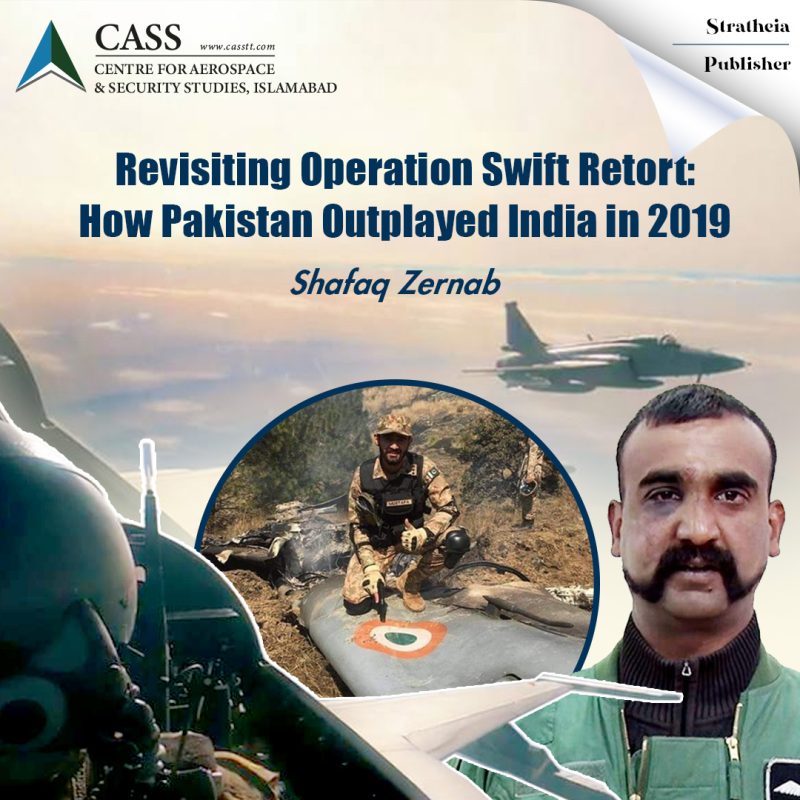
When the Pakistan Air Force (PAF) conducted Operation Swift Retort on 27 February 2019, it did not simply respond to the Indian attack at Balakot; it dispelled an emerging Indian discourse of a new normal in which New Delhi could launch conventional strikes across international borders with impunity. Deconstructing the engagement demonstrates that the victory of Pakistan was a culmination of methodically sound application of doctrine, electronic warfare, controlled escalation and resolve that reestablished the strategic balance in the region within hours.
The PAF leveraged better strategy and a strike package consisting of SAAB Erieye AEW&C and DA-20 Falcon aircraft to shoot down an Indian MiG-21 Bison and hit a Su-30 MKI. The tragic manifestation of India’s fog of war was the fratricide of its own Mi-17 V5 helicopter, which was shot down by the Indian ground forces amidst confusion; a case which highlighted the systematic failure of the Indian Command, Control, and Communication (C3).
Pakistan’s response was dictated by the principle of Quid Pro Quo Plus, a strategy aimed at restoring deterrence without provoking an all-out war. The PAF strike package, comprising JF-17 Thunder and Mirages, acquired intended military targets but shifted locks while employing weapons towards a clear area. The intent was clear: to show the resolve and ability to strike high-value targets without deliberately causing the loss of lives that would have led to a vertical escalation in a nuclearised environment.
This resolve-prudence trade-off enabled Pakistan to seize the moral high-ground. Pakistan portrayed itself as a responsible actor by also treating the captured pilot, Wing Commander Abhinandan Varthaman, with dignity as per international law and releasing him as a gesture of peace. This stood in sharp contrast to the battle of narratives that New Delhi was grappling with, including conflicting reports about a downed Pakistani F-16, a claim which was later debunked by the U.S. officials who confirmed that all Pakistani F-16s were accounted for. Moreover, all 4 of the downed Mig-21 missiles were displayed in the PAF museum.
The international response to the 2019 crisis was symbolic of modern-day geopolitics. Initially, it was subdued, as many major powers did not directly condemn the Indian actions. This marginal support emphasised Pakistan’s need to strengthen its economic and diplomatic footprint to counter the Indian narrative abroad. Nonetheless, the lesson of Operation Swift Retort is enduring: conventional deterrence remains functional in South Asia. Although India has since embarked on a frantic quest for silver bullets such as the Rafale and S-400, the success of Pakistan in 2019 is a stark reminder that the victory is not just decided by the sophistication of the machine but the cohesion of the doctrine and the preparedness of the force.
For the international community, the events of 2019 are a vivid reminder that the stability in the region relies on a strategic balance that can be ensured only when the allure of political battle is curtailed by the seriousness of the nuclear reality. Ultimately, from of the legacy of Operation Swift Retort to the strategic success of May 2025, best exemplified by the successful downing of 7 Indian aircraft during Operation Sindoor, PAF has once again demonstrated its aerial prowess and efficiency. May 2025 war dismantled false notion of Indian technical superiority, leaving India ensnared in its own commitment trap.
The writer is a Research Assistant at the Centre for Aerospace & Security Studies (CASS), Islamabad. The Article was first published by Stratheia. She can be reached at: [email protected].



