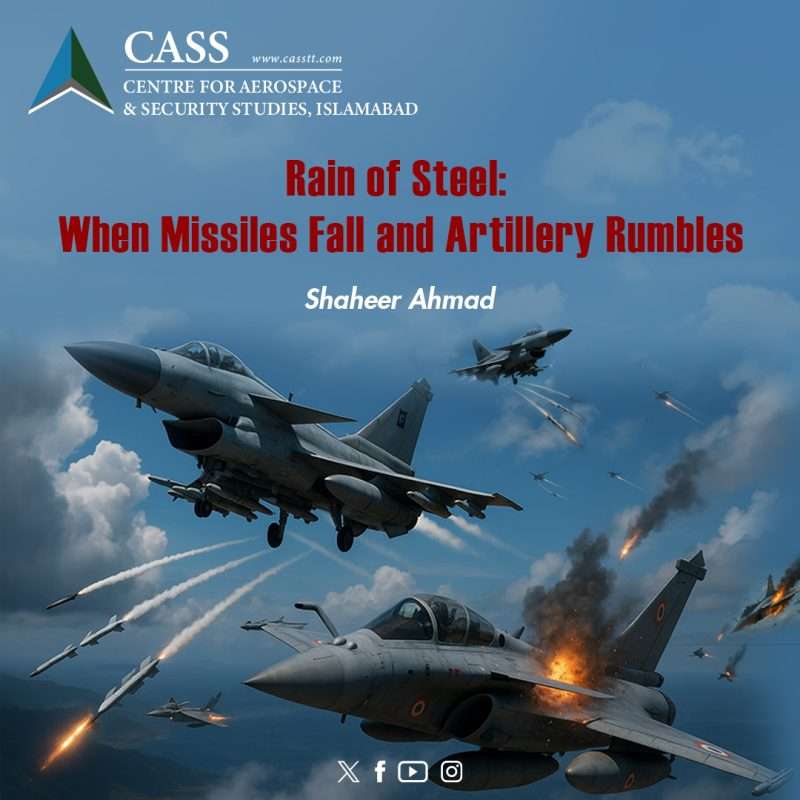
A great deal of world politics is fundamental struggle, but it is also a struggle that has to be waged intelligently. Zbigniew Brzezinski’s observation on hardcore geopolitics resurfaced afresh after the April-May 2025 intense military crisis between India and Pakistan. India’s Operation Sindoor launched against Pakistan, was met with an ironclad response, resulting in the downing of five Indian aircraft, including three French-origin Rafales. A day later, Pakistan hit back through a large-scale retaliatory strike, Operation Bunyan-un-Marsoos, against a series of Indian military targets. In retrospect, the four-day military showdown witnessed a decisive role of beyond-visual-range (BVR) missiles, surface-to-air missiles (SAM) systems, and long-range artillery in striking targets with pinpoint accuracy.
During the military exchanges, Pakistan’s indigenously developed and Chinese-origin weapons remained as an operational mainstay for Pakistan against the Russian and Western weaponry in India’s arsenal. These weapons provided Pakistan a higher degree of interoperability to edge out the numerically superior Indian Air Force (IAF) in conflict. Most notably, the J-10C Vigorous Dragon gained traction as it provided the Pakistan Air Force (PAF) with ‘first shoot’ capability against the IAF. The aircraft’s sophisticated detection, tracking, and targeting systems shrank the opponent’s response window, hence denying it freedom to operate in the air.
Amidst the crisis, the PL-15—a long-range BVR missile employed on J-10C gained widespread attention due to its role in bringing down Rafale aircraft. Developed by China’s Airborne Missile Academy, the PL-15 is regarded as an analog to the US AIM-120 Advanced Medium Range Air-to-Air Missile and European-made Meteor. Its radar homing design and estimated range of more than 200 km make it accurate for target tracking and resilient to electronic countermeasures. The first-ever use of PL-15 provided defence analysts a rare glimpse of the missile’s potency in real-time combat.
In conjunction with these assets, Pakistan has deployed long-range SAM systems to fortify its skies against aerial intruders. Among them, the HQ-9P systems managed to intercept the incoming missiles and deter the IAF from hitting critical nodes of command and control structures.
Concomitantly, long-range artillery’s overwhelming power was seen in neutralising ground targets and providing support and defensive fire to ground formations. Reports suggested that Pakistan used its precision-guided long-range multiple launch rocket system (MLRS) Fatah-I and II against a multitude of target vectors, including the adversary’s airfields, storage sites, and ground positions. It is widely believed that the Fatah-I successfully knocked out the Beas BrahMos storage site in Indian Punjab. Similarly, South China Morning Post reported the possible use of the SH-15—a 155mm self-propelled howitzer to hit military headquarters, artillery positions, and logistics sites.
While damage assessments are underway, the episode has reshaped the dynamics of conflict in the region toward precision-strike warfare; barrages from standoff distance that inflict cascading tolls on both sides. Moreover, the primacy of data links and network systems has been pivotal in guiding the long-range weaponry to precision. Pakistan’s ability to integrate ground-based radars, fighter aircraft, and airborne early warning and control systems (AEW&C) enabled it to remain ahead of the curve in the conflict.
Furthermore, the standoff also highlighted the precedence of network-centric systems over traditional firepower systems. From ground systems locking the targets to fighter jets firing the missiles from standoff distances, and finally AWACS seamlessly supervising the munitions to hit with pinpoint accuracy, demonstrates that mere firepower cannot let alone be decisive in the conflict. Instead, it has to be combined with the network and intelligent systems. Thus, this BVR capability has proved to be a game changer in modern aerial combat.
In retrospect, military confrontations today have evolved from mere firepower exchanges to achieve network-centric supremacy. Rather than simple acquisition and shopping for advanced systems, turbocharging network integration, data link unification, and standardising logistics would be integral to future warfare. Relatedly, the crisis also demonstrated the worth of maintaining peacetime operational readiness to uphold a credible deterrence envelope.
The brief aerial and ground exchange between two archrivals demonstrated the primacy of long-range BVR systems in future warfare. The multi-domain operations conducted by the PAF tactically handicapped the numerical ascendancy of the IAF. Furthermore, the preeminence of next-generation weapons demonstrated Pakistan’s upper hand in superior tactics, asset deployment, and operational readiness.
Shaheer Ahmad is a Research Assistant at the Centre for Aerospace & Security Studies, Islamabad. He can be reached at [email protected].